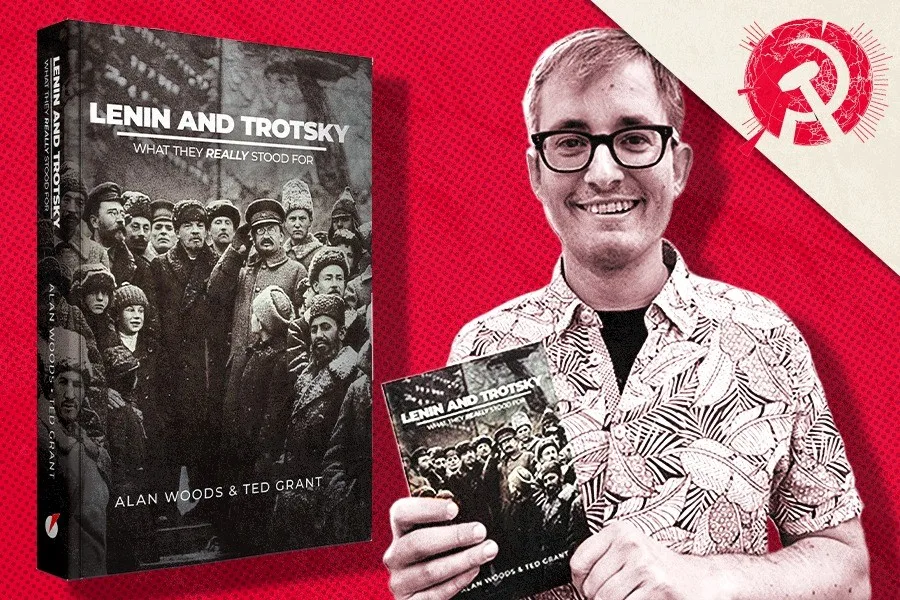
With the class struggle heating up everywhere, and with a new generation of communists preparing for battle, now is the time to arm ourselves with the hard-won lessons of the past. For that reason, we are republishing Lenin and Trotsky: What They Really Stood For by Alan Woods and Ted Grant; a Marxist classic which uncovers the real legacy of Bolshevism, against decades of slanders and distortions by the Stalinists.
With sections on the history of Bolshevism, the theory of the permanent revolution, and Lenin’s final fight – among others – the book is essential reading for understanding the principles and traditions on which the most successful revolutionary party in history was built. Get your copy now from Wellred Books, the publishing house of the Revolutionary Communist International.
To launch the book, Niklas Albin Svensson, a leading comrade of the RCI, will be speaking at next week’s World School of Communism on the ideas and legacy of these outstanding revolutionaries. Tune in to all the sessions of the World School – live or on demand – here.
[Order your copy at wellred-books.com, or by clicking here]
Why was this book written?
After Khrushchev’s ‘secret speech’ in 1956 – the speech that provoked the crisis in the communist movement – there was a reassessment across all those who adhered to what Moscow wanted to call Marxism-Leninism. Khrushchev attacked Stalin and tried to basically clean up the Soviet Union, open it up a little.
This then led to the uprising in Hungary – the political revolution in Hungary, where the workers took power, which was then suppressed by the Soviet Union– deepening the crisis in the communist movement.
This book was written in 1969, in reply to a guy called Monty Johnstone, who was a member of the CPGB, the British Communist Party.
This followed on from another crisis, which was in 1968. That was of dual character. On the one hand, you had the suppression of the Prague Spring, the Czechoslovak reform movement, by the USSR. But there was also the capitulation of the French Communist Party faced with the May 1968 revolutionary movement. The workers and students occupied the factories and so on, but were then basically sold out by the Communist Party, who made a deal with the French capitalists.
So in this context they were forced to re-evaluate some of what they had been saying before. Monty Johnstone comes out and does a kind of re-evaluation of Trotsky – basically trying to present a critique that was not as blatantly false as the previous ones. It was a more insidious form of criticism, which repeated some of the same slanders, but not in such an openly dishonest form.
That’s why this book was written – to answer these critiques, but also to raise the ideas of what the Bolsheviks, what Lenin, what Trotsky really stood for, and thereby give the communist movement an injection of the real theories, the real ideas of Marxism.
Why is there so much slander directed against Trotsky and Trotskyism?
Well, it is precisely because Leon Trotsky defended the real legacy of Lenin.
Going back to the 1920s, when Lenin died – even when he was ill in the last couple of years before he died and couldn’t participate in the same way – certain leaders started moving away from the revolutionary traditions of the Bolsheviks.
At this time, there was the New Economic Policy, which was giving a boost to the richer layer of the peasantry, but also leading to a certain development of capitalist production in the cities and, in particular, the growth of the state bureaucracy. And this started to put pressure on the party.
When Lenin died, there was a battle that erupted about who was going to become the next leader. It was well known at the time – you can read it in writings from the period – that the Bolshevik Party was considered the party of Lenin and Trotsky. This was known not just in Russia but abroad. And you can see that even in texts attacking Trotsky in 1925 in Britain – they start the whole thing by saying ‘we know this party as the party of Lenin and Trotsky’, and then start to explain why Trotsky really should not be considered in this way.
So in order to grasp the leadership of the party, a clique formed between Zinoviev, Kamenev, and Stalin. And this clique began attacking Trotsky in order to seize leadership.
I think they were not fully conscious of what they were doing at the time. They just felt that Trotsky was a threat to their authority.
In particular, they disliked the fact that he had written a pamphlet on the Lessons of October which attacked Zinoviev and Kamenev – and by implication Stalin – for having taken the wrong positions in April 1917 and again in October 1917, positions contrary to Lenin’s. He wrote this because he was trying to teach the world communist movement the lessons of 1917. And that did not put some of these leading members in a good light, because they had been wrong – which they admitted at the time. But it still grated on them.
They tried then to re-establish their authority by attacking Trotsky in a quite insidious way – basically trying to drive a wedge between Lenin and Trotsky, digging up Trotsky’s past, his attempts before 1917 to conciliate between the Mensheviks and Bolsheviks, and a bunch of theoretical questions which were completely misrepresented.
They claimed Trotsky did not understand the importance of the peasantry, that he was trying to jump stages in the revolution – all of this stuff which had really been resolved as theoretical questions, partly by the revolution itself.
Zinoviev and Kamenev later admitted that this had no principled basis. It was just to shore up their authority.
The worst effect of it is not just about Trotsky as an individual, but about how it distorted what Lenin had stood for, not just from 1917 onwards but from 1903. What this really represented was that the revolutionary traditions of October were a threat to the new bureaucracy that was growing. The bureaucracy instinctively saw the need to drive a wedge between the Communist Party and the revolutionary ideas of Lenin.
In the party congresses, you can see how they got more and more support, but were using more and more crude methods – starting with relatively open discussions but becoming more and more hooligan as time went on, expelling people, removing people from positions if they sympathised with Trotsky and the Left Opposition.
So really what Trotsky represented – and why he was so vilified – is not anything especially individual. It is because he represented the real traditions of the Bolshevik Party, the real traditions of October. And these other guys represented something else.
Stalinists even today call themselves Marxist-Leninists. Can they claim the legacy of Lenin?
Stalinism is really a construction after the fact. It is not something that anyone really claimed in the years just following Lenin’s death. It was never seen like that at any point.
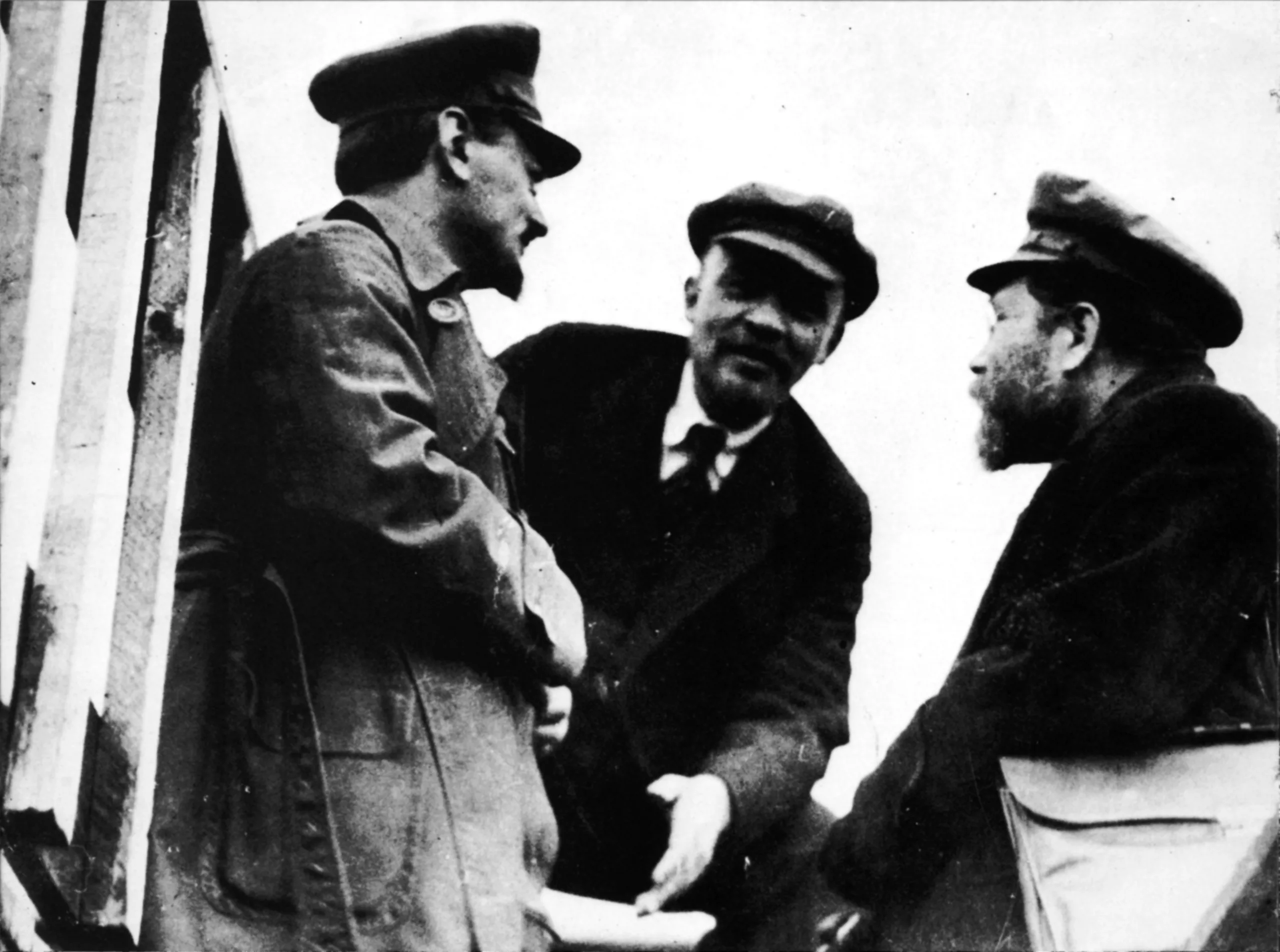
Because Stalin became the undisputed leader of the Soviet Union in the 1930s, it is assumed he was in some way Lenin’s heir – but it is not true.
Lenin was quite critical of Stalin in the last few years before his death. He saw danger in Stalin, particularly with regard to the national question – like over Georgia, where Stalin was very ruthless towards the national aspirations of the Georgians.
In his so-called Testament, Lenin wrote that Stalin ought to be removed from his position as General Secretary.
But more important than those personal questions is whether Stalin followed the legacy of Lenin in terms of ideas. And here it is quite clear these were two very different sets of ideas.
It started with the debate in 1924, where they began distorting the ideas of Lenin. They revived some of his less developed early formulations which he himself later clarified, but they forgot about the clarifications and just stuck to the earlier versions.
Lenin had the idea, up until 1917, of the democratic dictatorship of the proletariat and the peasantry. This slogan had real merits in counterposing itself to the Mensheviks, who believed the revolution had to be limited to what the bourgeoisie wanted and the proletariat should take a back seat. Against that, Lenin put forward the alliance of the proletariat and the peasantry. But he did not draw all the conclusions from that.
Trotsky went further. Trotsky said: ‘fine, you have the alliance of the proletariat and the peasantry, but who is going to dominate this alliance? Which class is going to be the leading force?’
The peasantry is not one class – it consists of multiple layers that do not all agree. And what happens when the proletariat starts trying to resolve its own problems, not just those of the peasantry or the bourgeoisie? It will move on to socialist tasks – nationalisation of the banks, nationalisation of heavy industry. The revolution then grows over from the democratic revolution into the socialist revolution. That is what Trotsky posed.
Lenin did not really want to go that far until 1917 itself, when he came out clearly and said: the two things are mixed, and we can only solve the democratic revolution through the socialist revolution, through what he called a second revolution.
At that point, there is no real difference between Lenin and Trotsky. You can find this in Lenin’s writings of February, March, and April 1917.
Stalin revived the old pre-1917 slogan. He claimed that Trotsky ignored the peasantry – which makes no sense if you look at what Trotsky actually wrote or the role he played in the revolution. Trotsky never ignored the peasantry. He said the working class must lead the peasantry in alliance with it, but that the working class has to be the hegemonic leader, in the driving seat.
That is what actually happened: it was not a peasants’ party that led the Russian Revolution; it was the Bolsheviks, a workers’ party, who did it in alliance with the peasantry.
But then Stalin went further than reviving Lenin’s old slogans. He actually went back to the ideas of the Mensheviks and their two-stage theory: first the democratic revolution, then somewhere down the line the socialist revolution. That is exactly the Menshevik position. And then came the idea that you can align yourself with the progressive bourgeoisie.
That is contrary to everything Lenin said. This two-stage theory then permeated the Communist movement from the 1930s onwards, producing one reformist mistake after another.
France is a good example. Instead of using the revolutionary movement of 1968 to overthrow capitalism, they made a deal. What came out of that movement was not a workers’ government – it was the return of de Gaulle.
Related to this is socialism in one country. Lenin’s position – the same as Trotsky’s – was that you could not have socialism without spreading it to the advanced capitalist countries.
Stalin started by revising this: we can have something resembling socialism without the revolution spreading elsewhere. But this got more and more watered down until the requirement was dropped altogether.
What this meant in practice is that the Communist International no longer needed to spread the revolution. It only needed to hold on to the conquests in the Soviet Union. Mass movements in other countries can then be used as bargaining chips.
The Spanish Revolution is the clearest example. They deliberately – and some of them admit this openly – betrayed the Spanish Revolution in order to court an alliance with Britain and France. They never got that alliance. But they did betray the revolution.
Lenin’s position was that it would be the duty of any Bolshevik to sacrifice the Russian Revolution if it meant the German Revolution could succeed. He saw the future as lying in the international revolution. And in the end this was proven correct – though it took much longer than either Trotsky or Lenin thought. The Soviet Union held on until the 1980s and 1990s, but eventually collapsed under the pressure of its own internal contradictions and the world market.
We are republishing this book in 2026. There is no USSR anymore. What is the relevance of this text for communists today?
Communist parties do not have the same kind of influence that they used to have, so these ideas do not appear in quite the same form. But the point is that these ideas did not fall from the sky. They represent something that occurs in all revolutionary movements.
Take Bangladesh two years ago. You had a revolutionary movement that overthrew the dictator – students and workers together. You could say they had their February 1917.
But then what happened? The leaders of the movement handed power not to the workers, but to another clique of the bourgeoisie, another wing of imperialism, who then set about reconstructing the old state.
And now the workers feel: what on earth did we do that for? Nothing has changed. They had elections which produced no advance for the working class whatsoever.
Egypt is another example – one president replaced by another; nothing changed.
The importance of these ideas is that they enable you to understand the processes taking place, to analyse the relationship between democratic demands and the struggle for socialism, and to understand why you cannot simply stop halfway, why overthrowing the dictator and thinking your problems are solved is not enough. It is a much bigger process.
Then there is the idea of socialism in one country, which is anti-Marxist on several levels. It does not understand the real dynamics of the capitalist economy and how interconnected the world has become.
It also denies the need to build socialism on the basis of advanced productive forces.
And it abandons the international duties of the communist movement – with tragic consequences in many circumstances, as history has shown.