This is an edited version of Niklas Albin Svensson’s introduction to ‘Lenin and Trotsky: What They Really Stood For’, at the recent World School of Communism
Trotskyists often get accused of ignoring or not appreciating the role of the peasantry in revolutions. This accusation is wrong and distorts the ideas of both Lenin and Trotsky. They ignore the real discussions as they unfolded in the Russian workers’ movement in the period leading up to October 1917.
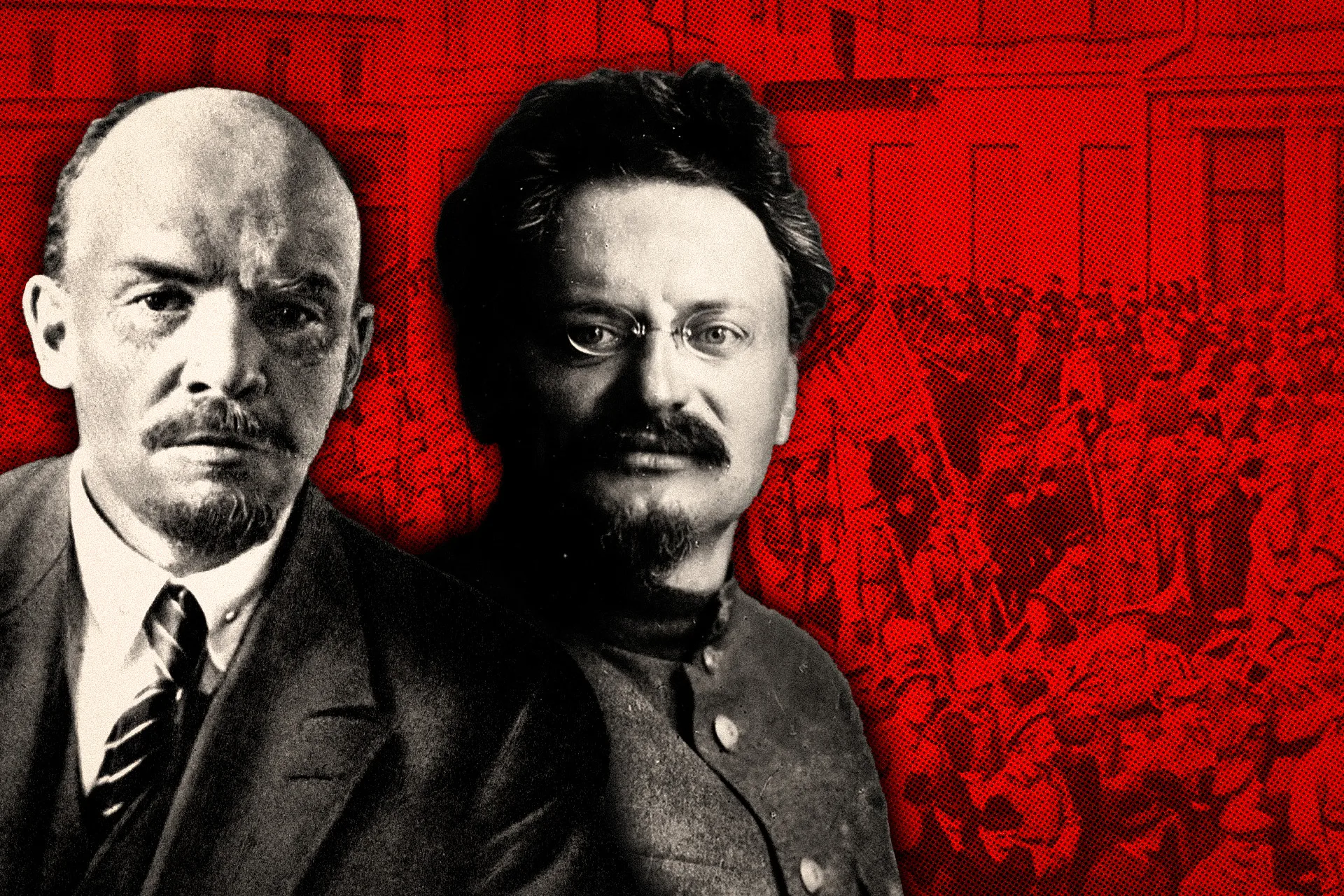
Lenin and Trotsky led the Russian Revolution to victory in October 1917. At the head of the Bolshevik Party, the two guided the working class to power. And for the first time in history, the working class didn’t just take power, they held on to it. However, there are plenty who claim that Lenin’s and Trotsky’s ideas were not the same at all. That in fact, there is such a thing as Trotskyism, distinct from and opposed to Leninism.
The ‘struggle against Trotskyism’, as Trotsky’s opponents called it, became the main ideological cover for the consolidation of the bureaucracy in the Soviet Union, and its turn to the right.
When publishing his book The Permanent Revolution in 1931, Trotsky pointed out that the debate over old differences of opinion among Russian Marxists had become converted “into a question of the character, the inner connections and methods of the international revolution in general”.
The history of the 20th century proved how correct this statement was.
The legend of Trotskyism
Following the defeat of the German Revolution in 1923, Trotsky intervened with his pamphlet, Lessons of October. It is a brilliant pamphlet that draws out the tensions and debates that happened during 1917, and how the Bolshevik Party navigated this. It placed particular stress on being able to read the mood and being prepared to take action when the moment presented itself – precisely what had been missing in Germany in 1923.
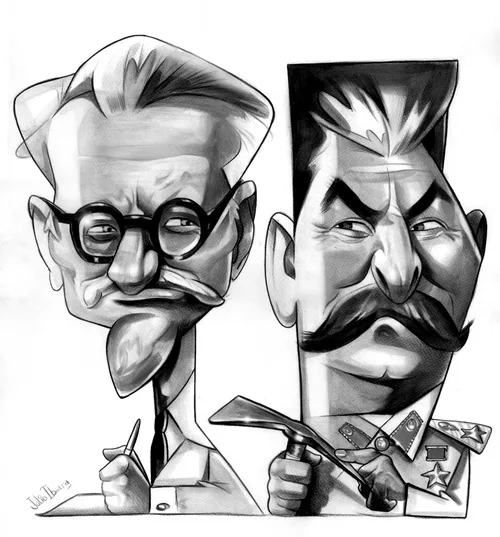
Trotsky drew the conclusion that without Lenin, who died in January 1924, the Bolshevik Party would have missed the opportunity to take power in Russia in October 1917. And he was quite right. This annoyed the leading clique in the Russian Communist Party (Stalin, Kamenev and Zinoviev, also known as the Triumvirate), who had been guilty of the very same mistakes in 1917 as had now been repeated in Germany.
It provoked the Triumvirate to retaliate. They did so in a series of writings that were later compiled into the book Errors of Trotskyism. It was a character assassination of Trotsky.
Zinoviev, who had been with Lenin for two decades, saw himself as Lenin’s natural successor. But Trotsky, who joined the Bolsheviks only in 1917, was now pointing out the mistakes that Zinoviev and other politburo members had made in that crucial year. For Zionoviev and others, there was also a personal element.
The debate, if one can use that word, was an attempt to discredit Trotsky as Lenin’s successor. But the Triumvirate had a problem, which was pointed out in the British introduction to the book:
“Comrade Trotsky’s name had always been associated in our minds with Comrade Lenin. ‘Lenin and Trotsky!’ These were the names with which we conjured in all our thoughts and feelings about the Russian Revolution and the Communist International.”
The British Communist Party had to admit that the two had always been mentioned together, whilst preparing to spread poison against Trotsky. In Russia, the Bolshevik Party was known among the masses as the ‘Party of Lenin and Trotsky’. The whole purpose of raising this discussion was to attempt to drive a wedge between the two.
Key to this question was the permanent revolution, and the role of the peasantry in the Russian Revolution. A resolution adopted by the Russian Communist Party’s Central Committee in 1925 attacks Trotsky for attempting to “leap over the peasantry” of attempting to break up the “alliance between the working class and the peasantry”, of putting forward “against the Bolshevik estimation of the driving forces of the Russian revolution and against the Leninist doctrine of the world proletarian revolution his old ‘theory of permanent revolution’”.
The democratic dictatorship of the proletariat and the peasantry
The question of the permanent revolution was a question first and foremost about the character of the Russian Revolution.
The problem that faced the Russian Revolutionaries had been known for some time. Already the Narodniks had battled with the problem in the 19th Century.
The problem was this: how do we resolve Russian backwardness, starting with Tsarism? How do we modernise Russia?
Russian progressively-minded intellectuals had tried reformism, they had tried terrorism, mainly attempting to base themselves on the peasantry. Giorgi Plekhanov and his Emancipation of Labour Group changed that. They brought Marxism to the Russian intellectuals. With this came the materialist view of history and the role that the working class played in the socialist revolution.
For western Europe, this made sense, with its developed industry and working class which constituted a majority of society, or close to. But with Russia so underdeveloped, with its backward economy and large peasantry, what did Marxism mean for Russia?
The task was not to bring Russia to the level of socialism, but to the level of bourgeois society. This meant: abolishing Tsarism and establishing a republic, land redistribution, and economic development.
For the Mensheviks the answer to this question was that the bourgeoisie must lead the revolution. But it wasn’t all that simple. As Lenin and Trotsky both noted, the bourgeoisie in Europe had played a cowardly role throughout the 19th century.
Lenin’s slogan until 1917 was ‘the democratic dictatorship of the proletariat and the peasantry’, which he argued for in his pamphlet Two Tactics of Social-Democracy. The pamphlet was directed against the Mensheviks, with whom he parted company in 1903.
Lenin raises his slogan against two other ideas. Firstly, he argues against the idea that we don’t have to struggle for the republic:
“The proletariat expects to find its salvation not by avoiding the class struggle but by developing it, by widening it, increasing its consciousness, its organisation and determination. Whoever degrades the tasks of the political struggle transforms the Social-Democrat from a tribune of the people into a trade union secretary.”
Lenin is opposing the economist idea that Marxists should abandon the political struggle, abandon the struggle against Tsarism, and focusing on what we today would call ‘bread-and-butter’ questions: higher wages, working conditions, etc. This had been the argument of the economists, who Lenin had been battling since 1902.
Trotsky agreed with Lenin on this point. He said, for example, that political democracy is a “necessary stage”, but he added that sometimes it lasts for decades, but other times the masses can emancipate themselves from “the prejudices of political democracy even before its institutions have been converted into reality”. That is a dialectical understanding of the question, and as we shall see later, one that Lenin shared.
The second idea that Lenin argued against, was the idea that the working class must limit its ambitions to that which the bourgeoisie is prepared to support. The Mensheviks had by 1904 moved in a similar direction to the economists. They did not deny the struggle against Tsarism as such, but they saw the bourgeoisie as leading that struggle. So the working class would merely play an auxiliary role, attempting to push the reluctant bourgeoisie to finish the revolution.
For example, the Menshevik Martynov writes:
“The struggle to influence the course and outcome of the bourgeois revolution can find expression only in the exertion of revolutionary pressure by the proletariat on the will of the liberal and radical bourgeoisie, and in the compulsion on the part of the more democratic ‘lower strata’ of society to bring the ‘upper strata’ into agreement to carry through the bourgeois revolution to its logical conclusion.” (quoted by Lenin in Social-Democracy and the Provisional Revolutionary Government)
However, as it is a bourgeois revolution, Martynov warns the workers must not frighten the bourgeoisie, or they will turn to Tsarism. We’ve heard this warning many times since: ‘don’t frighten the ruling class’, ‘don’t provoke imperialism’. This approach is essentially Menshevism.
And it is no surprise that Lenin took issue with it. In the aptly titled chapter of Two Tactics, ‘Will the Sweep of the Democratic Revolution be Diminished if the Bourgeoisie Recoils from it?’, he said:
“The bourgeoisie, in the mass, will inevitably turn towards counterrevolution, towards the autocracy, against the revolution and against the people, immediately its narrow, selfish interests are met, immediately it “recoils” from consistent democracy (and it is already recoiling from it!).”
In other words, Lenin did not think the bourgeoisie was capable of ‘carrying through the revolution’. He agreed with Martynov and the Mensheviks that the bourgeoisie would be scared by the revolutionary movement of the workers. This led the Mensheviks to the conclusion that the workers must be held back. Lenin, on the contrary, saw the working class as the real agent of history. He continues:
“There remains the ‘people,’ that is, the proletariat and the peasantry: the proletariat alone can be relied on to march to the end, for it is going far beyond the democratic revolution. That is why the proletariat fights in the front ranks for a republic and contemptuously rejects silly and unworthy advice to take care not to frighten away the bourgeoisie.”
This was the basis of the democratic dictatorship – the workers and peasants in an alliance to carry out the tasks of the bourgeois revolution, and not to worry about frightening the bourgeoisie.
“One of two things, gentlemen: either we, together with the people, must strive to carry out the revolution and win a complete victory over tsarism in spite of the inconsistent, self-seeking and cowardly bourgeoisie, or we do not accept this ‘in spite of,’ we fear lest the bourgeoisie ‘recoil’ from the revolution, in which case we betray the proletariat and the people to the bourgeoisie—to the inconsistent, self-seeking and cowardly bourgeoisie.”
Therefore the logic of Lenin’s position isn’t what Trotsky’s opponents would have liked it to be. When Lenin argues for the ‘dictatorship of the proletariat and the peasantry’ he was specifically barring the door to the idea that the bourgeois must somehow lead the revolution.
In this writing Lenin also expresses the idea that the working class would go beyond the bourgeois-democratic tasks in such a revolution. That they would go “far beyond”. Trotsky picked up on this point and drew certain conclusions, which we will return to.
The logic of Lenin’s position was the following, which he spelled out multiple times in the period 1905-6: the Russian Revolution by the proletariat and the peasantry would overthrow Tsardom and introduce the democratic dictatorship. This in turn would give an impetus to the class struggle – in Europe. The seizing of power by the workers in Europe would give backward Russia the material prerequisites for the socialist revolution and together with the workers of western Europe, the workers of Russia could begin the building of socialism:
“A complete victory for Social-Democracy in a democratic revolution… will enable us to rouse Europe, and the socialist proletariat of Europe, after throwing off the yoke of the bourgeoisie, will in its turn help us to accomplish the socialist revolution.”
In December 1905, Lenin drew a sketch of the revolution containing six stages, where the democratic revolution step-by-step became a socialist one.
The final stage, he described as follows:
“[A] new crisis and a new struggle develop and blaze forth, with the proletariat now fighting to preserve its democratic gains for the sake of a socialist revolution. This struggle would have been almost hopeless for the Russian proletariat alone… had the European socialist proletariat not come to the assistance of the Russian proletariat.”
“In such conditions the Russian proletariat can win a second victory… socialist revolution in Europe.
“The European workers will show us ‘how to do it’, and then together with them we shall bring about socialist revolution.”
It’s hard here to see any fundamental difference with Trotsky’s position except on the question of what the democratic dictatorship would look like.
Now, let’s turn to this question.
The proletariat and the peasantry
Trotsky didn’t disagree with Lenin’s conclusions about the importance of the peasantry. But he put it a bit differently in his Results and Prospects that was published in 1906:
“The fate of the most elementary revolutionary interests of the peasantry – even the peasantry as a whole, as an estate, is bound up with the fate of entire revolution, i.e., with the fate of the proletariat.”
He continues:
“The proletariat in power will stand before the peasants as the class which has emancipated it.”
However, through their class position and their internal differentiation between rich and poor peasants, and also the rural proletariat, they were doomed to vacillate between the working class and the bourgeoisie. In fact, the word ‘peasant’ itself is ambiguous, it could mean anything from a relatively successful farmer employing labourers, to a peasant paying lots of money to the aristocracy for their tiny plot of land.
Lenin on many occasions made similar points.
In Two Tactics, he writes, for example:
“The peasantry includes a great number of semi-proletarian as well as petty-bourgeois elements. This causes it also to be unstable and compels the proletariat to unite in a strictly class party.”
So, at this time, Lenin was arguing for a dictatorship of workers and peasants, but the unstable nature of the peasantry compels the workers to unite in a strictly class party.
The main point he is making here, however, is that the peasantry is vacillating but can be won over to the revolution. It is different to the bourgeois because the peasants are at the present time interested “not so much in the absolute preservation of private property, as in the confiscation of landed estates”.
It doesn’t make them socialist, Lenin points out, but it means they are “capable of becoming a wholehearted and most radical adherent of the democratic revolution” (Two Tactics, our emphasis). The peasantry wanted land (privately owned) whereas the workers were fighting to abolish private property. This was a contradiction, but one which could be overcome.
In the second phase of the revolution the peasantry would be differentiated:
“The proletariat must accomplish the socialist revolution, by allying to itself the mass of the semi-proletarian elements of the population in order to crush by force the resistance of the bourgeoisie and to paralyse the instability of the peasantry and the petty bourgeoisie.”
That is, when it comes to the socialist revolution, the peasantry needed to be divided. Because you could not expect the wealthier layers to support the working class in the struggle for socialism.
Would you accuse Lenin of underestimating the peasantry? Of course not, neither Trotsky nor Lenin did so. They both had a sober, and not a romantic approach to the question. And they didn’t treat the peasantry as one fixed category, but understood how the revolution itself would bring about a differentiation in the peasantry.
Which class to lead
From this flows a question: which class should lead? Trotsky differed with Lenin on this question before 1917. The difference was that he criticised Lenin for not following through the logic of his own position. The formula ‘democratic dictatorship of the proletariat and peasantry’ didn’t answer the question of which class should lead – the proletariat or the peasantry?
“One may, of course, describe such a government as the dictatorship of the proletariat and peasantry… but the question nevertheless remains: who is to wield the hegemony in the government itself, and through it in the country? And when we speak of a workers’ government, by this we reply that the hegemony should belong to the working class.” (Results and Prospects)
In other words, Trotsky agreed with the alliance, but he insisted that the working class should lead. After the revolution, in 1928 he put it even more bluntly:
“The peasant follows either the worker or the bourgeois. This means that the ‘democratic dictatorship of the proletariat and peasantry’ is only conceivable as a dictatorship of the proletariat that leads the peasant masses behind it.”(The Permanent Revolution)
From this follows the question of which tasks would be on the agenda? Would it be the tasks of the bourgeois revolution? In other words, land reform, a republic, etc. Or would it be a workers’ revolution which challenges private property itself?
“The dictatorship of the proletariat which has risen to power as the leader of the democratic revolution is inevitably and very quickly confronted with tasks, the fulfillment of which is bound up with deep inroads into the rights of bourgeois property. The democratic revolution grows over directly into the socialist revolution and thereby becomes a permanent revolution.”
This was Trotsky’s notion. In essence, he argued that one could not separate the democratic revolution from the socialist revolution, because the first would grow into the second.
Lenin’s position wasn’t so different. He understood perfectly well how the peasantry wasn’t a homogenous block. He had pointed out that the working class in a revolution would push to go beyond the democratic revolution. And he argued for a class-independent party, precisely because the peasantry is vacillating. But on the question of who was to lead this alliance, this dictatorship, he remained ambiguous.
There were other examples of how Lenin at this time was already thinking in the same terms as Trotsky. For example, in Two Tactics he warned against too dogmatic an approach:
“We all draw a distinction between bourgeois revolution and socialist revolution, we all absolutely insist on the necessity of drawing a most strict line between them; but can it be denied that individual, particular elements of the two revolutions become interwoven in history?”
Well, that is precisely what Trotsky predicted, and which ended up taking place in Russia in 1917. Four years after the revolution, Lenin returned to this question and spelled it out more clearly, and on the same line as Trotsky:
“Incidentally, the… heroes of ‘Two and-a-Half’ Marxism [the mensheviks etc.] were incapable of understanding this relation between the bourgeois-democratic and the proletarian-socialist revolutions. The first develops into the second. The second, in passing, solves the problems of the first. The second consolidates the work of the first. Struggle, and struggle alone, decides how far the second succeeds in outgrowing the first.”
Here we have it, the first develops, ‘grows over’ into the second. The second solves the unfinished business of the first, and the struggle will determine how far along the road towards socialism that the second revolution will go.
Compare this dialectical understanding of Lenin to the schemas that later came out of the Third International under Stalin and Bukharin, which divided the world into two categories: those ‘mature’ for socialist revolution, and those ‘immature’.
Before 1917 Lenin was not entirely clear about whether it would be possible to move on to the socialist tasks in Russia alone. Rather, he saw the democratic revolution in Russia as the spark of the European revolution, which then will reverberate back into Russia. “The European workers will show us ‘how to do it’”, as he wrote.
Trotsky put the matter a bit differently, but it is not a fundamentally different position. Both were arguing that the revolution would begin in Russia, and spread to Europe (and the world), where the advanced productive forces necessary for socialism already existed:
“Insofar as capitalism has created a world market, a world division of labour and world productive forces, it has also prepared world economy as a whole for socialist transformation.” (The Permanent Revolution)
In other words, the world, as a whole, is ready for socialism. This also means that “democracy and national emancipation” can only be realised in colonial countries, through “the dictatorship of the proletariat as the leader of the subjugated”. This was Trotsky’s position.
But it was also intimately linked to the question of internationalism:
“The completion of the socialist revolution within national limits is unthinkable. One of the basic reasons for the crisis in bourgeois society is the fact that the productive forces created by it can no longer be reconciled with the framework of the national state.”
In other words, to overcome bourgeois society, one must base oneself not on the nation state, which had already been superseded, but on the world economy and the world division of labour. That was the basis on which socialism could be built.
How did Lenin rearm the party in 1917?
As the February revolution broke out in 1917, Lenin observed the new reality that had been established. The Workers and Soldiers’ Soviets held the power, but, with the Mensheviks, the Socialist Revolutionaries and others in charge, it had handed the power to the bourgeoisie.
What was needed was to prepare the working class for a second revolution. As Lenin wrote in his Letters from Afar:
“Workers, you have performed miracles of proletarian heroism, the heroism of the people, in the civil war against tsarism. You must perform miracles of organisation, organisation of the proletariat and of the whole people, to prepare the way for your victory in the second stage of the revolution.”
In the struggle, the proletariat had two allies: firstly, the semi-proletarians and partly the small-peasant population, which was vacillating between the bourgeoisie and the proletariat. Secondly, the proletariat of the rest of the world.
“With these two allies, the proletariat, utilising the peculiarities of the present transition situation, can and will proceed, first, to the achievement of a democratic republic and complete victory of the peasantry over the landlords, instead of the Guchkov-Milyukov semi-monarchy, and then to socialism, which alone can give the war-weary people peace, bread and freedom.”
In other words, the workers will proceed with the bourgeois-democratic revolution with the help of the petty-bourgeoisie, and then towards socialism with the help of the workers of the world. This is the only way to secure the pressing needs of the masses.
The Central Committee resolution of 1924 chastises Trotsky for arguing that the party had to “intellectually… re-arm itself” in 1917. In other words, they disagreed that Lenin had to rearm the party. This line of attack is not an accident. The authors of the resolution were starting to abandon Lenin’s position of 1917 and were using Lenin’s pre-1917 position in order to slide back into Menshevism. All of course, in the name of combatting the ‘menshevik’ Trotsky.
The reason that Lenin had to rearm the party was because the leadership, even more than the rank-and-file, was confused about how to deal with this situation that had arisen. The so-called ‘old Bolsheviks’ objected to the line that Lenin put forward.
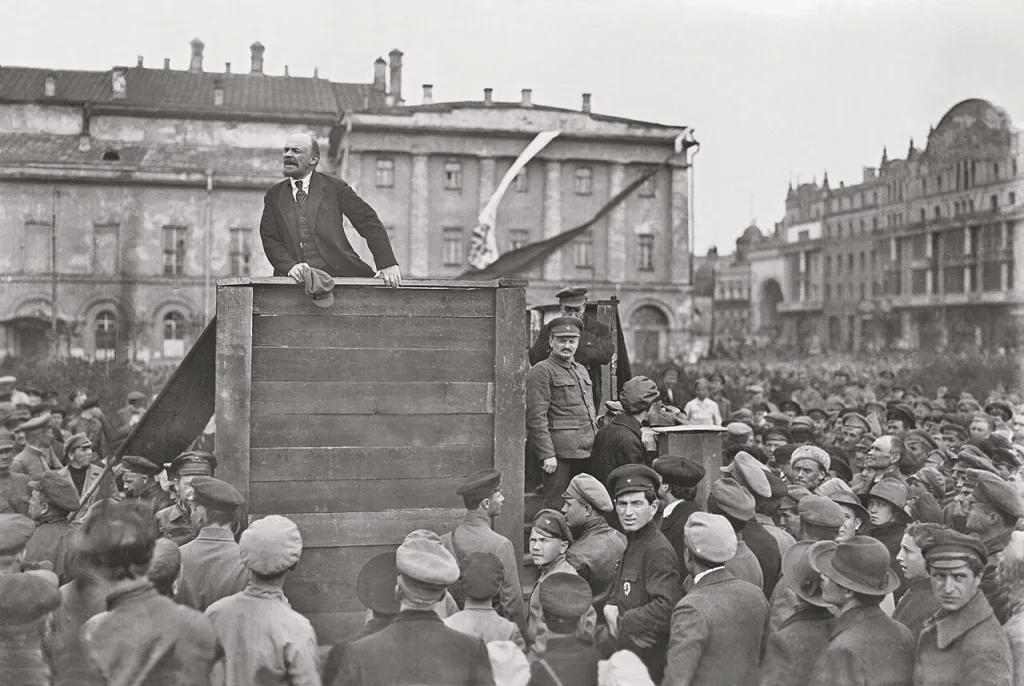
Kamenev, who became the spokesperson of the old Bolsheviks, insisted that the bourgeois revolution had not yet been completed, the land was still under the control of the land owners and the state wasn’t yet ‘democratic’. In other words, the bourgeois-democratic tasks remained unfinished, and therefore we must continue to support and work with the Soviets – “a bloc of petty-bourgeois and proletarian forces”.
“It would be a most grievous mistake to draw from this the premature conclusion that this revolution is not bourgeois-democratic, that it is approaching a socialist one” (our translation)
Here he based himself on the conservative side of the formula ‘democratic dictatorship of the proletariat and the peasantry’, which now led him to open the door to supporting the provisional government. Wasn’t this democratic dictatorship now becoming realised in the form of the Soviets – an alliance between the workers and the petty bourgeoisie?
To this idea Lenin replied in his Letters on Tactics:
“According to the old way of thinking, the rule of the bourgeoisie could and should be followed by the rule of the proletariat and the peasantry, by their dictatorship.
“In real life, however, things have already turned out differently; there has been an extremely original, novel and unprecedented interlacing of the one with the other. We have side by side, existing together, simultaneously, both the rule of the bourgeoisie (the government of Lvov and Guchkov) and a revolutionary-democratic dictatorship of the proletariat and the peasantry, which is voluntarily ceding power to the bourgeoisie.”
What had happened was what Lenin had hinted at in 1905, the bourgeois-democratic and socialist revolutions had become intermingled.
What had been created was a situation of dual power that had to be resolved one way or another. There now was a new special body of armed men: the workers and peasants, and they took their instructions from the Soviet!
In turn, the Soviet told them to obey the provisional government, “except those which run counter to the orders and decrees issued by the Soviet of Workers’ and Soldiers’ Deputies” (Order No. 1, Petrograd Soviet, 1917). What a state of affairs! And one that epitomised dual power. The bourgeois state can function, only insofar as it doesn’t contradict the will of the workers and soldiers!
The Bolsheviks were trained on the lessons of the Paris Commune and spoke a lot about a commune-type state, i.e. a workers’ state.
As Lenin put it:
“The real essence of the Commune is… in the creation of a state of a special type. Such a state has already arisen in Russia, it is the Soviets of Workers’ and Soldiers’ Deputies!”
He continues:
“[T]his fact does not fit into the old schemes. One must know how to adapt schemes to facts, instead of reiterating the now meaningless words about a ‘dictatorship of the proletariat and the peasantry’ in general.”
In other words, the workers and soldiers had created a new state in embryo, a workers’ state, supported by the soldiers, i.e. the peasants.
It is very clear that Lenin had now come to the same conclusion as Trotsky, which is what he made clear in his 1921 speech on the fourth anniversary of the October Revolution. The revolution had indeed grown over from the bourgeois to the socialist revolution. The alliance of the workers and peasants had been realised, with the working class at the head.
Where was Stalin?
It is worth noting the position of Stalin when he came back to Petrograd. He supported the same position as Kamenev. He claims his disagreement with Lenin only lasted a fortnight, but it was more than that.
You can see this in the article he wrote titled ‘The War’ in March 1917, before Lenin had returned. In order to solve the question of war, he argued:
“The solution is to bring pressure on the Provisional Government to make it declare its consent to start peace negotiations immediately.”
Here we find an echo of Martynov’s position of pressuring the bourgeoisie. The Provisional Government was, after all, the government of the bourgeoisie and the landlords.
This was completely contrary to Lenin’s position:
“The tsarist government began and waged the present war as an imperialist, predatory war to rob and strangle weak nations. The government of the Guchkovs and Milyukovs, which is a landlord and capitalist government, is forced to continue, and wants to continue, this very same kind of war. To urge that government to conclude a democratic peace is like preaching virtue to brothel keepers.” (our emphasis)
Kamenev and Stalin were the main ‘Old Bolsheviks’, but they weren’t the only ones. Lenin had to wage a sharp struggle in the party in April 1917 to get them to change their attitude and slogans towards the Provisional Government and its supporters in the Soviets.
What all the fuss was about
Why were all these old debates being dragged out again? Why did they also persist far beyond the days when Trotsky had any significant influence in the party?
Trotsky answers this in 1931:
“The campaign against ‘the old Trotskyism’ was in reality a campaign against the October traditions, which had become more and more cramping and unbearable for the new bureaucracy. They began to characterise as ‘Trotskyism’ everything they wanted to get rid of.” (The Permanent Revolution)
In Errors of Trotskyism, the authors had warned that Trotsky would become the leader of a right opposition. That he would gather around him petty-bourgeois and ‘non-party elements’. The truth is that it was the other way around. The New Economic Policy (NEP) of 1921 onwards strengthened the economy, but also the bureaucracy and the petty-bourgeois and bourgeois elements. They wanted peace and tranquillity for private accumulation of wealth, not revolutionary disturbances.
You can even hear echoes of it in Stalin’s statements about the permanent revolution in 1924:
“Where does the danger of this lie? In that such a revolution, if one took the trouble to realise it, would end with a complete breakdown, as it would deprive the Russian proletariat of its ally, the small peasantry.”
If one replaces the small peasantry with the kulaks, the NEPmen (the budding capitalist class created by the NEP) and so on, then you have here the real motivation behind the struggle against Trotsky. Trotsky makes this point in The Permanent Revolution:
“In particular, the caricatured and historically distorted counterposition of the permanent revolution to Lenin’s line of ‘alliance with the muzhik [peasant]’ sprang full-grown in 1923. It arose along with the period of social, political and party reaction, as its most graphic expression, as the organic antagonism of the bureaucrat and the property-owner to world revolution with its ‘permanent’ disturbances, and the yearning of the petty bourgeoisie and officialdom for tranquillity and order.”
In other words, the NEP, the baiting of Trotsky and the permanent revolution, and the growth of private capital and the rich peasants, all went hand in hand. The ‘alliance with the peasantry’ provided a political cover for the right-wing turn of the regime.
Furthermore, it paved the way for the theory of socialism in one country. That is, the theory that we no longer need to spread the revolution to Europe etc., but we can, as long as we can hold off imperialist intervention, build socialism here in Russia. This neatly fitted in with the resurrected theory of stages, which was like a caricature of Menshevism.
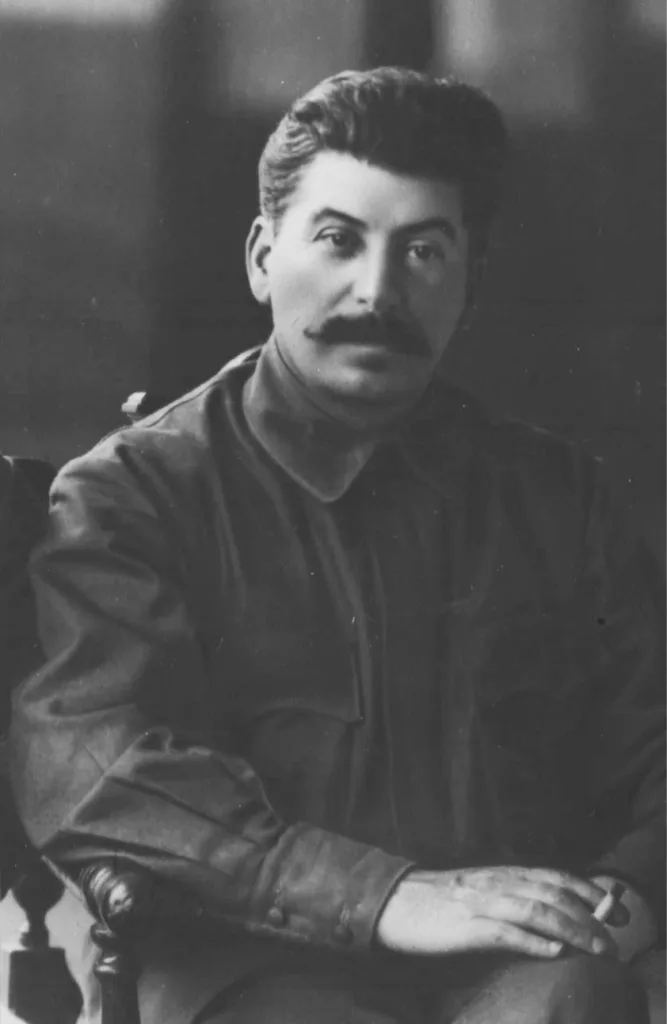
The conclusion of this theory was that there was no need to spread the revolution, and so the main question ceased to be to struggle for socialism, and instead became a struggle for ‘democracy’ and ‘peace’. The struggle for socialism was postponed. Thus the bureaucracy in the Soviet Union imposed their narrow interests on the communist movement. They sought peace with the capitalists, not struggle, and they were prepared to sacrifice the world socialist revolution to achieve that.
Conclusion
In the two major disagreements with Lenin, on one point Trotsky had been proven wrong: that of conciliationism between the best of the Mensheviks and Bolsheviks, and consequently the need for a Bolshevik-type party. On the other question, the character of the Russian Revolution, Trotsky had been proven correct.
Lenin in words, and more importantly deeds, showed he accepted Trotsky’s position. His opponents even accused him of this in April 1917. ‘But this is Trotskyism’, they said, and they were right. Lenin had accepted Trotsky’s position that the Russian Revolution would grow over into the socialist one. That was the necessary rearming that needed to be done to prepare for the October Revolution.
This isn’t just an argument about what happened over 100 years ago. It very much remains relevant today. If we look at the struggle in many countries where the working class is weaker and the peasantry remain stronger, or countries that are dominated by imperialism, we see the same dynamic. Is the struggle merely for democracy and national self-determination? Or is that struggle tied to and naturally grows over into the struggle for socialism.
Is it possible to divorce the struggle against imperialism and the struggle against capitalism? It is beyond the scope of this article, but Lenin’s Imperialism makes precisely the point that you can’t have capitalism in the modern epoch without imperialism.
Is the struggle in Kashmir, in Indonesia, in Bangladesh or India just a democratic struggle? Is it just a struggle for democracy or national self-determination? Not at all. It might start that way, but it cannot end there.
There’s also every possibility to spread the revolution from one country to another. From Kashmir to the rest of Pakistan, from Bangladesh to India etc. The conditions are there. That would mean a socialist federation of the Indian subcontinent. That would be a tremendous start, bringing together hundreds of millions of workers. It would not end there, but you could see that with the right leadership, that it is within grasp.
That leadership isn’t there. India, just to name one example, has a proud Communist tradition, with parties of millions of members. However, through the theory of stages, which is a negation of Lenin’s entire method, their leaders gave up the struggle for socialism. Instead they accommodated themselves to capitalism. What a waste.
Our task is to right the wrongs of history. And for that we need ideas. The ideas of Marx, Engels, Lenin, and yes, Trotsky, who carried on defending and developing the ideas of Marxism after Lenin’s death.
Whatever differences the two had before, when it came to the great revolution of 1917 they quickly found themselves on the same side. In ideas, and consequently practice.