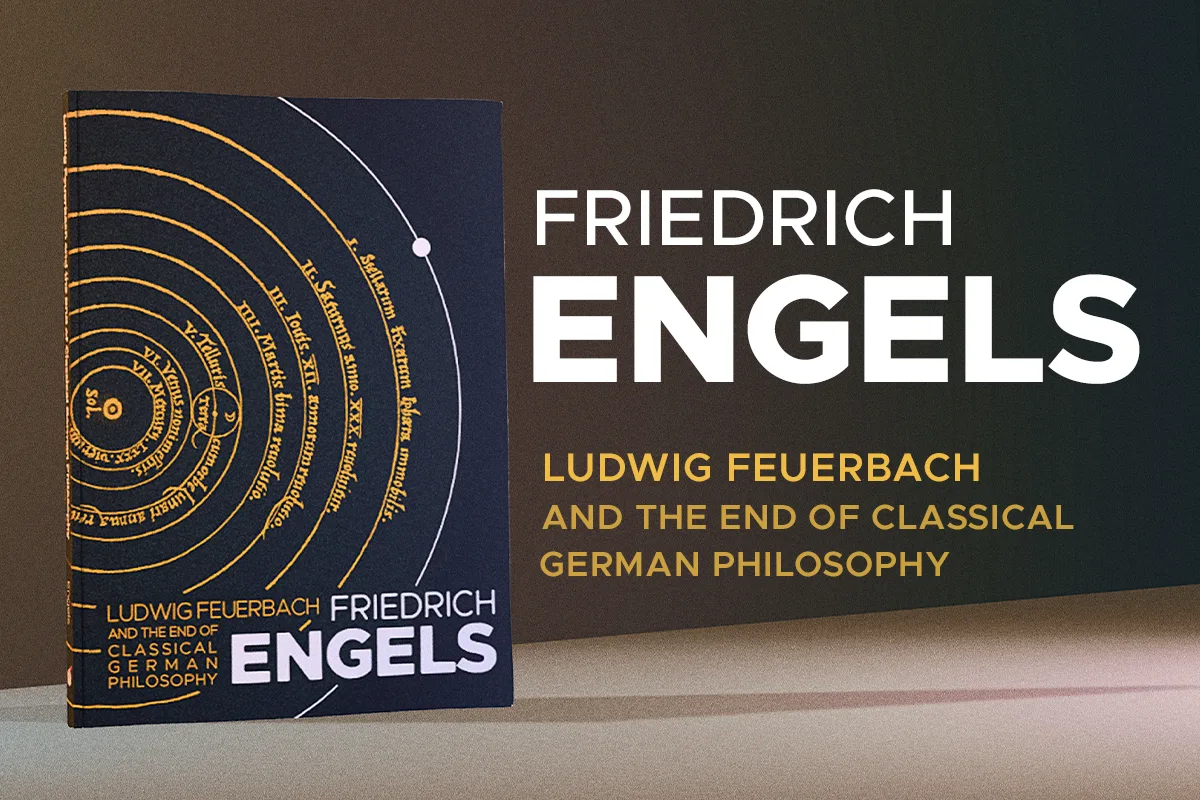
This is the introduction to Wellred’s Books’ new republication of Engels’ Ludwig Feuerbach and the End of Classical German Philosophy. This new edition includes Marx’s Thesis on Feuerbach as well as bonus articles by leading theorists of the RCI. Get your copy today!
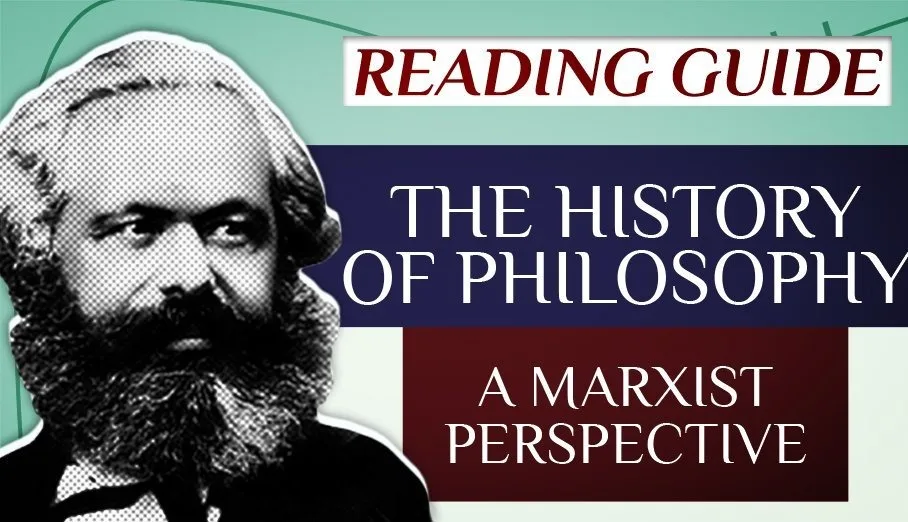
Friedrich Engels is best known as Karl Marx’s lifelong collaborator and the co-founder of scientific socialism. While Engels was very modest about his role in this collaboration, writing that “In Marx’s lifetime… I have played second fiddle,” he was an indispensable revolutionary leader and theoretician in his own right.
As well as writing important works jointly with Marx, such as The Communist Manifesto, Engels himself wrote many texts which are still Marxist classics today, including Ludwig Feuerbach and the End of Classical German Philosophy, published as a book in 1888.
Marx and Engels’ collaboration began in August 1844, when they met in Paris. After ten days of discussion they concluded that they were united on all the main points. Almost immediately they set about clarifying their relationship with the various philosophical trends that were influential in radical German circles at the time.
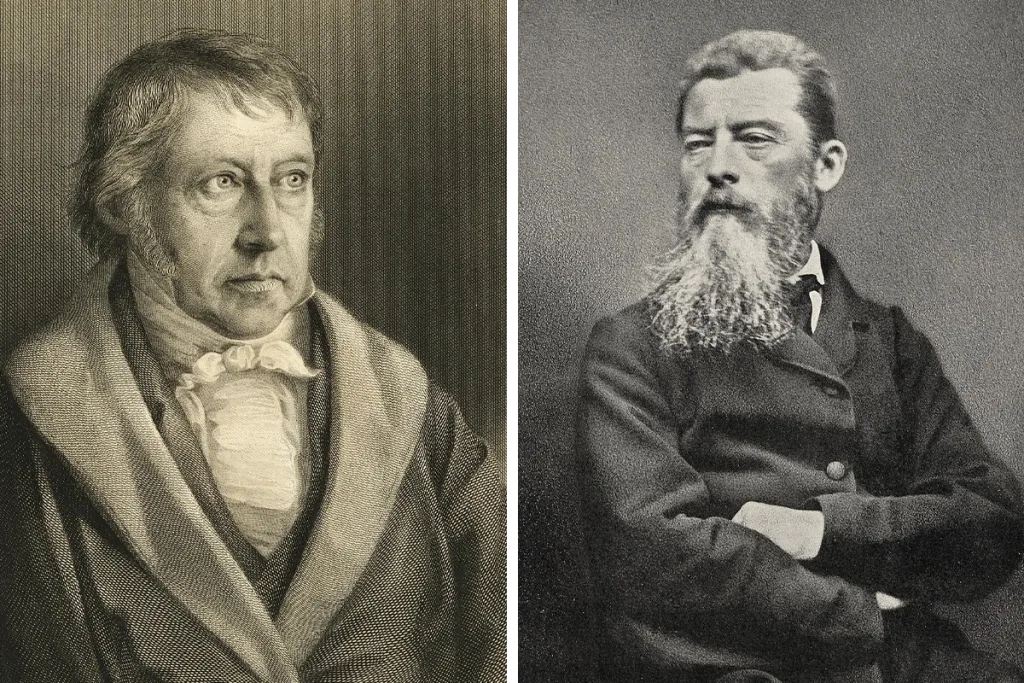
In particular, both Marx and Engels had been profoundly influenced by the ideas of GWF Hegel (1770-1831), and had counted themselves amongst the ‘Young Hegelians’, a group of his most radical followers. One of these Young Hegelians stood out above all the rest for Marx and Engels: Ludwig Feuerbach, whose Essence of Christianity caused a great stir in German intellectual and socialist circles after its publication in 1841.
Marx and Engels’ first joint works were thus overwhelmingly devoted to a thorough appraisal and critique of the Young Hegelians and Feuerbach. The first of these works was published as The Holy Family or Critique of Critical Criticism in 1844. The second, The German Ideology, was written between 1845 and 1846 but never completed, and would only be published in full in 1932, decades after the authors’ deaths. Nevertheless, this work marked a pivotal moment in the development of Marxist philosophy, the science of history, and of the communist movement.
Marx and Engels paid Hegel and Feuerbach their proper respects, having moved thought forward against the prevailing orthodoxy in a period of social backwardness prior to German unification. But they did not stop there: they took thought beyond the confines of German idealism and of idealism in general once and for all. This marked a revolution in philosophy, and one which presaged many revolutionary movements to come.
In later years, Marx focused on Capital, to produce the most comprehensive and penetrating critique of capitalism and bourgeois political economy ever written. Meanwhile, Engels did vital work writing Marxist texts on philosophy and history such as Anti-Dühring, an extract of which became the work Socialism: Utopian and Scientific. After Marx died in 1883, Engels carried on the painstaking task of completing the last two volumes of Capital as well as defending and promoting Marxist ideas for the working class moving into action. He continued to apply Marxism to current science in The Origin of the Family, Private Property and the State.
In order to understand why Engels wrote the present work so many decades after he and Marx had settled accounts with Feuerbach’s ideas, it is necessary to consider the important development of the European labour movement at the time. In the 1880s many Marxist parties were forming or growing: the French Workers’ Party, whose programme Marx and Engels helped to write; the Social Democratic Federation in Britain which, while disapproved of by Marx and Engels, was an avowedly Marxist organisation; Emancipation of Labour, the first Marxist group in Russia; and the Socialist Workers Party of Germany which, under the anti-socialist laws, grew from tens of thousands to hundreds of thousands. By 1889, the Second International was founded. With Europe rapidly industrialising, the working class was coming onto the scene and looking for organisations that reflected its interests.
These new parties needed leaders and members that were not just good organisers with strong convictions, but cadres able to apply the Marxist method to the changing situation. The rapid growth of Marxist parties brought with it an urgent need for theoretical clarity and education, in order to preserve their revolutionary DNA.
A correct theoretical basis is essential to a revolutionary party. The working class does not live in a vacuum. It is constantly in contact with alien classes whose outlook often penetrates the ranks of the workers, in particular through the reformist leaders of the labour movement. As Lenin famously observed: “Without revolutionary theory, there can be no revolutionary movement.”[1]
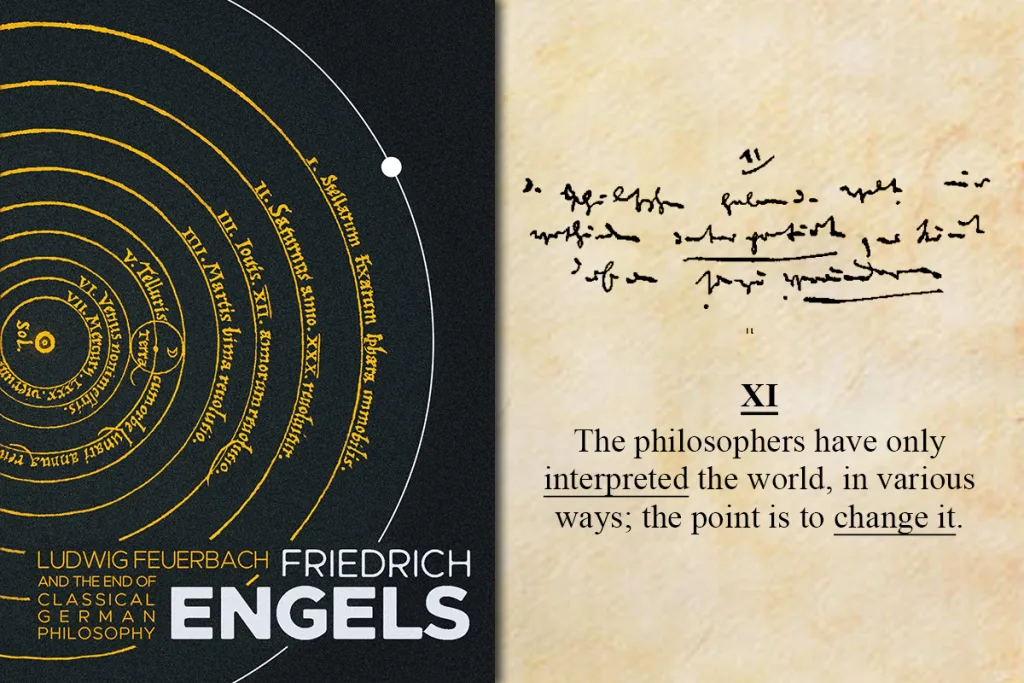
It was in this context that Engels returned to the thread of philosophy in a series of articles written for Die Neue Zeit (The New Times), the journal of the Socialist Workers’ Party of Germany (later called the Social Democratic Party of Germany), in 1886. When these articles were republished as a pamphlet in 1888, Engels also appended eleven short points from Marx’s personal notebook, which he used to prepare The German Ideology. These notes, which Engels gave the title Theses on Feuerbach, represent, in effect, the ‘birth certificate’ of Marxism – the point at which Marx’s ideas broke qualitatively from those who came before him, and produced a powerful new philosophy. Their identification and publication by Engels was therefore an immense and historic contribution both to the history of philosophy and to the Marxist movement.
In the same period Engels noted a “kind of rebirth” of classical German philosophy, including the ideas of Hegel and Feuerbach, in several countries. Indeed, Engels was originally commissioned to write his articles in Die Neue Zeit as a reply to a book on Feuerbach by a Danish academic, CN Starcke, which was published in 1885.
Classical German philosophy started out as a positive attempt to resolve the crisis of the Enlightenment, retaining the Enlightenment spirit of ‘dare to know’, while avoiding scepticism. In the 1882 preface to the German edition of Socialism: Utopian and Scientific, Engels writes:
We German Socialists are proud of the fact that we are descended not only from Saint-Simon, Fourier and Owen, but also from Kant, Fichte and Hegel.[2]
But at the time of its revival, classical German philosophy no longer had anything uniquely important to say about nature or society. Natural science was being transformed from a collecting science, categorising finished objects, to a systematising science discovering the interconnections, origins and development of things: from the transfer of energy and the processes of the cell to biological evolution. ‘Natural philosophy’, with its metaphysical, speculative explanations of natural processes, had been made redundant. The return to classical German philosophy, used to justify a retreat back to idealism, called for a defence of materialism.
Engels saw the need to explain the real content of these ideas, and their relationship with Marxist philosophy, the task which gave birth to the book in your hands today. Marxism did not simply destroy Hegel’s and Feuerbach’s philosophies, but grew out of and superseded them, preserving what was correct while moving beyond their limitations.
Hegel’s philosophy was dialectical: he saw both nature and ideas not as fixed, but in motion, this motion arising through internal contradictions. Ideal, social and natural phenomena come into and out of existence, going beyond the limits of their forms but eventually reaching their own limits. This dialectical method has a revolutionary implication: that all things are finite, will someday perish and can be replaced by a higher stage of development.
But Hegel’s philosophy had its own limits. Hegel was an idealist philosopher. He did not consider ideas to be reflections of the external, physical world in thought. Rather, he saw both nature and the mind as expressions of what he called the ‘Absolute Idea.’
Hegel used many natural examples to illustrate dialectical processes, and offered a profound insight when he explained that truth is a process, rather than simply a collection of facts or abstract principles to be discovered. But paradoxically he argued that this process has an end: the realisation of the Absolute Idea in art, religion and, above all, philosophy. But this Absolute Idea is devoid of content, simply thought grasping itself like a snake biting its own tail.
Having been a student of Hegel’s, Ludwig Feuerbach would later subject his philosophical system to a scathing critique. For Feuerbach, Hegel’s philosophy was just a more sophisticated and abstract version of theology. What was required was a break with idealism altogether. And in making this break, Feuerbach took up a fundamental principle of materialist philosophy: that thought reflected nature, and that humanity created God in thought.
Feuerbach’s critique of Hegel made an enormous impression on the young Marx and Engels. Marx wrote in 1844 that:
Feuerbach is the only one who has a serious, critical attitude to the Hegelian dialectic and who has made genuine discoveries in this field.[3]
But having succeeded in highlighting the fundamental weakness of Hegel’s idealism, Feuerbach himself was only able to go part way in his search for an alternative.
Feuerbach’s understanding of materialism never went beyond that of the eighteenth century, which saw matter as essentially dead and mechanical, unable to move without a prior external force and made of discrete, isolated particles. Accordingly, the materialists of the eighteenth century saw human nature as biologically fixed for all times and peoples, which rendered them incapable of offering an explanation for the obvious change and evolution of human society over the ages. Hence, in the philosophy of history, idealism reigned supreme.
Feuerbach rejected the mechanical conception of humanity to be found in this form of materialism and consequently rejected the label of ‘materialist’ altogether, preferring to refer to his own philosophy as ‘humanism’. But his alternative was ultimately no better, and arguably even fell short of Hegel’s philosophy of history. This is because he approached humanity not in terms of actual, living human beings but in terms of an abstract ‘human essence’, which he reduced to things like ‘love’ and ‘reason’. Ultimately, Feuerbach was a necessary step beyond Hegel but was unable to absorb the new developments of nineteenth-century science.
As Engels explains, Marx also departed from Hegel by returning to materialism, but this time a thorough, consistent materialism. Science was providing a systematic account of natural processes which confirmed dialectics in nature. Using the dialectical method contained in Hegel’s philosophy, Marx was at last able to overcome the limitations of the old materialism, to offer a materialist understanding of human thought, and of human society. Marx and Engels would sum up this understanding as follows in The German Ideology:
In direct contrast to German philosophy which descends from heaven to earth, here we ascend from earth to heaven. That is to say, we do not set out from what men say, imagine, conceive, nor from men as narrated, thought of, imagined, conceived, in order to arrive at men in the flesh. We set out from real, active men, and on the basis of their real life-process we demonstrate the development of the ideological reflexes and echoes of this life-process.[4]
This revolutionary approach to history, historical materialism, would provide the basis for the scientific socialism of Marx and Engels, and continues to guide the communist movement to this day. The final chapter of the present work remains one of the most brilliant explanations of historical materialism ever written. It remains an indispensable primer in Marxist philosophy, which ought to be read by anyone seeking to grasp the revolutionary ideas of Marxism.
We are proud to republish this work in a new edition, along with the Theses on Feuerbach, and supplementary articles on ‘Marx’s Revolution in Philosophy’ and ‘In Defence of Hegel’. We hope that these appendices will help the reader to even better understand and appreciate the ideas contained in Engels’ work.
We also believe that now is an especially important time for Engels’ pamphlet to be republished. The crisis of capitalism is provoking mass movements across the world, and millions of people are looking towards revolutionary and communist ideas.
Just as when Engels first wrote Ludwig Feuerbach and the End of Classical German Philosophy, there is an urgent need for Marxists to strive to master the Marxist method of dialectical materialism for themselves and apply it to the class struggle. This struggle has never been simply a struggle for economic necessities or political power, but for a society in which the riches of science and philosophy are the common inheritance and ongoing pursuit of humanity.
Marx and Engels turned philosophy from a contemplative activity to a tool for action to change the world. Armed with this philosophy, the working class will turn the aspiration of all oppressed people for liberation from an abstract ideal into reality. This is the legacy which Engels bequeathed to the world in the form of this work.
Wellred Books
London
October 2026
- VI Lenin, What Is To Be Done?, Wellred Books, 2018, p. 26. ↩
- Friedrich Engels, ‘Preface to the First German Edition of Socialism: Utopian and Scientific’, Marx and Engels Collected Works (henceforth referred to as MECW), Vol. 24, Lawrence & Wishart, 1989, p. 459. ↩
- Karl Marx, ‘Economic and Philosophic Manuscripts of 1844’, MECW, Vol. 3, p. 328. ↩
- Karl Marx and Friedrich Engels, The German Ideology, MECW, Vol. 5, p. 36. ↩