Following a summer of demonstrations against ongoing power and water cuts and medicine shortages, Tunisian workers and youth have been spurred on by the struggle of their brothers and sisters across the Mediterranean in France.
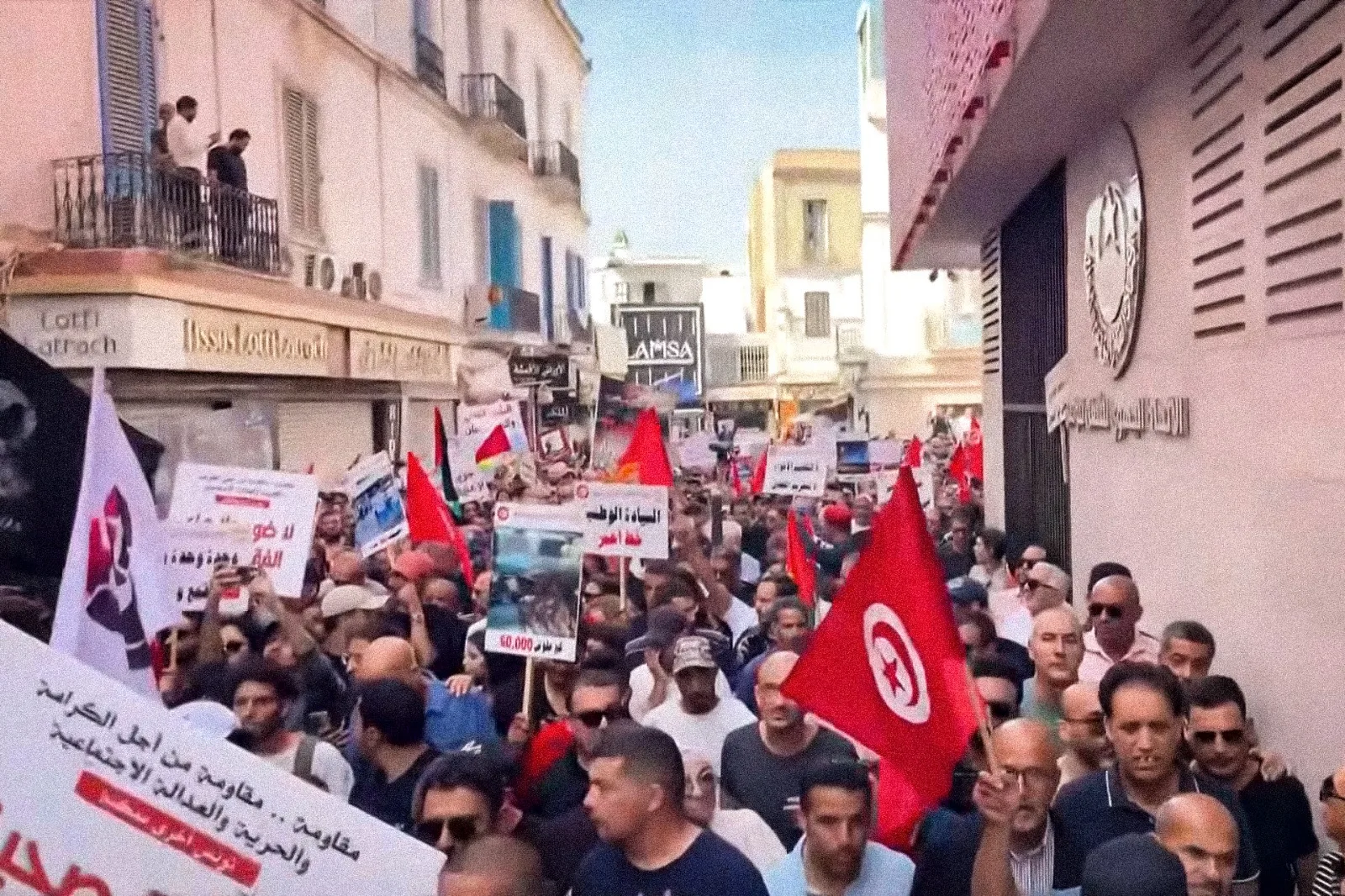
Over the course of the last month, small, trade union-led demonstrations in the capital, Tunis, have morphed into more spontaneous, youth-led clashes with the police, which have flared up across the country.
Scenes like this haven’t been seen in Tunisia since 2021-22, when demonstrations erupted on the tenth anniversary of the Arab Spring, in the context of the COVID-19 pandemic and the collapse of the healthcare system.
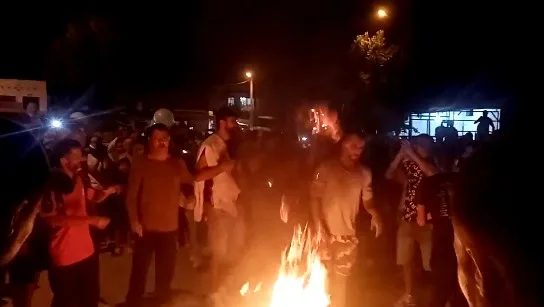
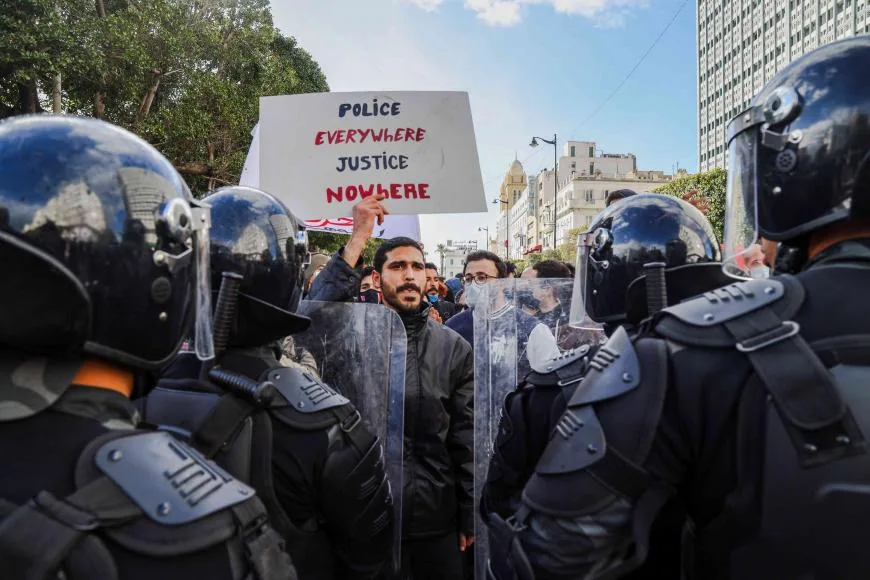
As security forces fire tear gas and charge into crowds, protestors have responded by blocking roads, throwing stones, and burning tires.
Marching down the central Avenue Habib Bourguiba, a location with strong ties to the 2011 Arab Spring uprising, protestors chanted the same slogans that were heard throughout the Arab world in 2011: “The people want the fall of the regime!”
This is significant. 15 years have passed since the revolution of 2011. A whole new generation of youth, without the memory of those events or of the demoralisation and defeat that followed, has grown up and is now raising the call for revolution afresh. While the clashes have subsided for now, tensions remain.
The masses reject Saied’s regime
On 17 October – the same day that hundreds of thousands of French workers and youth took to the streets – thousands rallied in Tunisia’s capital city.
Though they are not as big as the widespread mobilisations in Europe and Brazil, these are the largest protests Tunisia has seen for four years.
Protestors are raising economic and social demands alongside democratic ones. Placards displayed slogans like, “No democracy without freedoms,” and, “No dignity with poverty”.
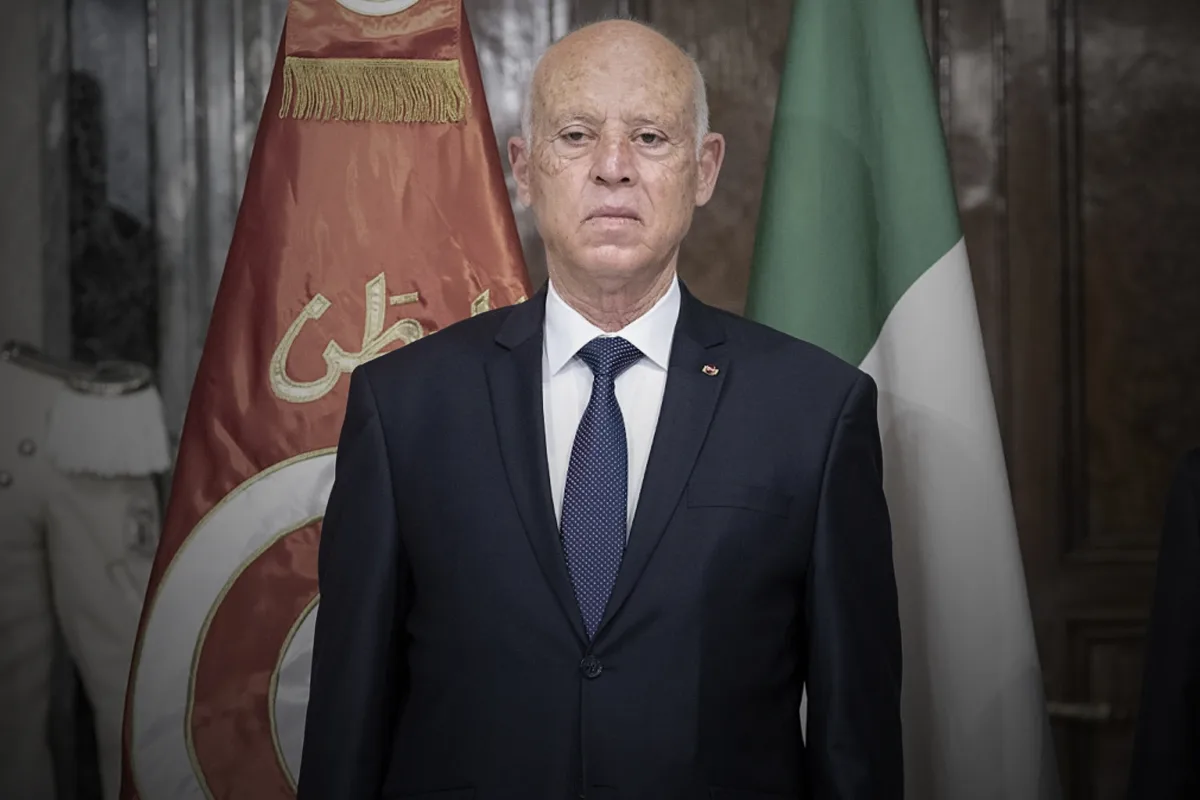
The demands of the demonstration included a solution to the rising cost of living, the release of political prisoners, the protection of basic democratic freedoms and trade union rights, and an end to President Kais Saied’s repressive regime.
In 2019, promising an alternative to the failed political status quo, and demagogically posing as a friend of the 2011 revolution, Saied was elected in a landslide victory against an opponent who was facing corruption charges.
In July 2021, parliament defied Saied by refusing to vote for decrees that would give him near-total power. In response, he suspended the chamber, accused parliamentarians of attempting a coup, before completely dissolving parliament in 2022.
At the time, given the complete discrediting of the corrupt parties and politicians in parliament, Saied’s ‘constitutional coup’ was met with a positive response, including amongst those protesting at the time. Some trade union leaders even welcomed this takeover.
But now, not a single illusion in Saied’s regime remains amongst the masses. Basing himself upon the same bankrupt, crisis-ridden economy, things have gone from bad to worse under the President’s time in power.
Youth unemployment in Tunisia sits at around 38 percent as of 2025, the second highest in the whole of North Africa. Graduates report struggling to find jobs for over a decade. It’s no surprise that the youth have been at the forefront of the latest protests.
And, just like in France, students have been demanding better school conditions, carrying signs displaying slogans like, “We are skipping our lessons to teach you one!”.
Meanwhile, like in Europe, Defence Minister Khaled Sehili, has massively hiked defence spending, raising it by 12 percent in the coming year, citing the ‘threats’ posed by “irregular migration” (i.e. the black sub-Saharan migrants he regularly incites hatred against), terrorism, and organised crime.
Arab Spring 2.0?
Officially, the demonstrations are being led by the Tunisian General Labour Union (UGTT), with cross-sector unions participating. Notably, the 17 October mobilisation came off the back of a recent two-day strike of fuel transport workers over wages and conditions.
Doctors, lawyers, and journalists – professions that have historically been well-paying – have made up a large number of those present, with their conditions taking a sharp hit this past year.
No doubt seeking to capitalise upon this growing movement, eight different parties – ranging from the ‘Marxist-Leninist’ Workers’ Party, to the liberal, pro-business Afek Tounes, to the Arab nationalist People’s Movement – have backed the demonstrations. Even the Islamist Ennahda released a statement in support of the protests.
These political parties may proclaim a shared hatred for the current regime, but this does not mean that they are fundamentally any different. People’s Movement, for example, was until recently one of Saied’s most steadfast supporters!
The masses are aware of this, and are wary of all parties. They aren’t looking to hand power to this or that opposition party. They want a complete uprooting of the system itself. The main lesson from the 2011 Arab Spring, which overthrew the hated dictator Ben Ali, as well as of Saied’s constitutional coup in 2021, is that it is not enough to replace one set of crooks with another. Any political party that bases itself on the weak Tunisian capitalist system will end up carrying out the same anti-worker and anti-democratic attacks.
Escalation and repression
On Thursday 22 October, the situation escalated quickly. While the demonstrations were already widespread and connected to a range of issues, five different civilian deaths – some of which are suspected to be at the hands of the state – have inflamed things even further.
The death of a man arrested on suspicion of drug dealing sparked intense protests. The police claim that he died from swallowing drugs, but the man’s family believe that police violence was to blame.
Earlier that same day in the city of Sfax, students protested over the death of a fellow student who suffered a fatal cardiac arrest as an ambulance took over an hour to arrive at the scene.
The UGET students union has since called a strike at Sfax University, calling for the Ministry of Higher Education, the Ministry of Health, and the university bosses to address the severe deficit of urgent medical facilities, equipment, and staffing, as well as overcrowded university accommodation. Students are also demanding the establishment of permanent medical points inside the accommodation.
Elsewhere in Sfax, crowds mobilised protesting against the police negligence that led to the death of a man during a police chase. In nearby Agareb, meanwhile, further state thuggery was on display as people demonstrated in response to a man self-immolating outside a government building – a form of protest that has become widespread since the Arab Spring.
In Nabeul, an elderly activist involved in a dispute outside of a factory was struck and killed by a vehicle. That same night, the factory was burned to the ground, allegedly by local residents. The perpetrator of the crash has not been identified, but the response from residents shows the tense mood that exists: people are on high alert, and see their class enemies conspiring against them, and are acting accordingly.
Security forces even had to be deployed to secure a National Guard station in the suburb of Ettadhamen in Tunis, where some protests have been taking place.
This state violence inflamed the demonstrations, with protestors burning tires, blocking roads, and throwing stones at the police in response.
The youth on the move
Just like their counterparts in Paris, the Tunisian ruling class must be trembling in shock.
The Tunisian Forum for Economic and Social Rights has reported 2,882 protests between July and September 2026, a 119 percent increase from this time last year.
The people are losing their fear once again. And the consciousness of the youth in particular is being transformed by these events, as they begin to look beyond the existing party divisions, and connect different issues to the corruption of their capitalist rulers.
Crumbling healthcare systems, worsening education and living conditions, and constraints on democratic rights have spurred on the so-called ‘Gen Z revolutions’ globally, and the Tunisian youth see themselves as part of this worldwide struggle.
As one Instagram user remarked, “This is the first time I’ve seen a European uprising at the same time as an Arab Spring. Albania, France, Belgium, Spain. May the same be for Tunisia and Morocco”. And another: “This time Tunisia’s got a world winter in mind, not an Arab Spring”.
The ‘Gen Z revolutions’ began in the oppressed, ex-colonial countries. Now, having spread to Europe, the Arab youth are seeking inspiration from the struggles unfolding in France, with which Tunisia has a historic connection through colonialism, and a continued connection through migration and shared use of the French language.
These events are raising a new generation of revolutionary youth. But the movement needs revolutionary leadership to avoid the failures of the past.
One of the main slogans of the 2011 revolution was, “Work, freedom, dignity”. The fact that the masses are still struggling for these three things exposes the utter bankruptcy of capitalism, in Tunisia and across the Arab world.
Down with Saied’s regime! No trust in the opposition parties! For revolutionary leadership!