Lenin, on 26 December, 1918, had clearly put forward the Bolshevik position:
This demand for the convocation of the constituent assembly was a perfectly legitimate part of the programme of revolutionary social democracy…While demanding the convocation of a constituent assembly, revolutionary social democracy has ever since the beginning of the revolution of 1917 repeatedly emphasized that a republic of Soviets is a higher form of democracy than the usual bourgeois republic with a constituent assembly.
Lenin constantly explained that it was one thing to have a fully worked out theoretical position and another to apply it to concrete conditions. In November 1918 in Germany power was in effect in the hands of the workers’ and soldiers’ councils, but the proletariat was not conscious of its dominant position. As in February 1917 in Russia, the workers and peasants handed over power to the “compromisers”, who in turn handed it back to the bourgeoisie.
While the Bolsheviks, between February and October 1917, called for “All Power to the Soviets”, they also put forward the call for a Constituent Assembly, which had long been part of their programme. Even after October, when the workers’ soviets took power into their own hands, the Soviets went ahead in November with elections for a constituent assembly. It was seen as a means of consolidating support for the revolution among the more politically backward sections of the middle class and the peasantry, of legitimizing the achievements of the soviets among all strata and in every corner of the country. The elections, however, reflected the weight of many sections who were lagging far behind the radicalized workers and peasants of the cities and surrounding areas. When the Constituent Assembly was convened in January 1918 it included a majority of delegates (predominantly right-wing Social Revolutionaries and Mensheviks) opposed to the soviet government.
In Germany the call for a constituent assembly was still linked, in the eyes of advanced workers, with revolutionary aspirations; in Russia in 1918, when the soviets, the real democratic organs of the masses, had already carried through a social transformation, the constituent assembly was seized on by the landlords, capitalists, and supporters of the “White” generals as a vehicle for counter-revolution. With a completely changed relationship of forces, the formal “democratic” rights of a reactionary constituent assembly could not be allowed to threaten the socialist revolution, and the Assembly was therefore dispersed by the soviets. Under the conditions prevailing in Germany in 1918, where the working class had not taken power, the question of the constituent assembly was posed in a completely different way.
Lenin in his book Left-Wing Communism, an Infantile Disorder, in dealing with many of the ultraleft tendencies within the young communist parties, attempted to draw all the experiences and lessons from the development of Bolshevism. In order to educate these young layers, Lenin explained: “Tactics must be based on a sober and strictly objective appraisal of all the class forces…” He continued, “It is very easy to show one’s ‘revolutionary’ temper merely by hurling abuse at parliamentary opportunism.” At all times it was necessary to take into consideration in your propaganda and slogans, the present consciousness of the working class. “You must not sink to the level of the masses, to the level of the backward strata of the class. That is incontestable,” states Lenin. “But at the same time you must soberly follow the actual state of the class consciousness and preparedness of the entire class (not only of its commonest vanguard), and of all the working people (not only of their advanced elements).” In dealing with the German “left” communist attitude towards parliament, he explained:
We must not regard what is obsolete to us as something that is obsolete to the class, to the masses…How can one say that ‘parliamentarianism is politically obsolete’, when ‘millions’ and ‘legions’ of proletarians are not only in favour of parliamentarianism in general, but are downright [according to the German lefts – RS] ‘counter revolutionary’!? It is obvious that parliamentarianism is not yet politically obsolete. It is obvious that the ‘lefts’ in Germany have mistaken their desire, their political ideological attitude, for objective reality. That is the most dangerous mistake for revolutionaries to make.
Lenin hammered home the need to constantly assess the consciousness of the working class, with all their illusions, in order to tailor material propaganda and slogans to find the greatest echo. The illusions of the masses will not be overcome by simply repeating abstractly the importance of soviets but by showing positively in action the correctness of revolutionary ideas and by going through the experience with them. The ultraleft or sectarian simply shouts from the sidelines whereas the genuine Marxist would participate in the struggle of the workers with all their illusions, constantly attempting to raise their level of consciousness at each stage in the development of the struggle.
The arguments for boycott of the National Assembly, when the masses were overwhelmingly in favour of participation, were completely wrong. In the end, despite the KPD boycott, 83 percent of the population voted, a bigger percentage turnout than in any prewar election.
Similarly, their demand after 8 December for “Down with the Government” was ultraleft and entirely incorrect, given their tiny support in the population, and simply miseducated their 3000 members and fed the impatience of workers who were looking towards insurrection. Lenin had warned against the misuse of such a slogan on 22 April, 1917:
The slogan ‘Down with the Provisional Government’ is an incorrect one at the present moment because, in the absence of a solid (i.e. a class conscious and organized) majority of the people on the side of the revolutionary proletariat, such a slogan is either an empty phrase, or, objectively, amounts to attempts of an adventurist character.
The tasks of the Bolsheviks were: (1) To explain the proletarian line; (2) To criticize the petty bourgeois policy; (3) To carry on propaganda and agitation; (4) To organise, organise, and once again organise.
Lenin fought against any traits of putschism or Blanquism in the Bolshevik Party. Their main task was to win a majority to their side by patient explanation, and not by ultraleft talk which could seriously miseducate the cadres and disorientate the party. Again in April, Lenin wrote:
In the theses I definitely reduced the question to one of a struggle for influence within the Soviets of Workers’, Agricultural Labourers’, Soldiers’ and Peasants’ Deputies. In order to leave no trace of doubt in this respect, I twice emphasized in the theses the necessity for patient and persistent ‘explanatory’ work ‘adapted to the practical needs of the masses’.
It was the failure of Luxemburg and Liebknecht to train the Spartacist cadres sufficiently in strategy and tactics that allowed the ultralefts to hold sway over the Spartacist organization.
By 11 November, the Spartacists had formally changed their name from Internationale Group to Spartacus League and opened up negotiations with the Revolutionary Shop Stewards and the USPD. Although they had a much wider influence than their membership the Spartacists had a very limited following in the councils, which was mainly confined to Brunswick and Stuttgart – they had no one on the executive of the councils in Berlin.
Towards the end of November, the German High Command in connivance with Ebert, made plans to occupy Berlin with loyal troops to establish a strong government. “Ten divisions were to march into Berlin,” General Groener later explained, “to take power from the workers’ and soldiers’ councils. Ebert was in agreement with this…we worked out a programme for cleaning up Berlin and the disarming of the Spartacists.” An attempted military coup took place on 6 December, when troops marched on the Chancellery declaring Ebert President. Ebert prevaricated and demanded time to consult his government colleagues. Meanwhile groups of government soldiers raided the Spartacist newspaper Rote Fahne, attacked a Spartacist-led demonstration, killing 14, while another arrested the executive committee of the Berlin councils. Spontaneously a crowd of workers marched on the Reichswehr soldiers, freed the executive members and foiled the coup attempt.
The SPD leaders played down the event, blaming the Spartacists for provocation. Seizing the opportunity the Spartacist League organized mass demonstrations and even strikes against the attempted putsch. The anger of the Berlin workers was reflected in the 150,000 strong demonstration called on 8 December. The Spartacists issued an urgent appeal: “Workers, soldiers, comrades! The revolution is in danger! Preserve your handiwork of 9 November!…The criminals are Wels and company, Scheidemann, Ebert, and company…throw the guilty men out of government! The revolution must be saved…forward to the task! To the fight!”
Groener’s troops began to arrive in the capital, greeted by Ebert. But within a short space of time they began to fraternize with the radicalized Berlin workers. The ruling class was forced to bide its time.
On 16 December a national congress of the workers’ and soldiers’ councils convened in Berlin. Rules for the election of delegates were left to regional bodies which resulted in a congress that was completely out of step with what was happening in the rest of Germany. Four-fifths of the 489 delegates were members or supporters of the SPD, 195 were party and trade union full-time officials – which outnumbered the 187 registered waged or salaried workers! Predictably, the vast bulk of the congress supported the calling of the constituent assembly, bringing it forward to January 1919.
Although the majority of the national congress supported the SPD, their politics were far from conservative. Resolutions were passed by big majorities demanding the abolition of the standing army and the establishment of a peoples’ militia. They also demanded that all badges of rank be removed and all soldiers be allowed to elect their officers with immediate right of recall. Furthermore, soldiers’ councils would be responsible for the maintenance of discipline throughout the armed forces. Later a key congress resolution on the economy demanding the immediate nationalization of all key industries was passed by an overwhelming majority.
The SPD ministers, however – faced with an officers’ revolt – had no intention of carrying out these demands, but on the contrary they established closer links with the German High Command.
On 23 and 24 December there were clashes between the regular army and mutinous sailors in Berlin. The government had demanded that 80 percent of the naval troops be discharged and its headquarters evacuated. Their refusal led to government troops being used against them, which resulted in 67 casualties. This was not the first time that the Reichswehr was used in this way, but it resulted in USPD ministers resigning from the government in protest and being replaced by majority socialists (SPD), including the ambitious Gustav Noske.
Throughout December an alliance of monarchists and counter-revolutionary elements of various descriptions (together with the SPD leaders), conducted a vicious witch-hunt against the Spartacus League. The Anti-Bolshevik League, financed with government money, plastered posters on walls in towns and villages slandering the Spartacist leaders. A murderous atmosphere was being created to instigate a pogrom against Liebknecht and Luxemburg. Giant posters appeared:
Workers! Citizens!
The downfall of the Fatherland is imminent!
Save it!
It is not being threatened from without, but from within:
By the Spartacist Group.
Strike its leader dead!
Kill Liebknecht!
You will then have peace, work and bread!
Signed Soldiers from the Front.
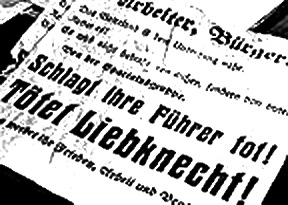
Poster distributed by the Anti-Bolshevik league calling for the murder of Karl Liebknecht.