The collapse of the Soviet Union is now triumphantly held up by the enemies of socialism as the final ‘proof’ that nationalisation and planning do not work and that, consequently, the human race must henceforth reconcile itself to the eternal domination of the laws of the ‘Market’, for ever and ever, amen. This is, indeed, the essential message of the celebrated ‘End of History’ of Francis Fukuyama. Yet history, in the Marxist sense, has by no means ended, and the future of world capitalism is no more secure now than it was before the fall of the Berlin Wall. In fact, it is infinitely less so.
The capitalists argued that the fall of the USSR proved the superiority of democracy and the ‘free market economy’ over ‘communism’. In reality, what collapsed in Russia was not socialism or communism but a bureaucratic and totalitarian caricature of socialism called Stalinism. And what happened afterwards? The rush to a market economy has made a handful of people very rich but caused the biggest economic disaster in history. Now there is widespread and appalling poverty in Russia, which was not the case before.
The collapse of Stalinism was supposed to usher in an epoch of peace, prosperity and democracy across the world. It has not. Instead there is a picture of general instability and turbulence at all levels: economic, social, political and military. There is war after war and terrorism is spreading like an uncontrollable epidemic. There was supposed to be a ‘peace dividend’, but now the USA is spending over $500 billion a year on arms. The barbaric war in Iraq alone cost the US Treasury about one billion dollars a week and ended in a mess. Iraq, Afghanistan, Ukraine and Syria all show the limitations of the power of US imperialism.
The organic crisis of world capitalism is exposed by a profound economic crisis, social and political instability, wars, terrorism and an all-pervading mood of pessimism at all levels of society. The old society is crumbling. It is in a state of terminal decay. This is the historic context in which capitalist restoration has taken place in Russia. And Russia will not escape from the general collapse. Despite its temporary success, oligarchic capitalism is rotten to the core. It offers no future for the people of Russia or any other country.
In 1940 a conversation took place between a French army officer and an officer of the German army that had just entered Paris in triumph. The German officer was naturally exultant but the Frenchman calmly replied: “The wheel of history has turned. It will turn again.” And so it did.
It does not take tremendous perspicacity to see that the present system is in a complete blind alley. The strategists of capital who, 20 years ago, were crowing over the collapse of the Soviet Union, are now filled with dread for the future. From their class point of view they understand what we understand. They can see the growing instability that is spreading throughout the world, the massive discontent and frustration that is undermining the old stability and upsetting the old certainties.
On a world scale capitalism now finds itself in a deep crisis. The demagogic attacks on socialism, Marxism and communism have an increasingly hollow ring, because they are made against a background of the deepening crisis of world capitalism. Falling rates of growth, permanent mass unemployment, attacks on living standards, vicious cuts, the attacks on the welfare state – this is the reality of capitalism in the advanced countries on the hundredth anniversary of the Bolshevik Revolution.
Contrary to what Trotsky had anticipated, the bourgeois wing of the bureaucracy succeeded in carrying out the counter-revolution in a relatively ‘cold’ way. In Eastern Europe, the Stalinist regime collapsed without a whimper. The Stalinist regimes appeared to be monolithic, powerful and invincible. Few people would have dared to guess that these same regimes would fall like ninepins in the face of a powerful movement of the masses. But this is what happened. And it can happen again.
The reason for this apparent paradox is not difficult to see. Once a given socio-economic system has exhausted itself, is no longer capable of developing the productive forces, and hence advance the cause of human civilisation, it begins to crumble and collapse from the inside. Under such circumstances, it only requires a single push to bring the whole edifice crashing down. History provides many examples of how an apparently solid regime can collapse overnight under certain conditions, as we saw in Eastern Europe in the late 1980s. This historic example cannot provide the capitalists and their apologists with a single crumb of comfort – quite the opposite in fact.
A quarter of a century ago Ted Grant predicted that when viewed in retrospect the fall of Stalinism would be seen as merely the prelude to an even greater historical drama: the terminal crisis of capitalism. Twenty-five years later, those prophetic words have come true. Then it was the Stalinist regimes of Russia and Eastern Europe that had exhausted their potential and were ripe for overthrow. Now the capitalist system finds itself in an analogous situation.
On a global scale, it is no longer capable of developing the productive forces as it did in the past. From an historical point of view, it is a system that has long since exhausted its potential and has become a monstrous obstacle in the path of human progress. What is required is the development of a mass movement strong enough to provide a decisive push. That movement sooner or later is going to come into existence.
In the same way that the Stalinist regimes were easily overthrown once the masses got on the move, it is possible that a bourgeois regime in Russia and the West could collapse when confronted with a massive movement of the working class, drawing behind it a big section of the middle class. That is a thought that must keep the strategists of capital awake at night, even now.
No one can break the instinctive will of the working class to change society. The whole history of Russia in the twentieth century is living proof of this assertion. The Russian proletariat has a long and glorious revolutionary tradition. They will rediscover it in the course of struggle. Of course, this process would be far quicker and more effective if a genuine mass Leninist current were present. But they will learn anyway. The Russian proletariat was the first to set up soviets on the basis of the 1905 Revolution. We must never forget that the soviets were not the invention of the Bolsheviks or any other party, but the spontaneous invention of the working class.
It is true that at present the forces of Marxism in Russia are weak and isolated. But the student of history knows that this is not the first time such a situation has existed. From the establishment of the first small propaganda circles of Marxists, to the 1905 Revolution, twenty years passed. From the period of reaction that followed the defeat of the first revolution there was a gap of ten years until the new awakening. In this time, the workers’ movement knew moments of bitter despair, but inevitably the situation changed. The present period is no different. In spite of all the difficulties, in spite of the terrible confusion and disorientation, which are the inevitable result of six decades of totalitarian reaction, the Russian proletariat will rise again.
In Greek mythology, there is a giant called Antaeus who wrestled with Hercules. Many times he was hurled to the ground but every time he would rise again with renewed strength which he derived from his mother, the earth. The working class is like that giant. No matter how many defeats and disappointments it suffers, it always returns to the struggle, because there is no alternative.
London
7 January 2017
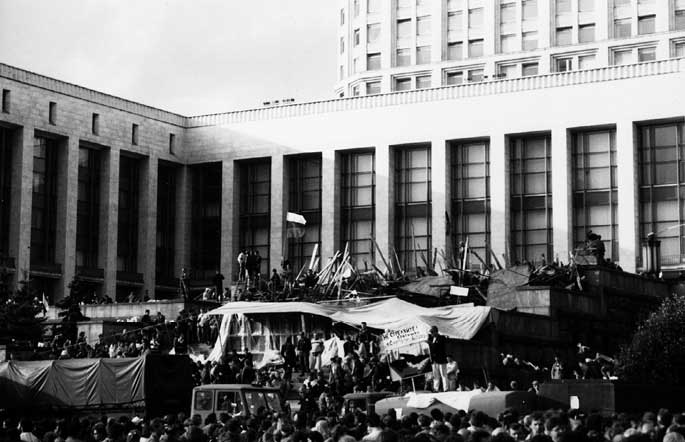
39. Awaiting the counter-attack outside the White House in Moscow.
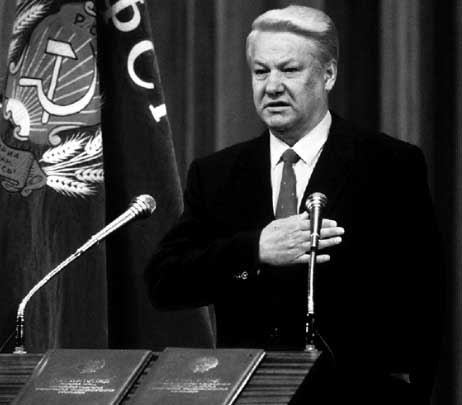
40. Yeltsin’s inauguration, 1991.
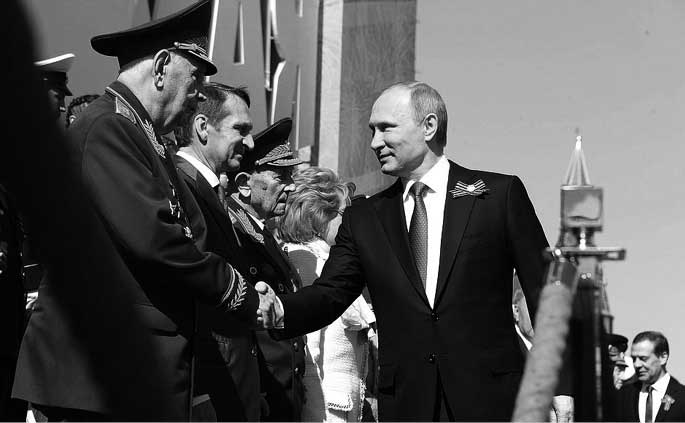
41. Putin at a military parade in 2016.