In the late 1890s, a party leader, Eduard Bernstein, began to articulate the outlook of these privileged sections by arguing for a complete revision of Marxism. He urged the party to recognize reality and the changed situation since Marx’s time. For Bernstein, capitalism had now changed and had overcome its contradictions of boom and slump, class lines were becoming blurred and therefore the class struggle obsolete. He formulated his opportunist viewpoint in the phrase: “The final goal, no matter what it is, is nothing; the movement is everything.” Bernstein was the forerunner of all those later reformist leaders who challenged the ideas of Marxism as not corresponding with the real development of society. The ideas of Kinnock, Gonzales, Mitterrand, Papandreou, are nothing new, but simply a vulgarized rehash of those expressed by Bernstein at the turn of the century.
In the German SPD Karl Kautsky and other leaders took up the fight against Bernstein’s revisionism. Kautsky’s attack on Bernstein, “How dare you renounce our heritage,” was not a defence of genuine revolutionary Marxism. For Kautsky, the ideas of Marxism had become like tablets of stone. He was a typical centrist, Marxist in words and phrases but reformist in deeds. His vulgarized Marxism was an attempt to reconcile reform and revolution. For Kautsky, theory and ideas were completely divorced from reformist practice and the day-to-day demands of the movement. The centrists’ whole being became adapted to reforms within capitalism. Kautsky was to end up after 1914 preaching national defence! The party congresses of 1901 and 1903, as well as the 1904 Congress of the Second International, passed resolutions condemning the new revisionism of Bernstein. But they meant very little in practice. The SPD secretary, Ignaz Auer, expressing the real cynical feeling of the bureaucracy, wrote to Bernstein in 1899,“My dear Ede, one does not formally make a decision to do the things you suggest, one doesn’t say such things, one simply does them.”
In the Second International Kautsky was regarded by friend and foe as the “Pope of Marxism”. His struggle against Bernstein was supported by Lenin who at that stage regarded himself as a follower of Kautsky. Prior to 1914, Lenin regarded the Bolsheviks as a “Bebel-Kautsky” wing of the Russian Social Democracy. “What we have claimed,” stated Lenin in 1906, “that our fight for the position of revolutionary social democracy against opportunism is in no manner whatsoever the creation of some ‘original’ Bolshevist tendency – has been completely confirmed by Kautsky… ” It was only the brilliant revolutionary, Rosa Luxemburg, who could observe Kautsky’s actions at close hand, who clearly recognized the limits of his pseudo-Marxism.
All individuals and great theories are put to the test by events. There was no bigger event than world war. Resolutions had been passed at the International Congresses of Stuttgart in 1907 and Basel in 1912, against the prospect of imperialist war and to issue a call to fight it by every means, including a general strike. Despite this, the declaration of war in August 1914 shattered the International.
The world war indicated the impasse of imperialism, where the productive forces had outgrown the nation state and private ownership of the means of production. German capitalism, which had arrived on the scene very late, had effectively missed out on the division of the globe by the imperialist powers, especially Britain. The only way German capitalism could break out of the straitjacket of the national market was by a violent redivision of the world. World war became inevitable.
In nearly every country, the leaders of social democracy capitulated to their own bourgeoisie, jettisoning the ideas of class struggle and internationalism. On 4 August, the SPD chairman read out a statement in the Reichstag:
We are faced with the iron fact of war. We are threatened with the horrors of hostile invasions…
It is for us to ward off this danger and to safeguard the culture and independence of our country. Thus we honour what we have always pledged: in the hour of danger, we shall not desert our Fatherland….Guided by these principles, we shall vote for the war credits.
To confuse the workers and justify their capitulation and their alliance with the reactionary Junker aristocrats and bourgeois parties, they used suitable quotations from Marx and Engels written in 1848 and 1859, ripped out of context.
The prestige of the German party within the International had been such that Lenin at first thought the issue of the SPD journal Vorwaerts carrying the news of the SPD voting for the Kaiser’s war budget was a forgery of the German general staff.
Rosa Luxemburg described the International as a “stinking corpse” which had betrayed the proletariat, delivering it bound, hand and foot, to the capitalists’ military machine.
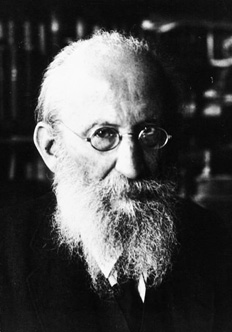
Eduard Bernstein
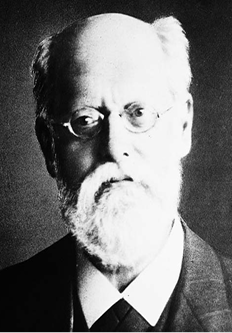
Karl Kautsky