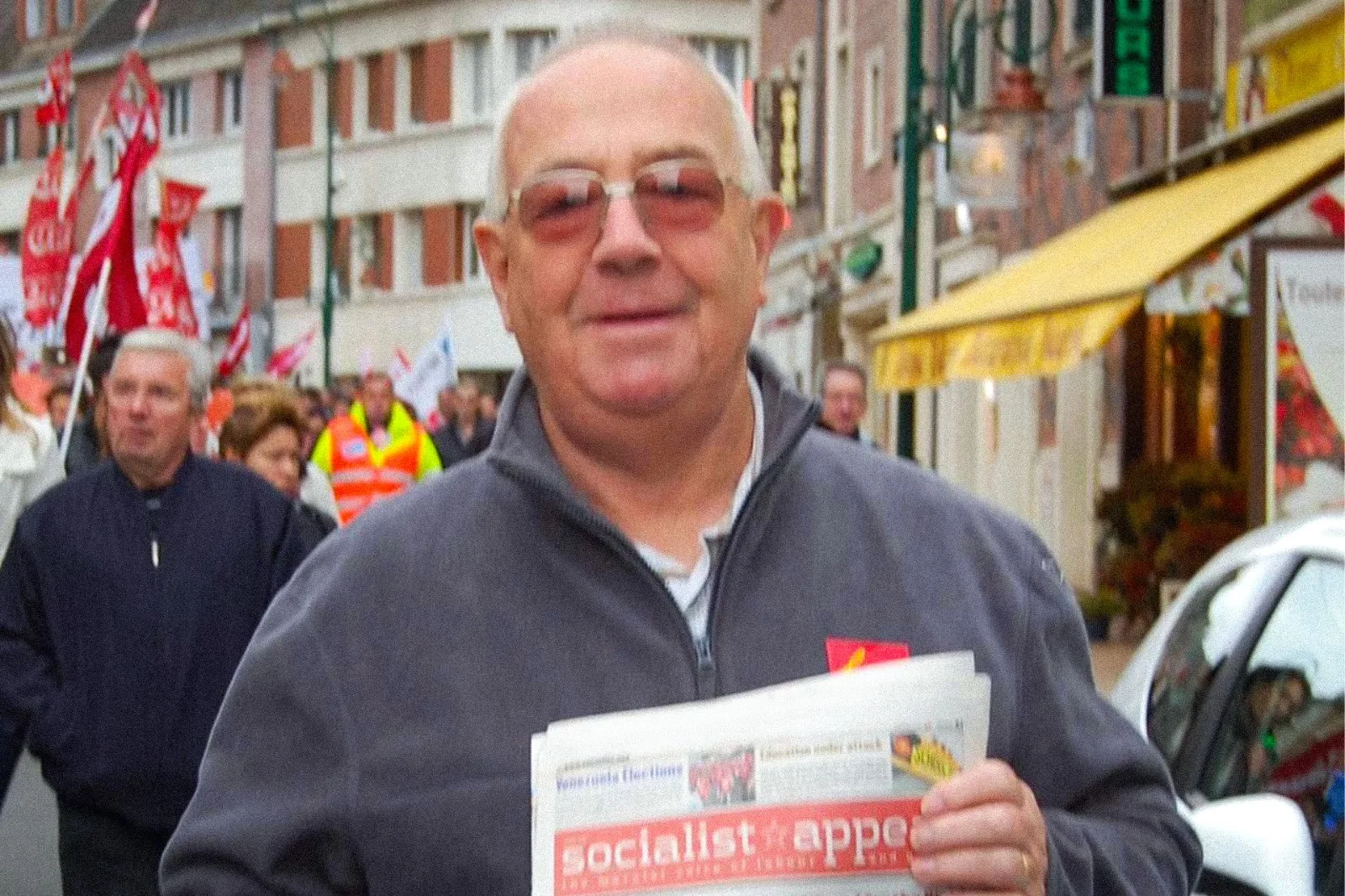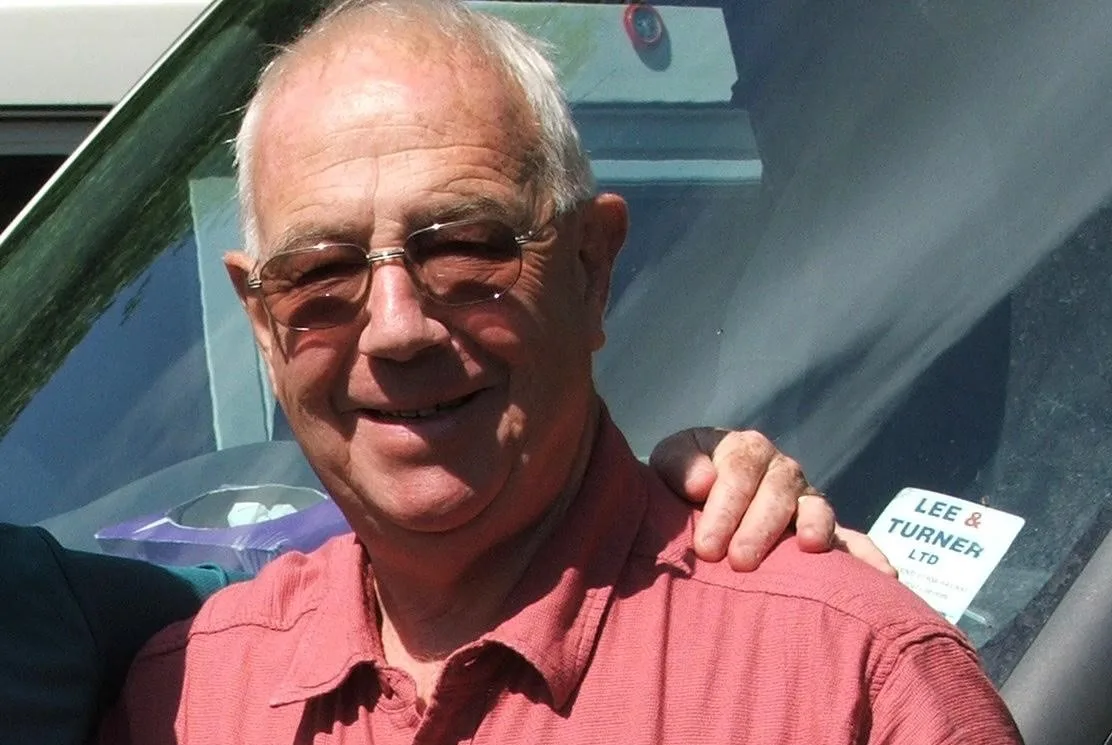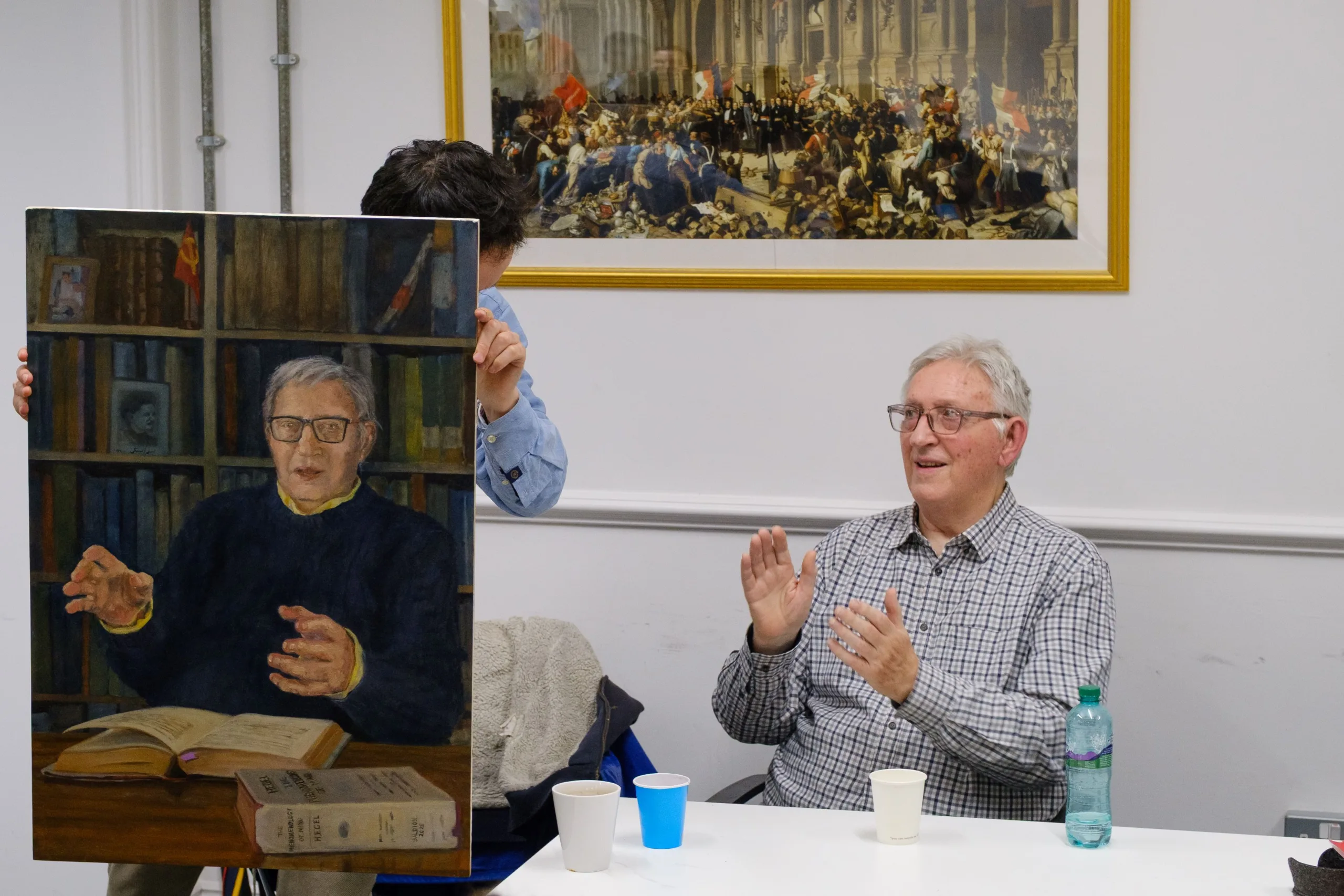
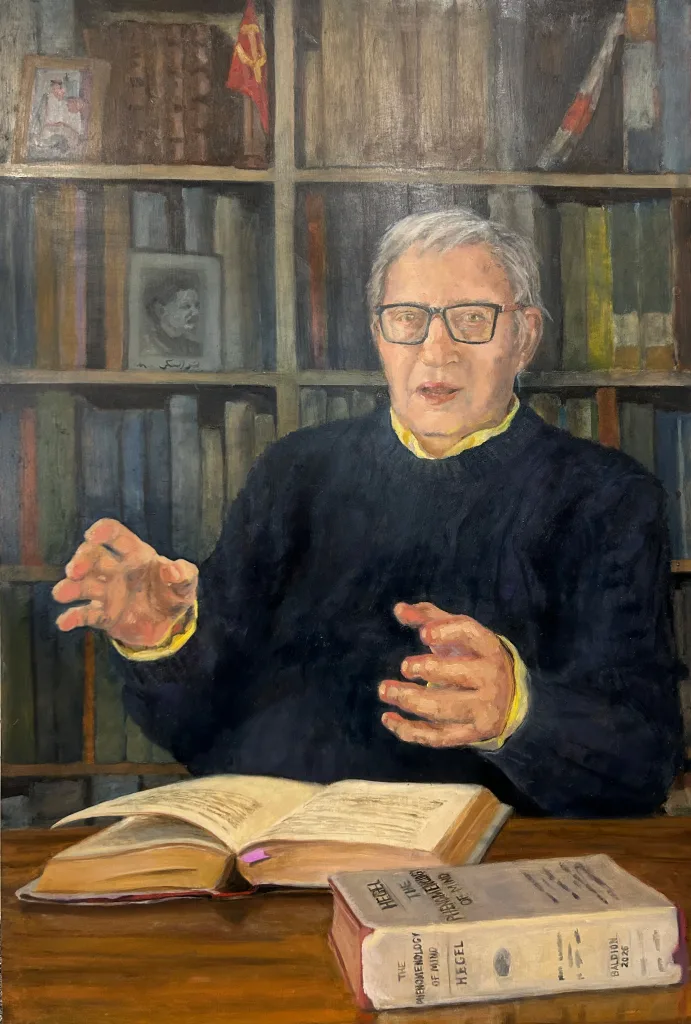
On 23 October, a few dozen comrades of the Revolutionary Communist International gathered in London to celebrate the birthday of Alan Woods, the main theoretician and leading member of the Revolutionary Communist International. On this special occasion, we were proud to unveil a wonderful portrait of Alan at his desk by award-winning communist artist Nico Baldion.
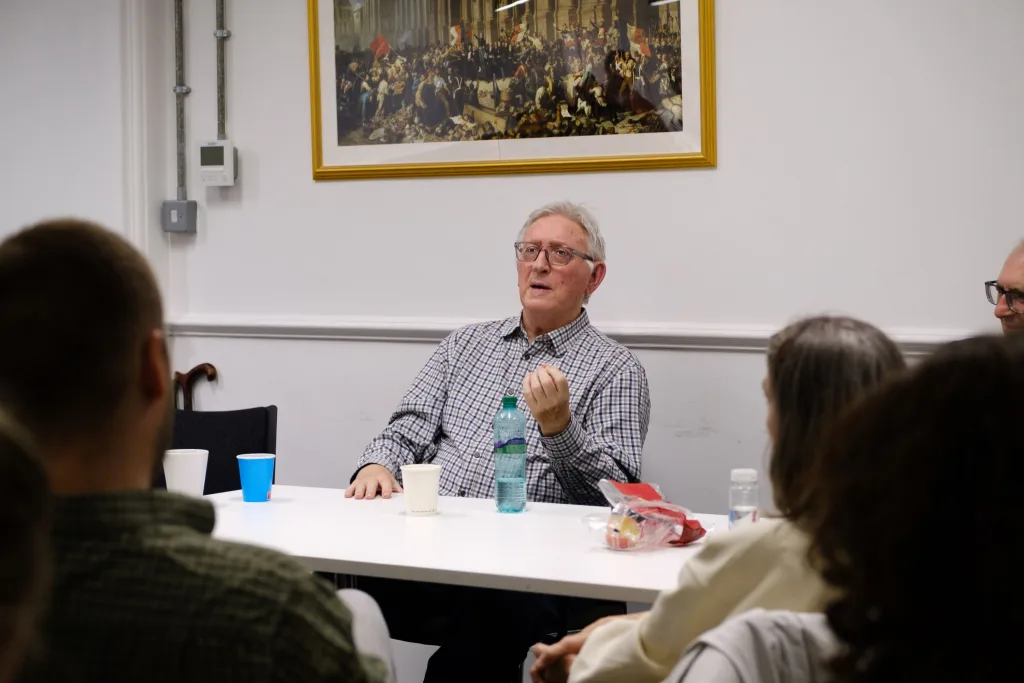
Before the portrait was unveiled, Alan spoke about his more than 60 years fighting for communist ideas, beginning in the 1960s when he joined Ted Grant’s organisation in the difficult conditions at that time.
Born to a family of working-class communists, Alan was committed to the ideas of Marxism very quickly, even getting himself dragged to the headmaster’s office at school for carrying around a copy of Anti-Dühring. In 1962, Alan went to university in Sussex and immediately got to work building the revolutionary party.
At the time, Ted Grant’s group had only a handful of members, numbering no more than 30 not just in Britain but anywhere in the world. When Alan went to university he was the only comrade south of London! As Alan explained: “At the time, we had no money, no full-timers, no office, and even our paper only came out a few times a year”.
These were challenging circumstances, yet Alan was undeterred and set about establishing a firm group of communists at Sussex university. Alan may not have had many resources at his disposal, or much practical experience building an organisation at that time. But with the ideas of Marxism, and above all by involving people, he built a powerful base at Sussex, not just among students but also among workers, and later in Swansea when he returned to Wales.
In reminiscences that were full of lessons and humour, Alan explained how we had gone from a tiny handful, to the powerful and growing International we have today. His advice for the young comrades listening? “Read Marx, Engels, Lenin and Trotsky, and once you have finished with all of that, read Trotsky, Lenin, Engels and Marx”.
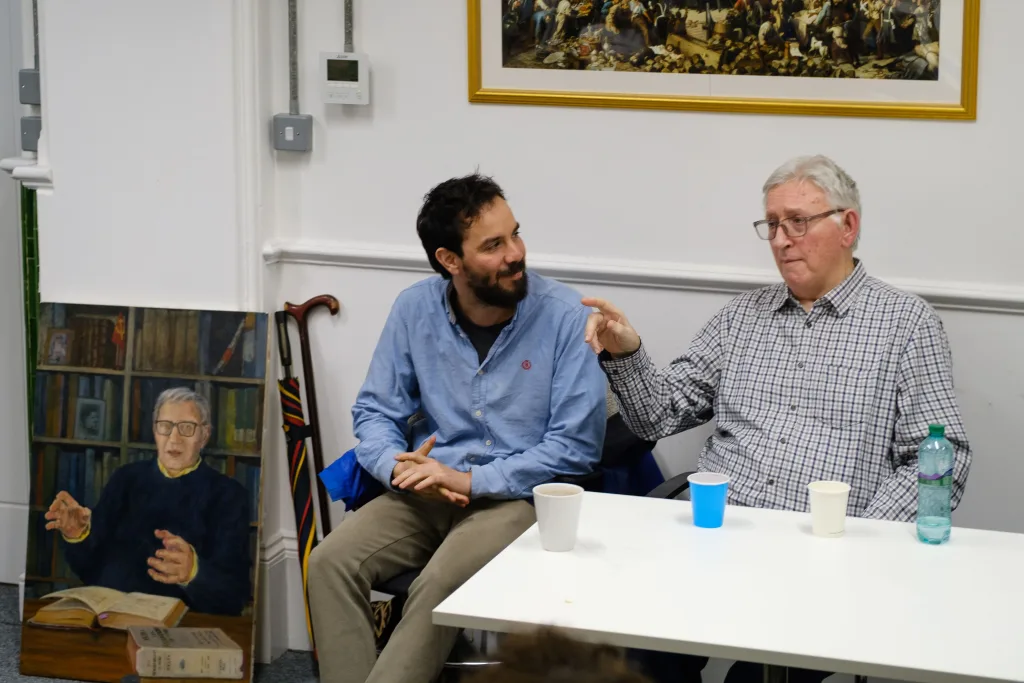
Alan admitted that when he was first approached by Nico with the idea of painting his portrait, he was initially hesitant. But looking at the result, he was by no means sparing in his praise.
The artist, Nico Baldion, is a prize-winning artist, recipient of the John Moores Painting Prize and John Moores Visitors’ Choice prize. While Nico’s paintings are known for their political and social themes – including the 2017 Grenfell disaster and the Spycops scandal in Britain – he is a particularly talented portrait painter.
Depicting Alan in his study, Hegel’s Phenomenology of Mind in the foreground, and bookshelves stacked with the classics of Marxism behind him, the painting captures what gave comrades like Alan and others a sense of certainty to move forward, through all the ups and downs: clear, correct ideas.
Discussing the motivation behind his work as an artist, Nico explained how in ancient Rome, only the Patricians were permitted to get their portrait painted. Today, comrades like Nico wield art as a weapon for the working class, to inspire revolutionaries in the struggle to end class society once and for all. This painting, in particular, is about capturing our history, and the role of Alan and others who have preserved the ideas and delivered them for the new generation to take up.
Post Scriptum
Incidentally, we were not the only ones to mark Alan’s 82nd birthday. The page, History of Wales, marked Alan’s 82nd birthday as a native son of Wales, with the following post:
“Born on this day 1944 in Swansea, Alan Woods – Author and Trotskyist political theorist, dubbed by the press as former Venezualan [sic] president Hugo Chavez’s right-hand man.
“Woods became interested in Marxism as a teenager and studied Russian at University in Brighton, Sofia in Bulgaria and Moscow. He went to Spain in the 1970s to join the struggle against the Francisco Franco dictatorship and on his return became a leading figure of the Militant tendency in Britain in the 1970s and 1980s.
“Woods, who speaks many languages, including Russian, Italian, Spanish, French and German, has often spoken in support of the former Venezuelan president Hugo Chávez who he met several times. When Chavez announced on TV that he was reading in great detail ‘Reform or Revolution’, which was written by Woods, it led to speculation that he was a principal adviser to the president.”
The idea that Alan was Chávez’s advisor was obviously a false story cooked up by the right in Venezuela. Alan nevertheless had an excellent relationship with the late revolutionary and president of Venezuela, and had an influence on his thinking. Alan himself relates those interesting encounters in his tribute to Chávez written in 2013.