The reparations became an impossible burden on the economy. In January 1923 Germany defaulted on the payments. Within days, the French General Degoutte, at the head of 60,000 troops was dispatched by the French Prime Minister Poincaré to occupy the Ruhr. In that industrial heartland of Germany was concentrated 80 percent of her steel and 71 percent of her coal production.
National revulsion spread like wildfire throughout Germany at the French occupation: half a million people demonstrated in Berlin alone. The government, under pressure from below, organized a campaign of “passive resistance”. Workers in the Ruhr were asked not to cooperate with the French, and to make the occupation as difficult as possible. Measures of resistance, strikes, go-slows and sabotage, slowed down the French, who resorted to 10,000 expulsions in the first six month period of 1923. A wave of militancy gripped the towns of central Germany as inflation gave way to hyperinflation. Living standards were cut to the bone, as the industrialists Thyssen, Krupp and Stinnes accrued greater and greater profits. Stinnes bought up a vast industrial empire on credit that was later repaid with worthless paper marks. Rubbing his hands, he argued forcefully that “the weapon of inflation would have to be used in the future too… ”
The price of a single loaf of bread in Berlin escalated from 0.63 marks in 1918 to 250 marks in January 1923. Then prices rose astronomically – a loaf was now 3465 marks in July, 1.5 million in September, reaching a peak of 201 billion marks in November 1923!
Boxfuls of worthless money were required to buy the basic necessities, as workers dashed off as soon as they were paid before their wages became worthless. Million-mark notes were used to paper walls. As one commentator explained, “An object which had been previously worth 24 cents now cost a sum which would formally have equalled three times the entire wealth of Germany!” By mid-1923, the Reichsbank was using 300 paper factories and 150 printing firms to supply Germany with the necessary money. Those on fixed incomes literally starved. The German petty-bourgeoisie was in absolute turmoil and looked desperately to the labour movement for a way out of the situation.
The struggle that had begun as one of national resistance against the French turned into the fiercest class struggle that Germany has ever seen. 53,000 Krupp workers at Essen, on 31 March, attempted to stop French troops requisitioning lorries carrying food supplies. The incident resulted in 13 dead and 40 wounded. On 13 April, at Mulheim, the workers seized the town hall, established a workers’ council and attempted to organize a workers’ militia.
In May a huge strike wave swept across the country demanding the overthrow of the Cuno government. More and more the German workers began to look to the Communist Party for a lead. All the conditions for revolution were now rapidly crystallizing in Germany. Unfortunately the KPD lagged way behind the situation. Radek, speaking at a meeting of the German Central Committee in May stated:
Today we are not in a position to establish the proletarian dictatorship because the precondition is missing, the revolutionary will amongst the majority of the proletarians!
By August, inflation accelerated to an incredible degree. Prices were now doubling every few hours. Spontaneous strike movements, numbering roughly three million, culminated in an all-out general strike which began in Berlin and spread throughout the country. Its generalized aim became the overthrow of the Cuno government which epitomized all that was rotten. Apart from the movement against the Kapp putsch, this strike was the largest and most intense ever experienced in Germany. Whereas in March 1920 the trade union leaders called for strike action, now it arose spontaneously. Out of utter desperation hundreds of thousands drifted away from the Social Democrats towards the KPD. On 12 August the Cuno government resigned. The Communist leaders could no longer ignore the political situation that was developing. By the end of the month they were summoned to Moscow to discuss the new turn in the situation. Meanwhile the party’s leading theoretician, Thaelheimer, was still talking of “a long road”.
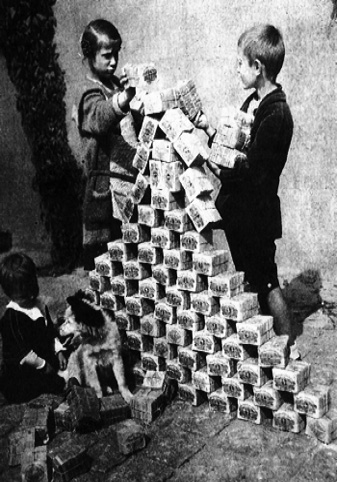
German marks were worth so little in 1923 that these children were using them as building blocks.
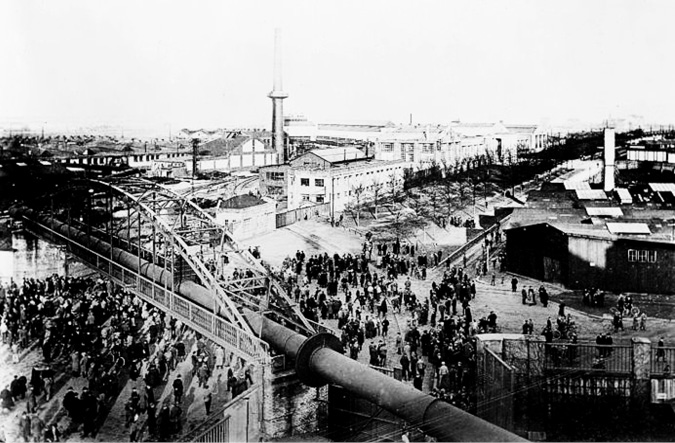
German workers remain outside the Rhine Metalworks, having shut them down in response to French occupation of the Ruhr, 1923.