This chapter describes the so-called peasant Soviets created by the CCP as it retreated from the cities. The Stalinist nature of the CCP dominated the character of these Soviets from their start. The political and organisational structures supposedly for the self-rule of the peasants by the peasants were, in fact, forced on the local populations by a Communist Party which was, in effect, an invading and occupying force, although a benign one. These so-called Soviets were set up in the most backward and isolated areas and had little or no basis in the experiences of the peasants involved.[1]
At all times the needs of the Red Army and the CCP overrode the wishes of the indigenous peasants and ultimately the Red Army would march out leaving them to the tender mercies of Chiang Kai-shek. Nevertheless, the Soviets did become popular with the middle and poor peasants and even amongst many rich peasants.
The KMT bandit extermination campaigns are presented in so far as they reflected the balance of power in China between Chiang Kai-shek and the CCP, forced the Communists to quit their major base in Jiangxi, and commence the Long March. The destruction of the Jiangxi ‘Soviet Republic’ and the flight of the Communists was both a military and political defeat for the CCP. It was the end of the first attempt to establish a revolutionary power based exclusively upon peasant rebellion. However, the idea that Soviet power could be transported in the baggage train of the Red Army from Jiangxi to Yenan was totally bureaucratic and one further step in dissolving the socialist revolution into peasant revolt.
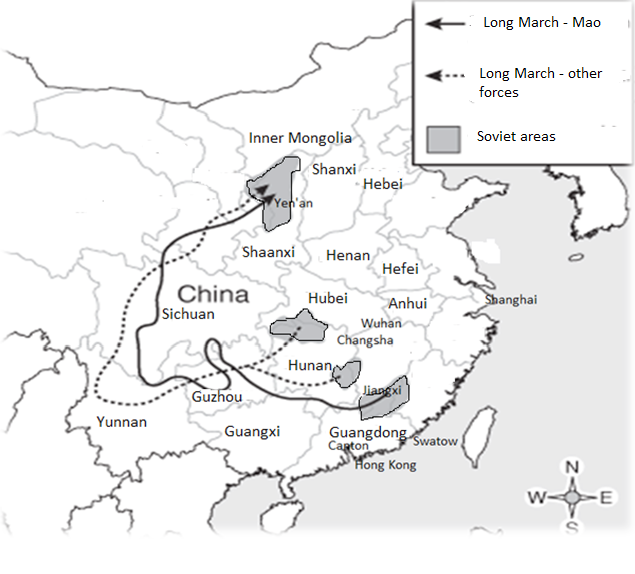
Map of China – showing major Soviet areas remaining after the 4th
“bandit extermination campaign”, at start of Long March (1934-35)
NOTE: Areas of the Soviets are not to scale
The CCP, in true Stalinist manner, has re-written its history to iron out the wrinkles, give it linearity and continuity, and place an omniscient Mao in the lead role. As the bureaucracy became more established as an independent factor and gathered to itself more power over the organisation, it increasingly required its own ‘pope’ to resolve disputes that arose from the inevitable conflict of interest between individuals and groups within the bureaucracy. The very nature of bureaucracy means it cannot submit such disputes to the democratic process of discussion and action by the masses without endangering its own existence.
The official history presents Mao taking the helm at the Tsunyi conference (15-17 January 1935, soon after the start of the Long March) at which the brilliance of his military strategy won the day, and after which he was always right and the undisputed leader of the CCP, ousting the 28 Bolsheviks who had led the Party almost to extinction. This re-writing began in 1945 when Mao Zedong presented the Resolution on Some Questions in the History of Our Party to the CC. This document re-wrote Party history to present the defeats of the CCP as due to the opportunism of Chen Duxiu, and the left adventurism of Ch’u Ch’iu-pai, Li Lisan, and Wang Ming.[2] Nowhere does Mao rebuke the architect of CCP policies, Joseph Stalin, because Mao accepted Socialism in One Country, the theory of stages, the bloc of four classes, and the bureaucratic structure that allowed Stalin to force his strategies onto the CCP.
At the end of the Long March, the Communists would arrive in Shensi province, an area which many considered to be outside China proper. The final stages of the Long March coincided with the 7th World Congress of the CI and the launch of the Popular Front strategy. This meant an about turn for the CCP, leaving ultra-leftism behind and returning to class collaborationist policies. The CCP’s base area would be declared a special administrative region of the KMT and not a Soviet, and its social policies would be limited accordingly.