To all intents and purposes, the insurrection had triumphed. The only goal that had not yet been achieved was the taking of the Winter Palace, which remained in the hands of forces loyal to the government. Lenin, who had hoped that the uprising would all be over before the opening of the Congress of Soviets, displayed his impatience at the delay, which was caused by the inexperience of the insurrectionists. The political preparations for the uprising had been carried out with far greater professionalism than the technical side, which was far from perfect. There were many organisational defects. Troops arrived late because a locomotive had burst its pipes, the shells for the assault cannon proved to be the wrong size, they could not find a red lantern to signal the start of the attack, and so on. But in the end, none of this was decisive. Such anecdotes belong to the category of historical accidents. What was decisive was the winning over of the masses which left the Provisional Government isolated and defenceless in the moment of truth. Thus, although there were originally 3,000 defenders inside the Winter Palace, they just melted away in the course of the night. The real situation was understood by the commanding officers inside. A council of war was convened, at which Admiral Verderevsky made the most pertinent observation: “I don’t know why this session was called,” he said. “We have no tangible military force and consequently are incapable of taking any action whatever.”
The taking of the Winter Palace was a bloodless affair, more akin to a police operation. When warning shots were fired from the cruiser Aurora, the garrison simply melted away into the night. The Right SR Minister of Agriculture, Semyon Maslov, rang the Duma in a state of despair:
The democracy sent us into the Provisional Government; we didn’t want the appointments, but we went. Yet now, when tragedy has struck, when we are being shot, we are not supported by anyone. (A. Rabinowitch, The Bolsheviks Come to Power, p. 284 and p. 290, my emphasis.)
When the assault was finally launched, there was no resistance. At about 2 a.m., while the tired and demoralised members of the Provisional Government waited around the table, the door burst open and, in the words of one of those present:
A little man flew into the room, like a chip tossed by a wave, under the pressure of the mob which poured in and spread at once, like water filling all corners of the room.
The little man was Antonov-Ovseyenko of the Military Revolutionary Committee. “The Provisional Government is here – what do you want?” asked the Minister Konovalov. “You are all under arrest,” came the peremptory reply.
The start of the Congress of Soviets had been scheduled for 2 p.m., but was delayed, finally opening its doors at 10.40 p.m., while the siege of the Winter Palace was still in progress. The debates were occasionally punctuated by the sound of gunfire. Inside the Congress, a dramatic scene was being played out.
It had been a momentous session. In the name of the Military Revolutionary Committee Trotsky had declared that the Provisional Government no longer existed.
“The characteristic of bourgeois governments,” he said, “is to deceive the people. We, the Soviets of Workers’, Soldiers’, and Peasants’ Deputies, are going to try an experiment unique in history; we are going to found a power which will have no other aim but to satisfy the needs of the soldiers, workers, and peasants.”
The voting strength at the Congress gave the Bolsheviks and their Left SR allies a clear majority. Out of a total of 670 delegates, there were 300 Bolsheviks, 193 SRs – of whom more than half were Lefts – and 82 Mensheviks – of whom 14 were Internationalists. As we have seen, the Bolsheviks had a crushing domination in the key industrial centres in the north and west. And their support was still growing. The congress opened with the election of the Soviet presidium. The Bolsheviks presented a joint slate with the Left SRs and Menshevik Internationalists. The result was: 14 Bolsheviks, 7 SRs, and four Mensheviks. However, the latter refused to take the seats allocated to them. The overwhelming majority of the Congress voted for the formation of a Soviet government.
The indignation of the Mensheviks and SRs knew no bounds. When Trotsky announced that the insurrection had triumphed, that troops loyal to the Provisional Government were advancing against Petrograd, and that a delegation must be sent to them to tell them the truth, there were howls of “You are anticipating the will of the Congress of Soviets!” But the time for formal niceties was long past. Trotsky answered coldly: “The will of the All-Russian Congress of Soviets has been anticipated by the rising of the Petrograd workers and soldiers.”
The Mensheviks and SRs were not alone in their opposition to the uprising. Even at this late hour, the Bolshevik Conciliators were still against taking power. John Reed reports a momentary encounter with Ryazanov, the vice chairman of the trade unions, “looking black and biting his grey beard. ‘It’s insane! Insane!’ he shouted. ‘The European working class won’t move! All Russia – He waved his hand distractedly and ran off.” Martov, now a very sick man, maintained his vacillations right to the end. Lenin’s hopes that he would at last find his way to the revolutionary camp proved futile. Martov insisted on the formation of a coalition government with the right-wing socialist leaders “in order to prevent civil war”. This proposal would, in effect, have nullified the insurrection and put the clock back to where it had been before. Such an outcome was unthinkable. Lenin and Trotsky were both against it, but the conciliators were in favour. On behalf of the Bolshevik contingent, Lunacharsky announced that he had nothing against the proposal, which was actually passed. But the Mensheviks immediately revealed the complete hollowness of the proposal by denouncing the overthrow of the Provisional Government, and walking out of the Congress. As they walked out, in the midst of jeers and whistles from the delegates, Trotsky’s voice thundered after them:
All these so-called Socialist compromisers, these frightened Mensheviki, Socialist Revolutionaries, Bund – let them go! They are just so much refuse which will be swept into the garbage-heap of history! (J. Reed, Ten Days That Shook the World, pp. 122-23, p. 123 and p. 131.)
The victory of the insurrection was not the final episode of the Bolshevik Revolution. The forces of reaction rallied and attempted a counter-attack which was defeated. Then a bloody civil war was unleashed against the Bolsheviks that lasted another four years. In this conflict the Soviet power was confronted with the might of world imperialism in the shape of 21 foreign armies of intervention. At one point, all the territory that remained in the hands of the Bolsheviks was the area around Moscow and Petrograd – approximately equivalent to the old Muscovy. Yet one by one the enemies of the revolution were thrown back. From the shattered remnants of the old tsarist army Trotsky fashioned a new proletarian force, the Red Army, which astonished the world with its victories. The heroism, organisation, and discipline of the Red Army were the key to victory, but it could never have succeeded without the internationalist appeal of the Bolshevik Revolution. Through the medium of the Communist International, Lenin and Trotsky issued an appeal to the workers of the world, which was taken up with enthusiasm. The British dockers refused to load arms ships bound to counter-revolutionary Poland. There were mutinies in every one of the armies dispatched against the Bolsheviks. Against all expectations, the Soviet power survived to show the world for the first time that it is possible to run society without private capitalists, bankers, and landowners. It is true that, under conditions of terrible economic and cultural backwardness, the Russian Revolution suffered a process of bureaucratic degeneration. But not before it had provided a spectacular proof of the tremendous potential of a nationalised planned economy.
The historic ascent of humanity taken as a whole, may be summarised as a succession of victories of consciousness over blind forces – in nature, in society, in man himself. Critical and creative thought can boast of its greatest victories up to now in the struggle with nature. The physico-chemical sciences have already reached a point where man is clearly about to become master of matter. But social relations are still forming in the manner of the coral islands. Parliamentarism illumined only the surface of society, and even that with a rather artificial light. In comparison with monarchy and other heirlooms from the cannibals and cave-dwellers, democracy is of course a great conquest, but it leaves the blind play of forces in the social relations of men untouched. It was against this deeper sphere of the unconscious that the October Revolution was the first to raise its hand. The Soviet system wishes to bring aim and plan into the very basis of society, where up to now only accumulated consequences have reigned. (L. Trotsky, The History of the Russian Revolution, p. 1191.)
We will leave the final word to a great revolutionary who has too often been falsely portrayed as an implacable opponent of Lenin and Bolshevism. From her prison cell in Germany, Rosa Luxemburg greeted the October Revolution with the following words:
Only a party which knows how to lead, that is, to advance things, wins support in stormy times. The determination with which, at the decisive moment, Lenin and his comrades offered the only solution which could advance things (‘all power in the hands of the proletariat and peasantry’), transformed them almost overnight from a persecuted, slandered, outlawed minority whose leader had to hide like Marat in cellars, into the absolute master of the situation.
Moreover, the Bolsheviks immediately set as the aim of this seizure of power a complete, far-reaching revolutionary programme: not the safeguarding of bourgeois democracy, but a dictatorship of the proletariat for the purpose of realising socialism. Thereby they won for themselves the imperishable historic distinction of having for the first time proclaimed the final aim of socialism as the direct programme of practical politics.
Whatever a party could offer of courage, revolutionary far-sightedness and consistency in a historic hour, Lenin, Trotsky and the other comrades have given in good measure. All the revolutionary honour and capacity which Western Social Democracy lacked was represented by the Bolsheviks. Their October uprising was not only the actual salvation of the Russian Revolution; it was also the salvation of the honour of international socialism.
Rosa Luxemburg’s final judgement on the Bolshevik Party can stand as the last word of the history of the greatest revolutionary party in history:
What is in order is to distinguish the essential from the non-essential, the kernel from the accidental excrescences in the policies of the Bolsheviks. In the present period, when we face decisive final struggles in all the world, the most important problem of socialism was and is the burning question of our time. It is not a matter of this or that secondary question of tactics, but of the capacity for action of the proletariat, the strength to act, the will to power of socialism as such. In this, Lenin and Trotsky and their friends were the first, those who went ahead as an example to the proletariat of the world; they are still the only ones up to now who can cry with Hutten: “I have dared!”
This is the essential and enduring in Bolshevik policy. In this sense theirs is the immortal historical service of having marched at the head of the international proletariat with the conquest of political power and the practical placing of the problem of the realisation of socialism, and of having advanced mightily the settlement of the score between capital and labour in the entire world. In Russia the problem could only be posed. It could not be solved in Russia. And in this sense, the future everywhere belongs to ‘Bolshevism’. (R. Luxemburg, The Russian Revolution, pp. 39-40 and p. 80.)
Endnotes
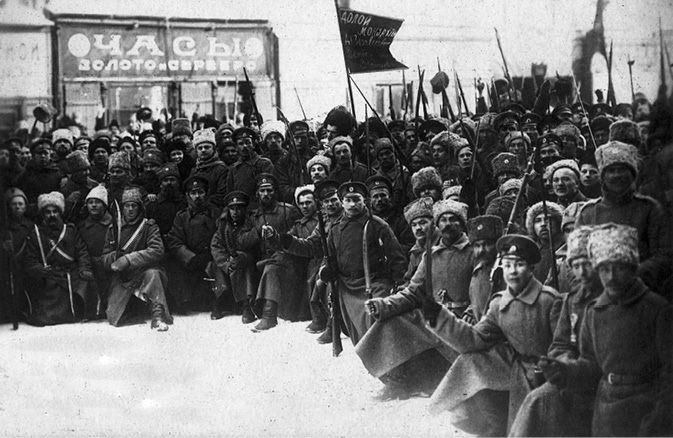
30. Troops pose for the camera on the Liteiny Prospekt, Petrograd, during the first days of the February Revolution. Their flag reads “Down with the Monarchy – Long Live the Democratic Republic”.
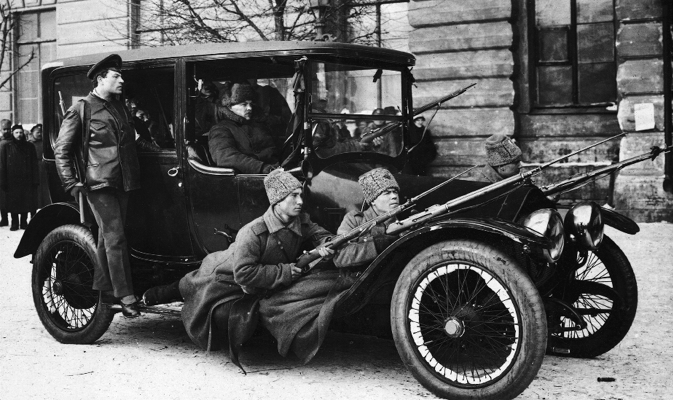
31. The People’s Militia on patrol during the first days of the February Revolution in Petrograd 1917.
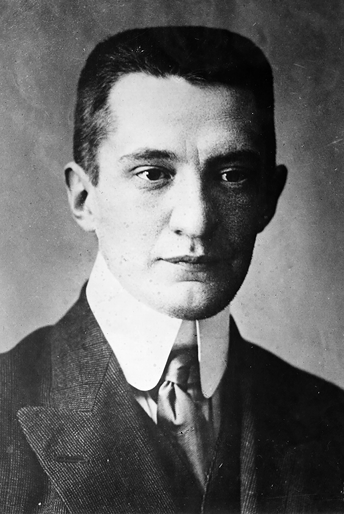
32. Alexander Kerensky.
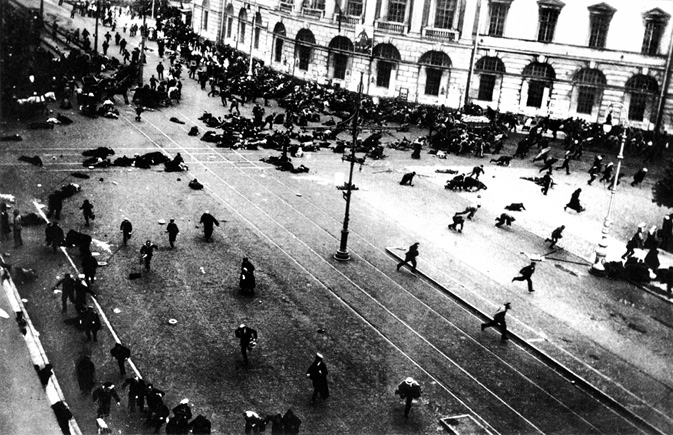
33. Provisional Government troops open fire on a peaceful demonstration on the Nevsky Prospekt during the ‘July Days’.
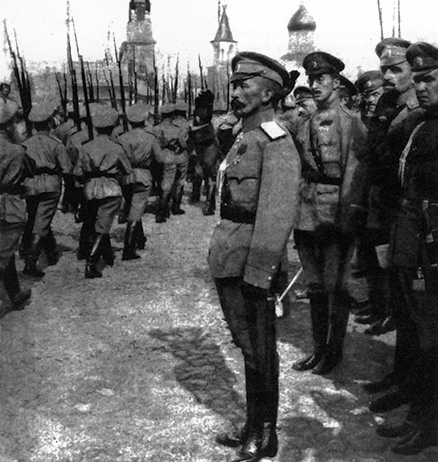
34. General Lavr Kornilov, 1917.
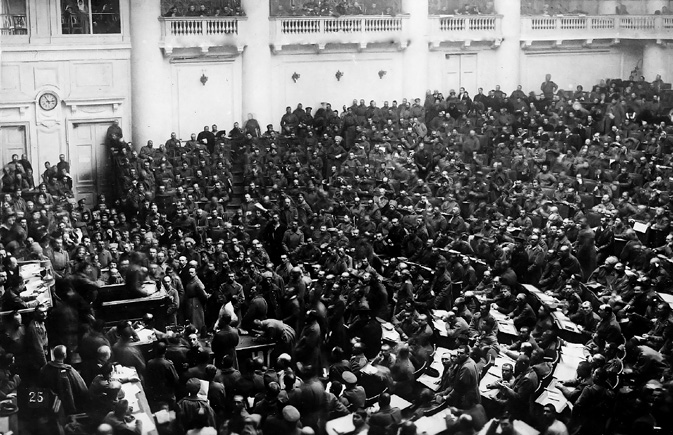
35. Assembly of the Petrograd Soviet, 1917.
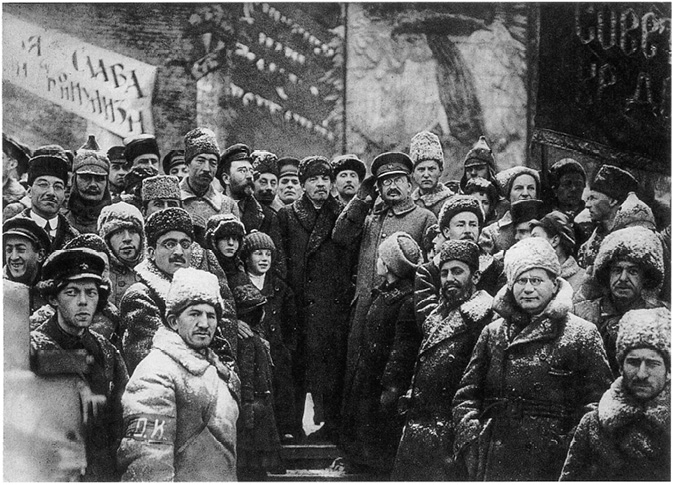
36. Lenin and Trotsky in Moscow on the second anniversary of the Revolution, November 1919.