In Berlin in early January, there existed a state of crisis. The three USPD ministers had just resigned from the government. Fears of a coup had begun to circulate, the campaign by the extreme right against the Spartacists was in full swing, and an anxious and frustrated mood began to develop amongst the advanced workers. After its formation, the Communist Party of Germany began to conduct a relentless campaign against the Social Democratic Government and for the need to extend and complete the socialist revolution. Reaction, in league with the right-wing ministers, was preparing a bloody showdown with the Spartacists and the ranks of the Independents in order to strike a decisive blow against the revolution and prepare the way for the restoration of the old order.
In 1925 General Groener, at a trial in Munich, described the plot hatched between the general staff and Ebert and Noske: “On 29 December Ebert summoned Noske to lead the troops against the Spartacists. On that same day the volunteer corps assembled, and everything was now ready for the opening of hostilities.” Again, General Georg Maercker’s memoirs recorded: “In the very first days of January a meeting attended by Noske, who had just returned from Kiel, took place at General Staff Headquarters in Berlin with the Freikorps leaders concerning the details of the march (into Berlin).” Gustav Noske, who, on January 6, had assumed the title of “People’s Commissar of Defence”, answered the call to deal with the Berlin workers with the words: “One of us has to be the bloodhound.” Noske was to relish this new-found role.
At the end of December a price of 10,000 German marks had been put on the head of Karl Radek, the Bolshevik representative in Germany, by the Anti-Bolshevik League. At the same time a campaign of denigration was carried out against Emil Eichhorn, the police president of Berlin and a member of the USPD. He had organized a new “left” police force of 2000 workers and soldiers. The action against this man was to be used as the provocation to force the Spartacists, the ranks of the USPD and the Berlin workers into premature action. On 3 January, after a series of false charges, Eichhorn was called upon by the Ministry of the Interior to resign. The right-wing Social Democrat, Eugen Ernst, was to be appointed in his place. As expected, Eichhorn refused to budge.
At the time of this provocation, the Berlin Executive of the USPD, which was in discussions with the Revolutionary Shop Stewards, immediately adopted a resolution supporting Eichhorn. They then met with KPD leaders to discuss joint action. With the refusal of the government to back down, the USPD Executive in Berlin, together with the Revolutionary Shop Stewards and the KPD, called for a mass demonstration on 5 January. This resulted in hundreds of thousands of workers marching to police headquarters. A “Revolutionary Committee” was established representing the Berlin USPD, the KPD and the Revolutionary Shop Stewards. They were informed that the Berlin garrison was supporting their stand and that they could rely on military assistance from Spandau and Frankfurt. The Committee therefore decided, given their apparent support, to resist the dismissal and use the opportunity to attempt the overthrow of the Ebert-Noske-Scheidemann government.
In December groups of revolutionary workers had occupied the editorial offices of Vorwaerts, the journal of the SPD. They had been persuaded to leave, but now, once again, the suggestion was made of a further occupation. After accomplishing this, other important news printing offices were also occupied. The next day, 500,000 workers took to the streets, as many large factories went on strike. Further demonstrations were called by the Revolutionary Committee, which then went into permanent session, but without plans or detailed strategy of how their aims could be met.
The workers not only occupied the Vorwaerts and the press quarters, but also the Reich printing office, the railway headquarters, food warehouses and other buildings. Even the Reichstag was occupied for a brief period. Noske later wrote:
Great masses of workers…answered the call to struggle. Their favourite slogan ‘Down, down, down’ (with the government) resounded once more. I had to cross the procession at the Brandenburg Gate, in the Tiergarten, and again in front of general staff headquarters. Many marchers were armed. Several trucks with machine guns stood at the Siegessaule. Repeatedly, I politely asked to be allowed to pass, as I had an urgent errand. Obligingly, they allowed me to cross through. If the crowds had had determined, conscious leaders, instead of windbags, by noon that day Berlin would have been in their hands.
The official position of the KPD at this time was against an attempt to overthrow the Social Democratic government. Given the balance of forces nationally such an action would be a pure adventure. But the general tone of the KPD newspaper Rote Fahne was full of attacks on the government and urged the workers to take action. The two KPD representatives on the committee, Karl Liebknecht and Wilhelm Pieck, without the party’s authority, backed the resolution supporting insurrection. Liebknecht was a workers’ leader, a man of action captivated by the mass movement. For him the revolution was a gut reaction. He was no theoretician, and lacked a firm understanding of the tactics and strategy that were needed to carry through a successful revolution. The “Revolutionary Committee” had endless discussions, but failed to give any coherent direction to the mass movement, which began to dissipate. This prolonged vacillation and indecision had catastrophic consequences in confusing and disorienting the proletariat.
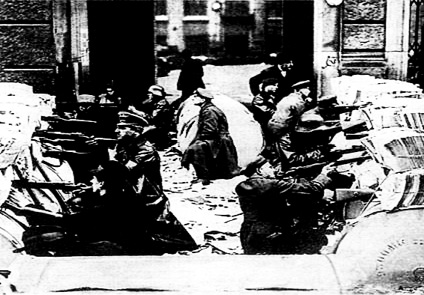
Spartacists defending their position during the January 1919 uprising, with a makeshift barricade made out of newspapers.