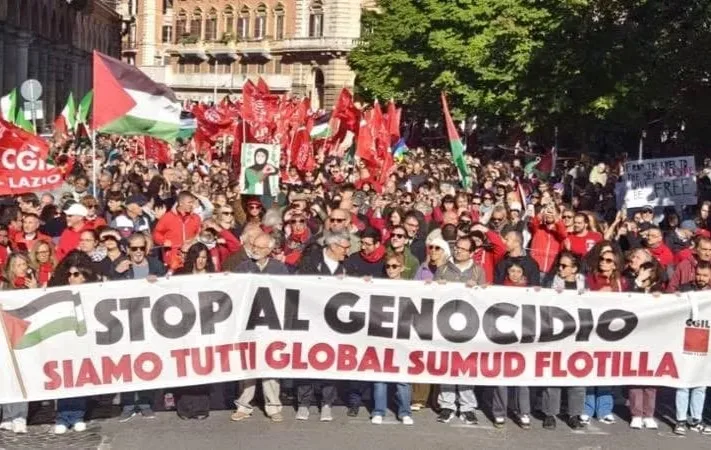
The mood of anger among school students and the youth in general that we have seen in France – and Spain and many other countries – has affected Italy big time. Huge protests have taken place over the last few weeks.
The situation is building up towards a general strike called by the USB union for 30 October. Later, there will be the 20 November general strike, called by the larger CGIL union confederation for the same day as the European-wide youth protest against militarisation.
The article we are publishing below is about the intervention of the young comrades of the PCR, Partito Comunista Rivoluzionario – the Italian section of the RCI – in Bologna on 24 October. It is important to understand the background to what happened on that day.
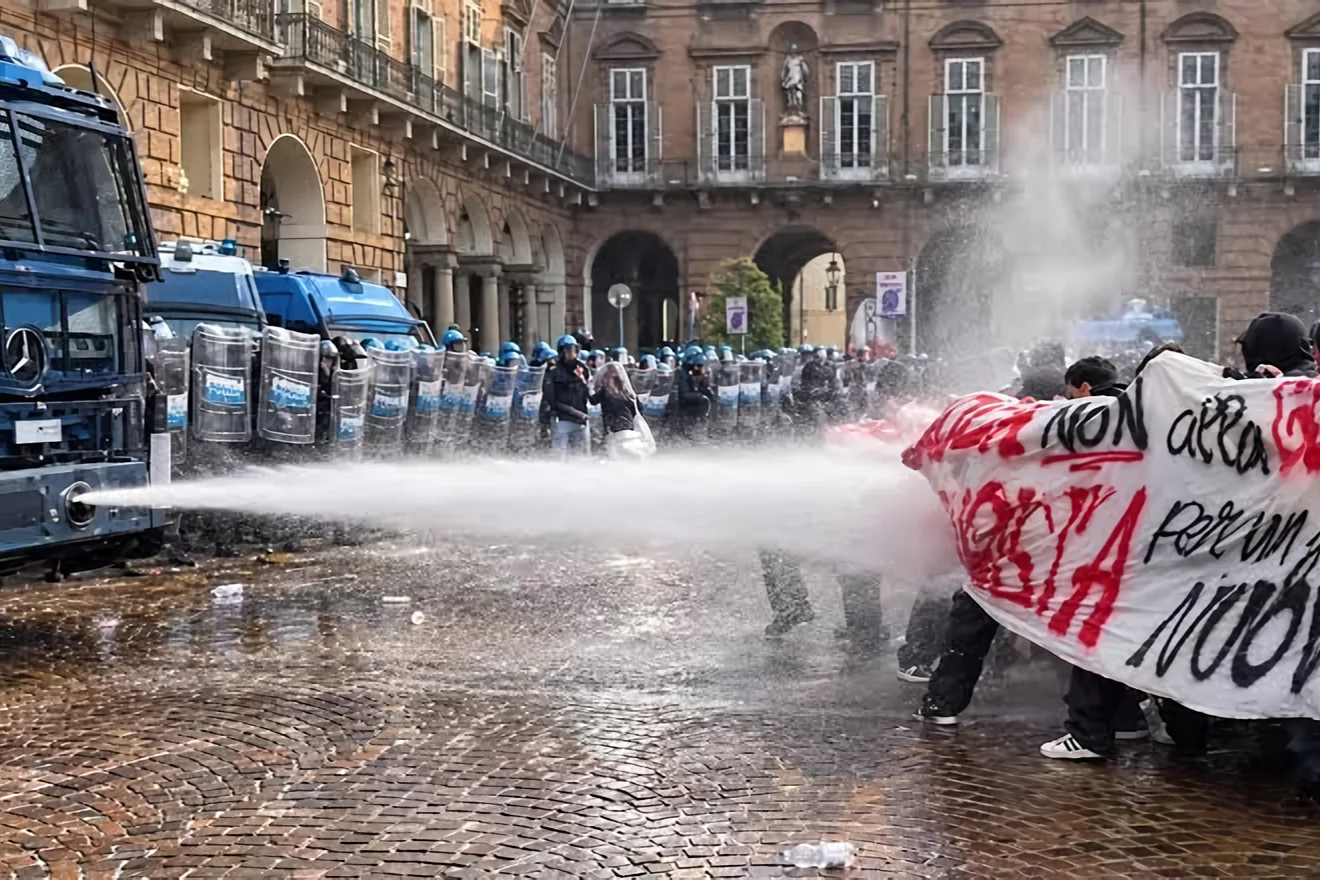
On 16 October, there were widespread protests all over Italy, with up to half a million school students protesting in dozens of cities. This was followed by protests the next day on 17 October, which led to violent clashes with the police in Turin, Milan, Rome, and Bologna.
The police used heavy-handed and brutal methods in an attempt to crush and intimidate the youth, many of whom were stopped and ID’d. Several were arrested.
This is now referred to as ‘M1710’ – the 17 October Movement.
In Milan city centre, towards the end of the protests, clashes broke out which involved a lot of second-generation youth from immigrant families, followed by attacks on some of the more famous luxury shops in the fashion centre of Milan. Since then, the mainstream media have been concentrating all their attention on the breaking of shop windows and the looting that took place.
This is very convenient for the government and the capitalist class that stands behind it. They are consciously using it to distract attention away from the reasons why we are witnessing such an outburst of anger from the youth in Italy.
They don’t have to talk about the decay of the education system due to underfunding; they don’t have to talk about the sky-high rents; the extremely low wages; the unstable job situation; the unemployment; or the lack of any future for the present generation of youth.
It is not surprising that the second generation is particularly angry. The Meloni government, together with the far-right leader of the recently founded Futuro Nazionale party, Vannacci, are constantly blaming immigrants for everything.
Vannacci is very open about ‘remigration’. Whatever problem you want to raise, from the decay of the healthcare system, the decay of the education system, housing, unemployment, there is always one answer: ‘remigration’, i.e. the forced expulsion of millions of immigrant workers and their families.
Schools are in decay? Blame the children of immigrants!
Meloni demagogically raised the idea that in some schools there are too many immigrant children, which she claims brings down standards. She introduced a decree at the end of September that puts a limit of 30 percent on the number of immigrant children per classroom – a truly demagogic gesture.
The total number of children of immigrant families in Italy is 11 percent of the school population, two-thirds of which were born in Italy. And even those who were not born in Italy are growing up in the country and speak perfect Italian.
Immigrant workers – around 2.6 million – in Italy actually generate close to €200 billion – 9.7 percent of GDP – and contribute around €45 billion in tax and social security revenue. They pay more into the system than they take out. They also make up for the significant demographic fall of recent years in Italy. But why let the truth spoil a good story, as the saying goes.
And when brutal police repression provokes an explosion of anger among the youth, all the media concentrate on the ‘violence’. The government introduced another decree – on 20 October – which includes the possibility of arresting protestors and imposing heavy fines and up to five years in prison.
However, the youth are fully aware of the fact that it is the state that is violent – the number of youth brutally manhandled and beaten by the police is testimony to this. It is the ruling class that is violent, with its open support for repressive measures at home while supporting wars abroad and upping its campaign to militarise the country.
In these conditions, class consciousness is making a huge leap towards the idea that the revolutionary overthrow of this rotten system is the only way.
It is in this context that what happened in Bologna on Saturday is of great interest. In the conditions described above, youth gathered in the centre of town to take part in a demonstration.
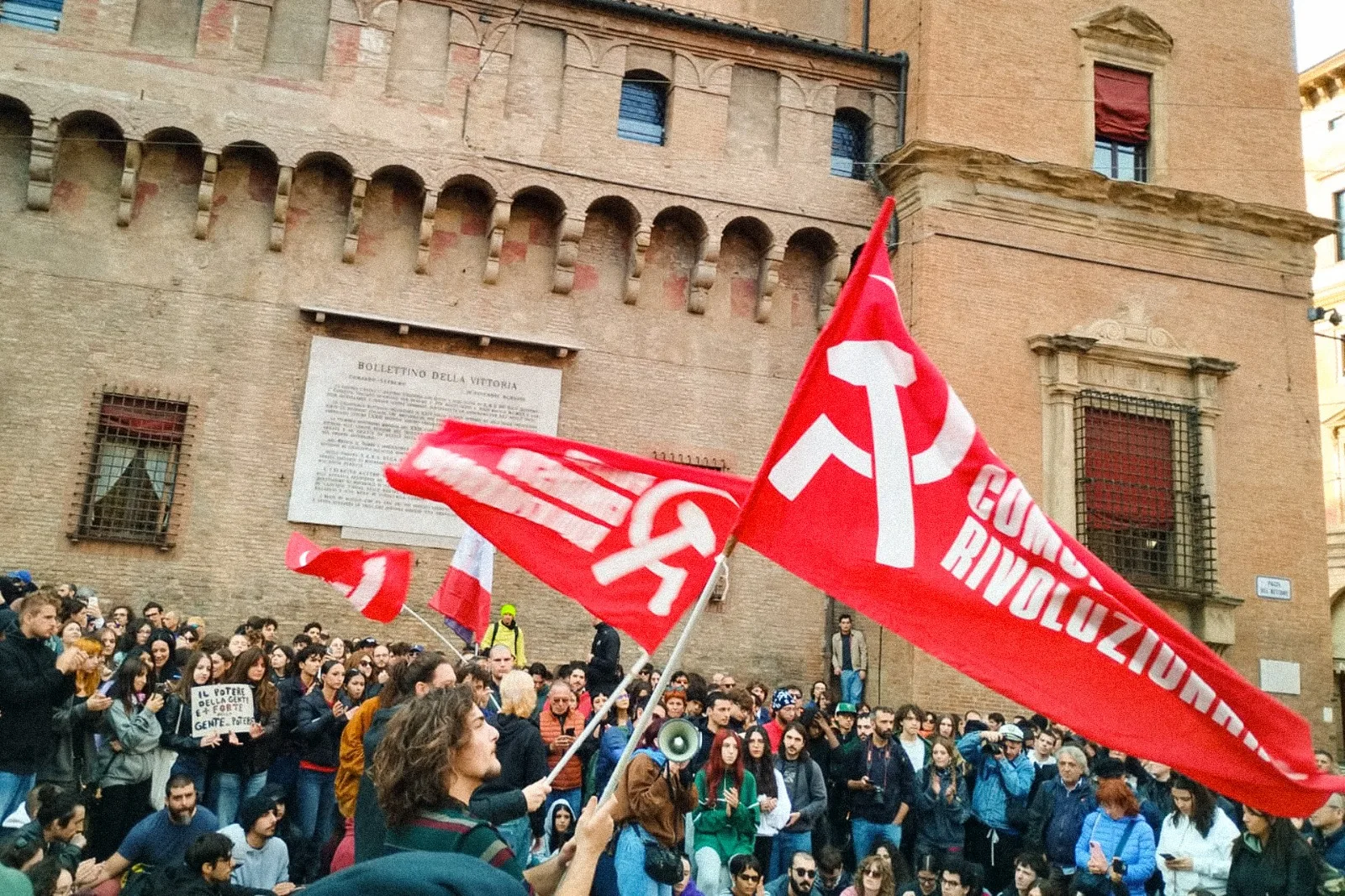
But there was no leadership, no organisers. That is where our young comrades stepped in and organised an impromptu meeting right there in the square to discuss how to move forward. It shows what can be done even with relatively small forces, but with the correct ideas and methods.
Fred Weston
Italy: Revolutionary Communists take centre stage at Bologna demonstrations
Edoardo Bertolino
On Saturday 24 October, hundreds of people took to the streets all across Italy in response to the call for mobilisation promoted on social media.
[Originally published in Italian at rivoluzione.red]
However, in Bologna, the Movimento 17 Ottobre (M1710, an anarchist group which has assumed leadership of the movement since the protests in Milan earlier this month) coordinator had been arrested that morning, and nobody knew where the gathering point would be.
We expected a challenging situation, characterised by heavy state repression. At a time like this, when we are seeing revolutions and mass movements erupting in the heart of Europe, the bourgeoisie would inevitably tremble at such a mobilisation and set its enforcers upon the people.
As we made our way to Piazza Maggiore – where spontaneous marches in the city usually set off – with our flags unfurled, we were stopped numerous times by passers-by keen to join the march; the closer we got, the more the group of people following us grew.
Once we reached the square, the police stopped us to check our identities and discourage us from taking part in the march. Meanwhile, as we spoke to people, the mood in the square became clear: there was a strong desire to fight, but at the same time, confusion, caused by the lack of clear direction.
The events in Bologna confirm once again that a process of radicalisation and the maturation of class consciousness has been taking place behind the scenes. Now it is exploding once more into a movement with enormous potential.
There were nearly a thousand of us, and nobody knew what to do; whether to set off on the march, or where to go. Although we knew we were there to protest against the high cost of living, even the slogans were unknown!
So we gathered everyone together and called a meeting to discuss the slogans and the upcoming general strike on 30 October.
The idea went down well. The thousand people – whose numbers were still growing – formed a circle to listen, and the less shy among them took the floor.
A young man, who looked to be around 25, spoke up, explaining that he was not a communist, but that he recognised that the economic difficulties he faced stemmed from the current system and that something had to be done.
The struggle against the right wing, against capitalism, and the need to organise, as well as the need to unite student struggles with those of the workers, were at the heart of the debate. Slogans we put forward on these topics were the most appreciated by the demonstrators. All this made the Revolutionary Communist Party a point of reference for those present. The chants were clear: ‘Meloni government, resign!’
We issued a final appeal to take to the streets on 30 October, with a procession led by a banner with slogans demanding Meloni’s resignation and a stand against capitalism and the government’s repressive laws.
Subsequently, the arrival of a small procession from the university area interrupted the rally and prompted people to set off in a march. Within half an hour, the police began to crack down violently.
This event demonstrates the enormous willingness to mobilise and the search for political answers that exists today. There is a need for discussion, organisation and a revolutionary programme. This is what we, as the PCR, brought to the streets on Saturday, and this is what we will continue to do within the movement, starting with next Friday’s strike: develop the struggle and build the forces of communism.