[Originally published in Italian at rivoluzione.red]
30 October was an important day of struggle in Italy, which marked a new qualitative leap for the movement.
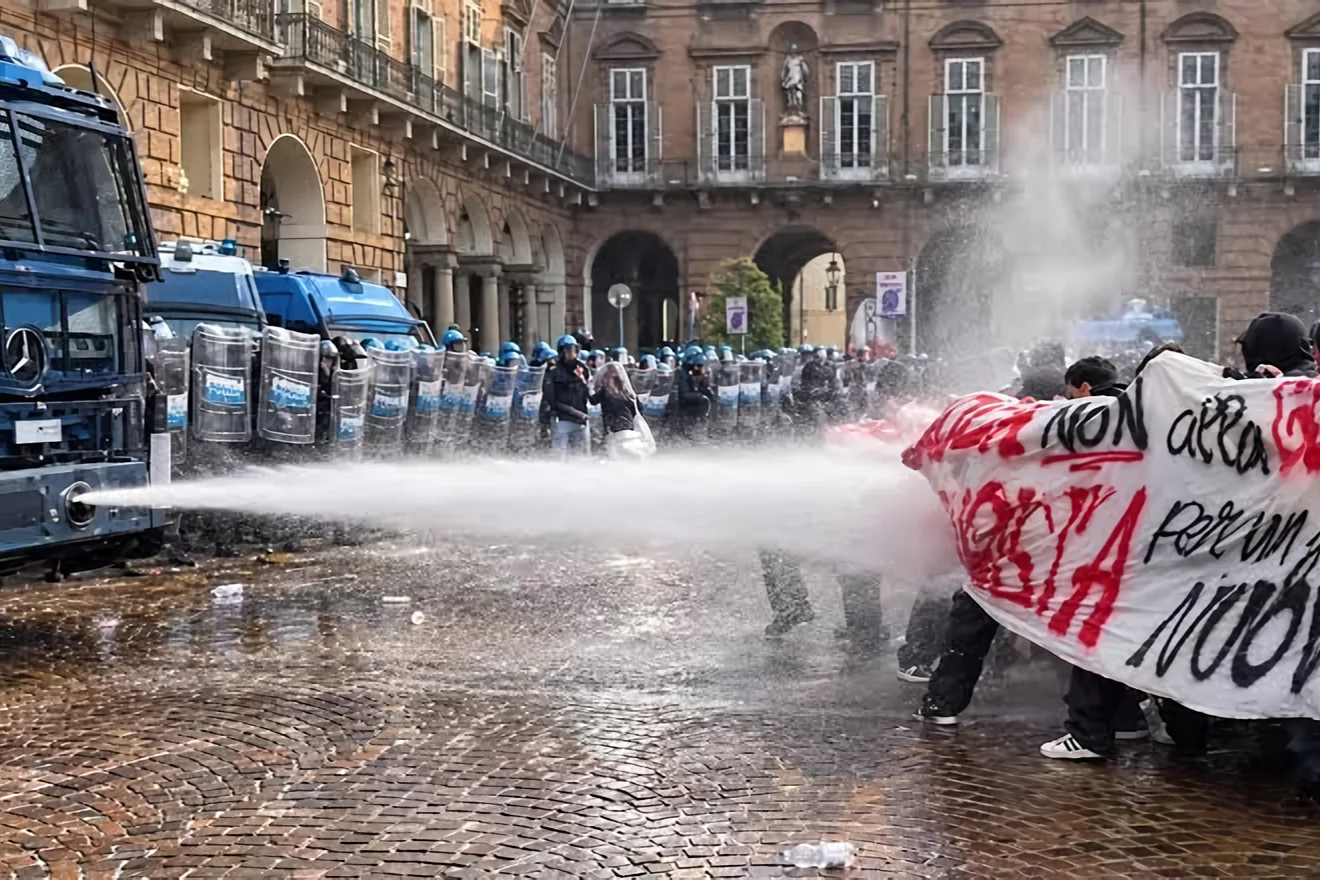
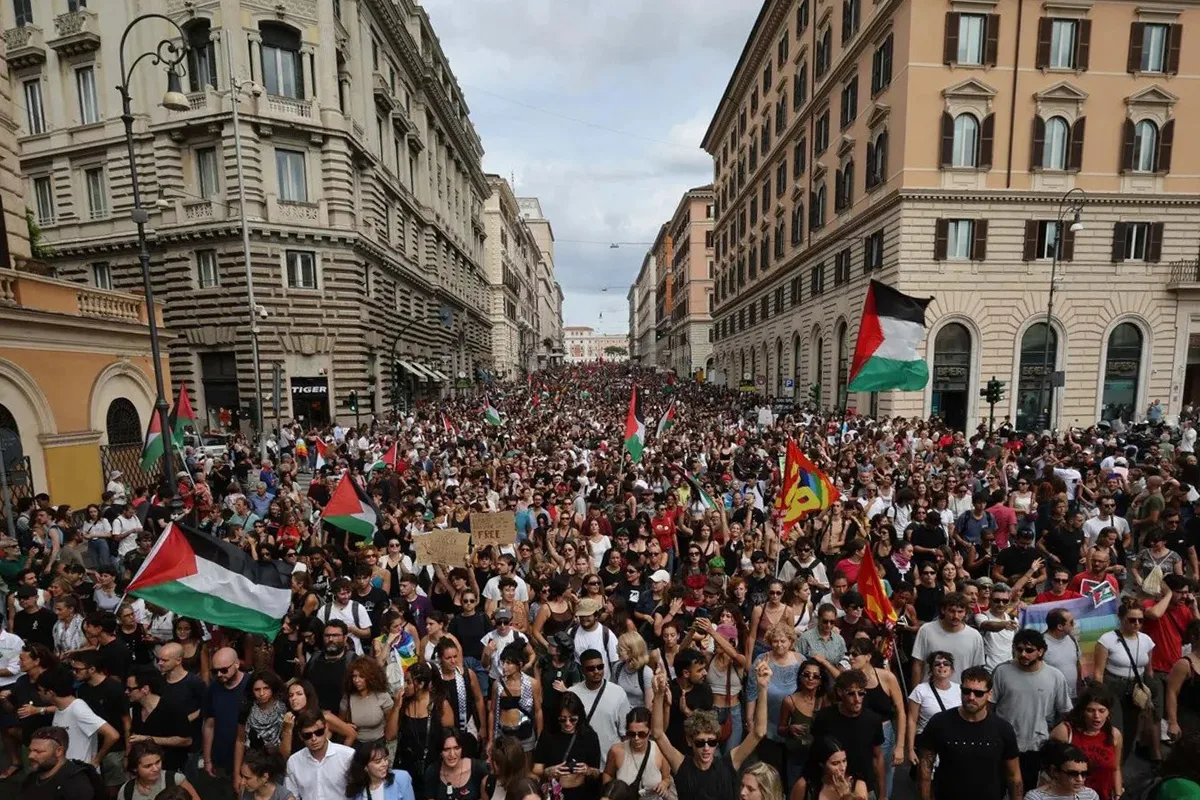
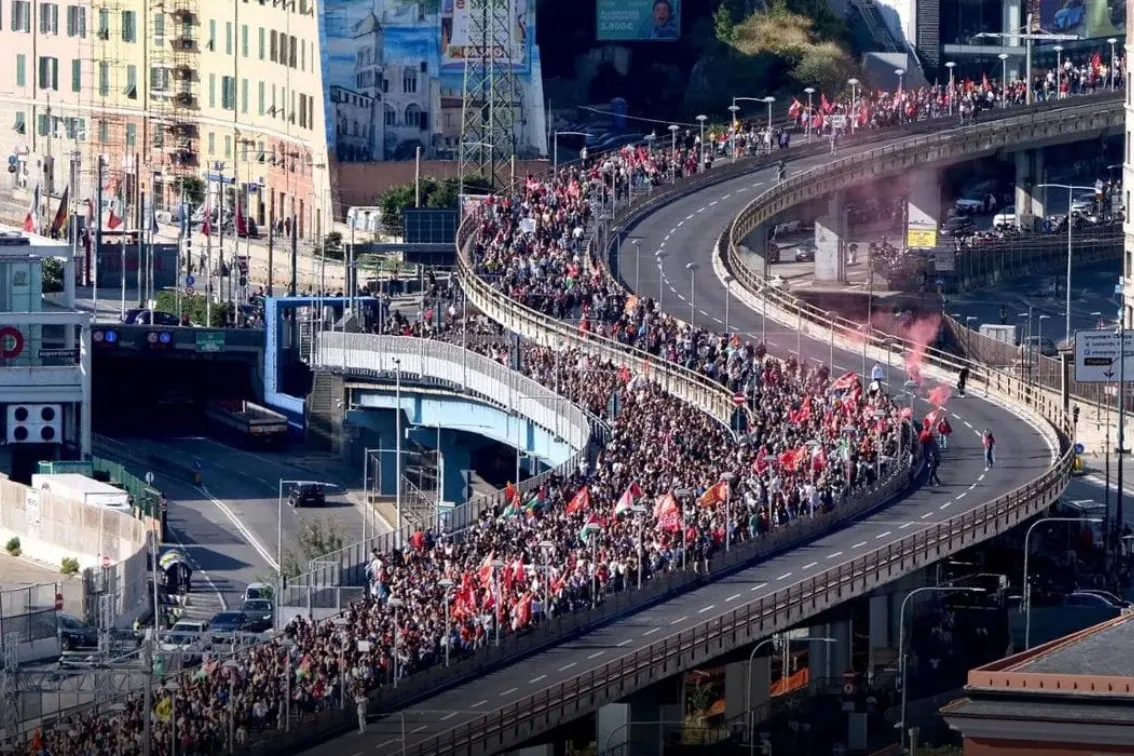
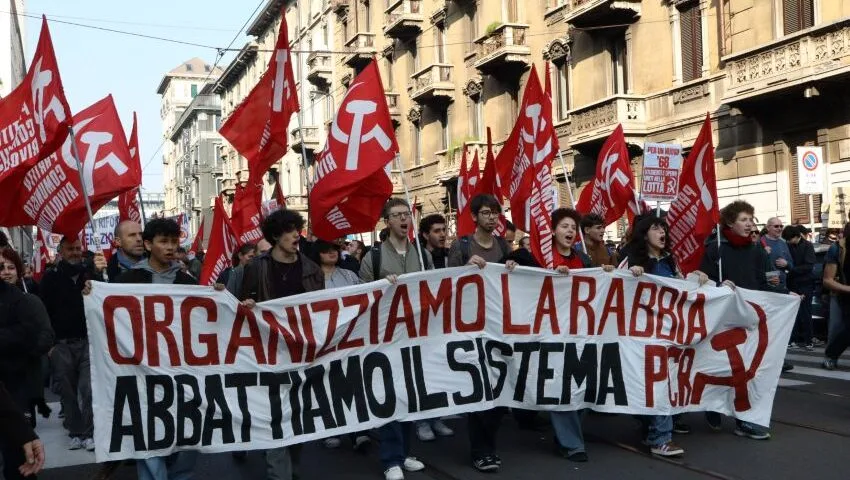
The demonstrations, organised by the radical USB union, saw a very large turnout: at least 50,000 in Milan and Turin, 40,000 in Bologna, and 20,000 in Naples and Rome. In total, several hundred thousand people took to the streets, a resounding show of strength against the government and its attempts at repression.
It is also significant that there were so many marches in smaller towns, involving thousands of people. Indeed, in some places where the strike organisers had not arranged anything, other local groups or collectives called for demonstrations.
This gives an indication of the nature and scale of the movement. What has developed over the last few weeks, from 16 October onwards, is a mass, spontaneous youth movement. At the forefront are new faces who do not belong to any organisation.
These are young people who often took part in last year’s demonstrations in support of Palestine, but who have now stepped up to play a leading role. First, they organised demonstrations outside the traditional channels, and then they flooded the squares en masse when the demonstrations were called.
On 30 October, a first contingent of workers – particularly from the education and public sectors, but with support from other sectors too – joined these young people. Those who promoted the strike deserve credit for setting a date, which catalysed the process.
The sight of the demonstrations clearly expressed this early stage of the movement: long, snaking processions with few contingents representing political groups or workplaces; colleagues meeting up in the march and discussing who had gone on strike; a clear predominance of young people, with groups arriving from schools, where no one recalls any picket lines for years, reaching the square and dissolving into the mass.
What is the movement fighting for?
This resurgence forms part of the wave of struggles unfolding across Europe. On 30 October, young people in Italy told their French, Spanish, and Albanian comrades: ‘We’re here too’.
The movements erupted over different issues – the housing crisis in Spain, the state of schools in France, the cost of living in Italy, the plundering of the countryside in Albania – but all quickly transformed into a more general struggle.
What are people taking to the streets for? The simplest answer we could give is: everything. That is to say, living conditions have become unbearable in terms of housing, work, education, war, the environment, healthcare, repression, and the lack of a future. All of these are inextricably linked because they are consequences of the crisis of the capitalist system.
But whilst it is clear what we are fighting against, we need to translate this sentiment into a programme that sets out clear objectives. We propose the following points:
- An immediate doubling of funding for education and healthcare and a drastic cut in military spending.
- A generalised increase in wages and automatic wage adjustments in line with inflation.
- A reduction in working hours and the recruitment of the unemployed. Less work and work for all!
- The construction and allocation of social housing and the expropriation of the assets of large property funds.
- Refusal to pay the public debt to banks and speculative funds.
- The nationalisation, under workers’ control, of strategic enterprises and companies in crisis.
The ruling class argue that measures such as these are not feasible. This is true if one remains within the framework of capitalism, where everything is subordinated to the generation of private profit and where those who hold the economic levers of society cannot be challenged.
However, they are certainly feasible provided that we challenge private ownership of the major means of production and vast wealth of society. The point is that the resources exist today to ensure a different society and a different way of life. But this necessarily involves a struggle over which class holds control: the capitalists or the workers.
Bring the country to a standstill! Bring down Meloni!
Meanwhile, the government’s budget is delivering yet another slap in the face to those mobilising. 5,000 teachers and 2,000 school support staff are to be cut. Funding is being allocated to private schools while funding for nurseries is being cut, the retirement age is being raised, and real pensions are being reduced. Rather than lowering rents, tax breaks are being given to landlords.
Meloni, however, is in trouble: the propaganda against the ‘violent’ protesters in the streets has not worked. There is widespread sympathy for the movement, and the repression has, if anything, led to further radicalisation. Even Vannacci, the leader of the far-right party National Future, has suddenly disappeared from the political debate.
Elsewhere too, the protests have put the right on the back foot. What the Spanish and French sections of the RCI report is quite telling: 65 percent of voters for the right-wing populist Vox and the People’s Party in Spain support the demands of the housing movement. Around 50 percent of Le Pen’s voters support the movement in France. This demonstrates that the prevailing trend in society is not a shift to the right, but a lack of credible political alternatives.
A government crisis is entirely possible in Italy, too. There are no shortage of potential flashpoints.
Alongside the youth movement, the transport workers’ struggle has dealt a severe blow to the government. But what is most significant is that in the South, students have joined them by taking to the streets. Meanwhile, workers have not complained about empty shelves but have said instead: ‘This is how we should be fighting too’. The idea of bringing the economy to a standstill is gaining ground.
30 October was a day of major demonstrations, but not yet a general strike that brought the country to a standstill. This is a decisive milestone that has yet to be reached.
Today, this strike must be organised. The general strike called by the CGIL (Italy’s largest trade union federation) for 20 November – which will follow on from the day of action on 5 November in France and the general strike on 11 November in Spain – must have this aim.
Let us be clear: we do not believe the CGIL leadership will do this, as it promotes class conciliation. Its sole focus is the upcoming general election and a broad, reformist ‘Campo Largo’ coalition government, which will solve nothing. In Milan, the CGIL even organised a rally for ‘social cohesion’ following the youth demonstrations.
But the workers themselves can do it. The model exists: on 3 October last year, it was the pressure and spontaneous mobilisation of the workers that forced the leaders of the trade unions to organise a political general strike of historic significance.
Today it must be the workers, together with students and young people in general, that organise themselves in the workplace, hold assemblies, discuss a programme of struggle, take action into their own hands, and turn 20 November into a day that brings the country to a complete standstill.
The aim of bringing down the Meloni government – which has emerged spontaneously in the slogans chanted in the streets – can be achieved in this way.
In this regard, policies that divide the movement – whether through differing dates or separate demonstrations promoted by various trade union groups, or between trade unions and youth organisations – are unacceptable. The front must be united, and unity is achieved when workers have the power to decide. Are there different organisations with different ideas? That is entirely normal. Let them be openly debated, and then let the workers decide in their assemblies (just as students are doing in schools).
This is why it is now necessary to complement pure and simple mobilisation with debate and organisation.
We need a revolutionary party!
One final point. The movement on the ground has marked a qualitative leap forward, including with regard to the need for political organisation. In the past, spontaneous movements – even very radical ones – translated their distaste for institutional politics into a generally anti-party, if not outright anti-political, sentiment. This sentiment was a genuine one, but immature. This phase has largely passed.
Today, in the streets, we have found a thirst for political ideas and a desire for organisation. The mobilisations of the recent past have taught us that a large spontaneous movement is wonderful, but not enough. We need to understand how the system can be broken down, and we need to organise ourselves on the basis of clear ideas to do so. Many are already championing the ideas of genuine communism. Others are not yet there, but are open to discussion.
This shift in consciousness has been partly reflected in the success enjoyed by the Partito Comunista Rivoluzionario’s – the Italian section of the Revolutionary Communist International – demonstrations in the streets on 30 October. But it is clear that the process is much broader than this.
We therefore set ourselves the task of offering our party to the radical, mobilised workers and youth who have drawn these conclusions, and of building it together with them.
If we understand the depth of the process that has been set in motion, then we understand the need to build a strong revolutionary party. That means a party in the true sense of the word: not an electoral bandwagon but a collective, militant body that seeks to internalise the lessons of the history of the labour movement in the form of theory, and use them to advance the struggle of the working class today.
It means a party which, whilst committed to advancing every struggle, prioritises overthrowing and overcoming the capitalist system. A party which brings together young people and workers and organises them as a collective force; which discusses democratically how to act, makes an honest assessment of its own actions and, on this basis, rises to the challenges posed by the era in which we live.
To those who share the conviction that such a party is necessary, we call upon you to join us in building the PCR in Italy and the Revolutionary Communist International throughout the world.