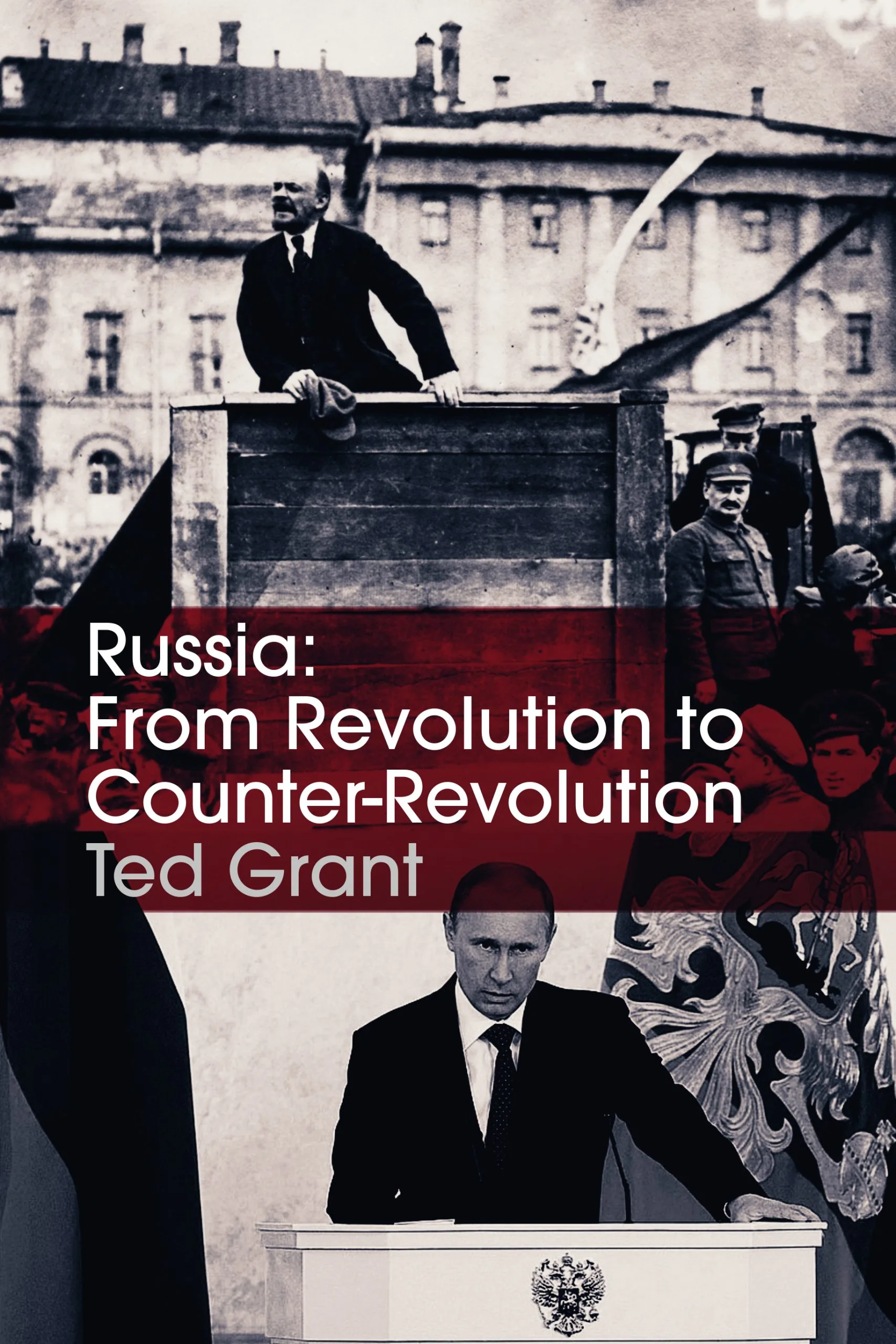
Russia: From Revolution To Counter-Revolution

The October Russian Revolution, led by Lenin and Trotsky, swept away landlordism and capitalism and placed the working class in power for the first time. It transformed the idea of socialism from theory into practice. From this point of view, the Bolshevik revolution can be considered the greatest event in history.

The revolution changed the course of world history and the last century has been dominated by its consequences. Ted Grant’s book traces the evolution of Soviet Russia from the Bolshevik victory of 1917, through the rise of Stalinism and the political counter-revolution, its emergence as a super-power after the Second World War, and the crisis of Stalinism and its eventual collapse.

The book, which was first published in 1997, has been updated and edited in the light of new developments and the subsequent re-establishment of capitalism in Russia. Grant based his analysis on that of Leon Trotsky, who first analysed Stalinism in his Revolution Betrayed.

While the counter-revolution has attempted to bury the memory of October, the new crisis of world capitalism has led to a revival of interest in Marxism and the significance of Bolshevism. The republication of Ted Grant’s book in this centenary year of the revolution therefore comes at a fitting time.

Inizia a leggereAcquista il libro
  1. List of Illustrations

Preface to the 2017 edition

  1. About the present work
  2. The question of the class nature of Russia
  3. What the book contains

Introduction

  1. Fear of revolution
  2. What the Revolution achieved
  3. Unprecedented advance
  4. Women and the October Revolution
  5. Why the Soviet Union collapsed
  6. Trotsky’s analysis
  7. Caricature of socialism

1. The Balance Sheet of October

  1. The advances of the planned economy
  2. Was the October Revolution a coup?
  3. Permanent mobilisation
  4. Party and class
  5. All power to the soviets!
  6. The myth of the Constituent Assembly
  7. The peasantry and the soviets
  8. Naked reaction
  9. Lenin’s internationalism
  10. The price of isolation
  11. Unprecedented collapse
  12. The New Economic Policy

2. The Rise of Stalinism

  1. The Marxist theory of the state
  2. The semi-state
  3. The old state machine
  4. Roots of bureaucracy
  5. Lenin’s struggle against Stalin
  6. The bureaucratic reaction
  7. The United Opposition
  8. Why didn’t Trotsky take power?
  9. The role of the individual

3. From Five-Year Plan to the Purges

  1. Forced collectivisation
  2. Economic zig-zags
  3. Increased social divisions
  4. Soviet foreign policy
  5. German Revolution 1923
  6. Socialism in one country
  7. The Third Period
  8. The victory of Hitler
  9. Popular Frontism
  10. The Spanish Revolution
  11. The Purge trials
  12. Old Bolsheviks exterminated
  13. Families wiped out
  14. The slaughter of the general staff
  15. The mark of Cain
  16. The end of the Comintern

4. The Nature of Stalinism

  1. The controversy over the class character of the USSR
  2. The transitional state after October
  3. Thermidor and Bonapartism
  4. What is Bonapartism?
  5. Stalinism: a form of Bonapartism
  6. ‘Bureaucratic collectivism’?
  7. Trotsky on ‘state capitalism’
  8. ‘A trade union in power’
  9. The theory of ‘state capitalism’ today

5. From War to ‘De-Stalinisation’

  1. Once again: The advantages of the planned economy
  2. Consequences of the Purges
  3. ‘For the archives’
  4. The tide turns
  5. Stalin’s manoeuvres
  6. Eastern Europe after the war
  7. Victory in China
  8. From Stalin to Khrushchev
  9. Stalin’s last purge
  10. Soviet imperialism?
  11. The Hungarian Revolution
  12. The Novocherkassk uprising

6. The Period of Stagnation

  1. The fall of Khrushchev
  2. The Soviet Union lags behind
  3. Technological advance
  4. Agriculture – the Achilles’ heel
  5. Living standards in the 1970s
  6. The problem of quality
  7. The state under Brezhnev
  8. Art and science
  9. Trials of writers

7. The Meaning of Perestroika

  1. An absolute fetter
  2. Gorbachev and Stalin
  3. Bureaucratic mismanagement
  4. A parasitic caste
  5. Ferment of discontent
  6. A gigantic zero
  7. Yeltsin’s demagogy
  8. Illusions in Gorbachev

8. From Foreign Policy to the National Question

  1. Arms expenditure
  2. ‘Peaceful coexistence’
  3. Crisis in Eastern Europe
  4. East Germany in ferment
  5. Czechoslovakia, Romania and Hungary
  6. The national question and October
  7. The national question and Stalinism
  8. The scourge of anti-Semitism
  9. ‘Independence’ no way out

Afterword: The Collapse of Stalinism

  1. The rise of Yeltsin
  2. The New Union Treaty
  3. The 1991 attempted coup
  4. Why the coup failed
  5. The fall of Gorbachev
  6. The drive towards privatisation
  7. Yeltsin’s manoeuvres
  8. The storming of the White House
  9. Western illusions
  10. A regime of decline
  11. Capitalist counter-revolution and women
  12. Capitalism can seriously damage your health
  13. The workers react
  14. Embryonic soviets
  15. The collapse
  16. The subjective factor
  17. The role of the ‘Communist Party’
  18. How the CP leaders around the world ‘explained’ the collapse of the USSR
  19. Simply a ‘misunderstanding’?
  20. Russia’s humiliation
  21. Putin’s rise to power
  22. Chechnya
  23. Georgia and Ukraine
  24. The nature of Putin’s regime
  25. Contradictions of oligarchic rule
  26. Towards a new October!
  1. Bibliography

Risultati