The heroic proletariat of Moscow has shown that an active struggle is possible, and has drawn into this struggle a large body of people from strata of the urban population hitherto considered politically indifferent, if not reactionary. And yet the Moscow events were merely one of the most striking expressions of a ‘trend’ that has broken through all over Russia. The new form of action was confronted with gigantic problems which, of course, could not be solved all at once...
– VI Lenin, The Workers’ Party and its Tasks in the Present Situation
Armed uprisings were not confined to Moscow. There were, in fact, a whole series of armed uprisings – in Kharkov, Donbas, Yekaterinoslav, Rostov-on-Don, the Northern Caucasus, and Nizhny-Novgorod and other centres. The national question also flared up with uprisings in Georgia and the Baltic states in particular. Even before the Moscow rising, there was a general strike and insurrection in Latvia. In Georgia, too, the December general strike gave rise to an armed uprising in the workers’ district of Tiflis (Tbilisi), led by the legendary ‘Kamo’ (Ter-Petrosyan). This uprising was smashed by reactionary peasants. There were also uprisings in Siberia (railway workers) and in many other areas local ‘republics’ were declared. There were serious uprisings along the railway lines in the Donetsk region where battles occurred in several stations, attracting the support of peasants in the surrounding districts. In Yekaterinoslav news of the Moscow rising brought together Bolsheviks, Mensheviks, Bundists, and SRs in united action for a political strike. There were strikes in mines and factories in the Donbas region organised by soviets or strike committees. In many areas there were clashes and battles with the army and police. The radicalisation of the Mensheviks is shown by the fact that they organised and led the uprising in Rostov-on-Don, which was smashed by Cossacks using artillery. But the Moscow rising did not succeed in arousing the proletariat of St. Petersburg. This proved a fatal weakness. The absence of an uprising in the capital meant that the government could concentrate its forces on crushing the workers of Moscow, and then put down the local movements one by one. In the end, the defeat in Moscow took the heart out of the movement.
Bitterly disappointed at the failure of the Petersburg working class to come to the aid of the rising, some sections of the Social Democrats initially blamed the workers of the capital for the defeat. Such reactions in a moment of despair are perhaps understandable. However, in later years, an entirely false interpretation of these events was unscrupulously put in circulation by the Stalinists, beginning with that notorious compendium of lies, Stalin’s Short Course which claimed that:
[T]he St. Petersburg Soviet of Workers’ Deputies, being the Soviet of the most important industrial and revolutionary centre of Russia, the capital of the tsarist empire, ought to have played a decisive role in the revolution of 1905. However, it did not perform its task (!), owing to its bad, Menshevik leadership. As we know, Lenin had not yet arrived in St. Petersburg, he was still abroad. The Mensheviks took advantage of Lenin’s absence to make their way into the St. Petersburg Soviet (?) and to seize hold (?) of its leadership. It was not surprising under these circumstances that the Mensheviks Khrustalyov-Nosar, Trotsky (!), Parvus, and others managed to turn the St. Petersburg Soviet against the policy of an uprising. (J.V. Stalin, History of the CPSU (B), p. 128.)
This is a particularly crass way of expressing a theme which has since been repeated in a variety of keys. However, this ignorant slander was answered in advance by Lenin, who on innumerable occasions expressed his complete solidarity with the general tactical line adopted by the St. Petersburg Soviet.
In her memoirs of Lenin, Krupskaya recalls the prevailing mood among the St. Petersburg working class at the time:
The Central Committee called upon the proletariat of St. Petersburg to support the uprising of the Moscow workers, but no coordinating action was achieved. A comparatively raw district like the Moskovsky responded to the appeal, but an advanced district like the Nevsky did not. I remember how furious Stanislaw Wolski was – he had been agitating in that very district. He lost heart at once and all but doubted whether the proletariat was as revolutionary as he had thought it to be. He failed to take into account that the St. Petersburg workers were worn out by previous strikes, and most important of all, they realised how badly organised and poorly armed they were for a decisive struggle with tsarism. And it would be a struggle to the death, they had the example of Moscow to tell them.
Even in a revolutionary situation, different layers of the working class move at different speeds and at different times. To use a military analogy, the Achilles’ heel of the 1905 Revolution consisted of the fact that the bulk of the reserves were moving into action at a time when the advanced guard was worn out and incapable of continuing the struggle. This explains the apparently contradictory fact that the more backward working class districts were prepared to come out while the more advanced sections did not respond. The same observation holds good for the peasantry, without which the revolution in the towns was doomed to failure. Only in the course of 1906 did the movement in the villages assume massive proportions. By that time, however, the backbone of the working-class movement had already been broken, although this was far from clear at the time.
The December defeat was a heavy blow. In her biography of Lenin, Krupskaya recalls that:
The Moscow defeat was a very bitter experience for Ilyich. It was obvious that the workers had been badly armed, that the organisation had been weak, that even the links between Petersburg and Moscow had been poor. (N.K. Krupskaya, O Vladimirye Ilyiche, vol. 1, p. 142 and p. 159.)
Yet even after the December defeat, Lenin did not believe that the revolution had exhausted itself. Throughout the year 1906, there was a whole series of strikes and movements of the proletariat, which led Lenin to believe that revolution was still on the agenda. Far from criticising the Petersburg workers for not rushing to arms in December, Lenin gave the following evaluation of the situation:
Civil war is raging. The political strike, as such, is beginning to exhaust itself, and is becoming a thing of the past, an obsolete form of the movement. In St. Petersburg, for instance, the famished and exhausted workers were not able to carry out the December strike. On the other hand, the movement as a whole, though held down for the moment by the reaction, has undoubtedly risen to a much higher plane.
The peasant movement was growing and might yet have given a fresh impetus to the towns, particularly in the spring. The regime itself was in crisis, faced with the possibility of financial collapse. The inner cohesiveness of the armed forces was still in the balance. It was essential that the workers should husband their strength as far as possible for the decisive all-Russian struggle that lay ahead. And Lenin specifically warned the Petersburg workers against the danger of provocation:
It would be very much to the advantage of the government to suppress the still isolated actions of the proletariat. The government would like to challenge the workers of St. Petersburg immediately, to go into battle under circumstances that would be most unfavourable for them. But the workers will not allow themselves to be provoked, and will know how to continue on their path of independent preparation for the next all-Russian action. (LCW, The Workers’ Party and its Tasks in the Present Situation, vol. 10, p. 93 and p. 94.)
With the wisdom of hindsight, it is possible to see that the period from the October strike to the December uprising marked the high tide of the 1905 Revolution. With the defeat of the Moscow proletariat, the movement in the towns, despite the still powerful strike movement in 1906, had effectively been broken. The mighty upsurge of the peasantry came too late. The Party, which was weak and divided at the outset of the revolution, had grown impressively in the space of a few months, but the task of uniting and leading a movement of millions proved to be beyond the capabilities of a few thousand cadres, despite heroic endeavours and sacrifice. The incredible thing was not that the Russian Marxists had failed to lead the proletariat to victory in 1905, but the way in which a tiny handful of revolutionaries, with scarcely two decades of work behind them, had grown from insignificant propaganda circles to a powerful party, with tens of thousands of activists leading hundreds of thousands of workers, in the space of just a few months.
Although it was defeated, the revolution had not been in vain. In the same way, in science, even an unsuccessful experiment is not necessarily wasted. There are some similarities with the history of revolutions – though the human cost is, of course, incomparably greater. Without the experience of the Paris Commune and without the experience of 1905, the successful revolution of 1917 would have been impossible, as Lenin pointed out many years later:
All classes came out into the open. All programmatic and tactical views were tested by the action of the masses. In its extent and acuteness, the strike struggle had no parallel anywhere in the world. The economic strike developed into a political strike, and the latter into insurrection. The relations between the proletariat, as the leader, and the vacillating and unstable peasantry, as the led, were tested in practice. The Soviet form of organisation came into being in the spontaneous development of the struggle. The controversies of that period over the significance of the Soviets anticipated the great struggle of 1917-20. The alternation of parliamentary and non-parliamentary forms of struggle, of the tactics of boycotting parliament and that of participating in parliament, of legal and illegal forms of struggle, and likewise their inter-relations and connections – all this was marked by an extraordinary wealth of content. As for teaching the fundamentals of political science to masses and leaders, to classes and parties alike, each month of this period was equivalent to an entire year of ‘peaceful’ and ‘constitutional’ development. Without the ‘dress rehearsal’ of 1905, the victory of the October Revolution in 1917 would have been impossible. (LCW, “Left-Wing” Communism: An Infantile Disorder, vol. 31, p. 27, my emphasis.)
The 1905 Revolution also had profound international effects. Overnight the idea of the general strike became a central issue in the discussions of the international workers’ movement. The revolution acted as an inspiration and a stimulus to the workers of the rest of Europe. In Germany there was a strike wave in 1905 – 508,000 workers were on strike – approximately four times more than in 1904. April 1906 saw the first political general strike in German history. Nor were the effects of the Russian Revolution confined to Europe. It had an effect on the developing revolutionary movements of the colonial peoples. In December 1905 Persia experienced its bourgeois revolution, which reached its peak in 1911. China in 1905 was also in the throes of a mass revolutionary movement associated with the bourgeois democrat Sun Yat-sen. This in turn prepared the Chinese bourgeois revolution of 1911-13. Turkey also saw the rise of a revolutionary movement. Like a heavy rock thrown into a still pond, the Russian Revolution made big waves capable of reaching very distant shores.
1905 was a decisive turning point. For the first time, revolutionary Social Democracy became a decisive force within the working class of the whole of Russia. Within a space of nine months, the movement underwent a complete transformation. The consciousness of the workers advanced by leaps and bounds on the basis of great events, which shook the foundations of all the old beliefs, habits, and traditions, compelling the working class to come to terms with the realities of its own existence. By a process of successive approximations, the working people tested one political option after another, from worker-priests and humble petitions, passing through economic strikes for better wages and conditions, constitutional reforms and imperial manifestos, bloody pogroms, street demonstrations, and workers’ self-defence squads, to the highest expression of the class struggle – the political general strike and armed insurrection. At each stage, the breaking free of the masses from their old illusions was marked by the rise and fall of political trends and accidental figures of all kinds. The Gapons and the Khrustalyov-Nosars for a brief instant loomed large upon the stage of history before vanishing forever, leaving no trace behind them. But the genuine revolutionary tendency represented by Bolshevism, despite all mistakes and inevitable ups and downs, advanced resolutely to its natural place at the head of the revolutionary proletariat. The theoretical, political, and organisational weapons which enabled the Bolshevik Party to lead the workers to victory in October 1917 were forged in the white heat of the revolution of 1905, and tempered in the long dark night of reaction which followed.
Endnotes
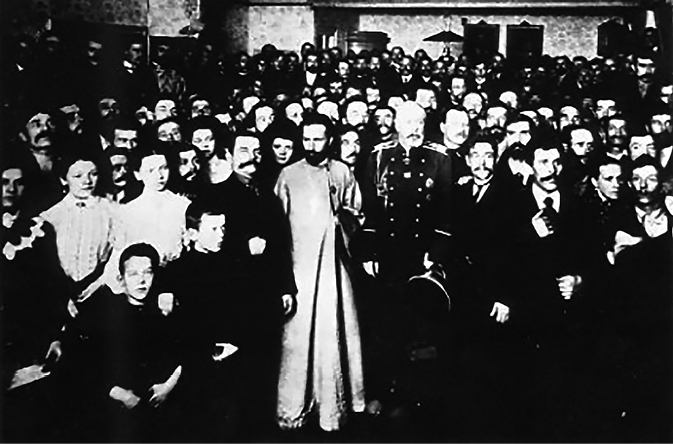
8. Father Gapon in white with the Chief of Police to his left, St. Petersburg 1905.
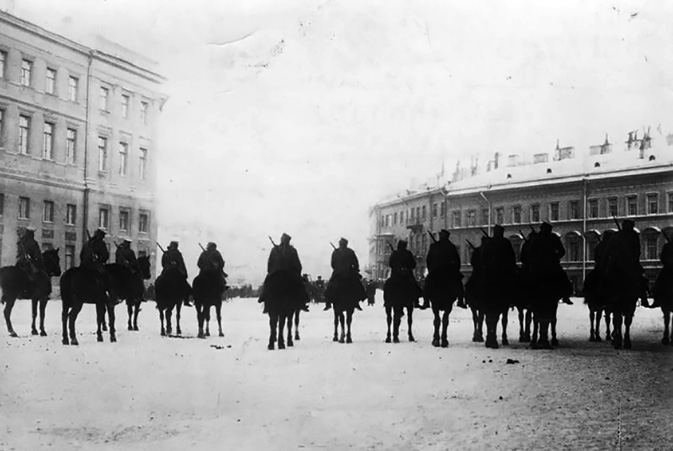
9. Cavalry at the Pevchesky Bridge delay the movement of the procession to the Winter Palace, 9 January 1905.
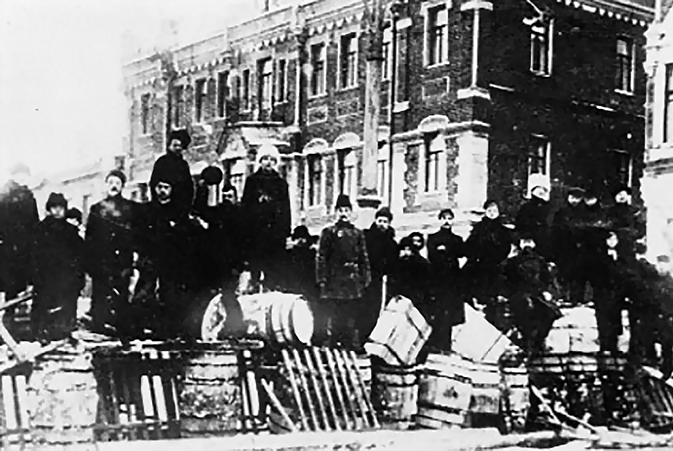
10. Barricades in St. Petersburg, 1905.
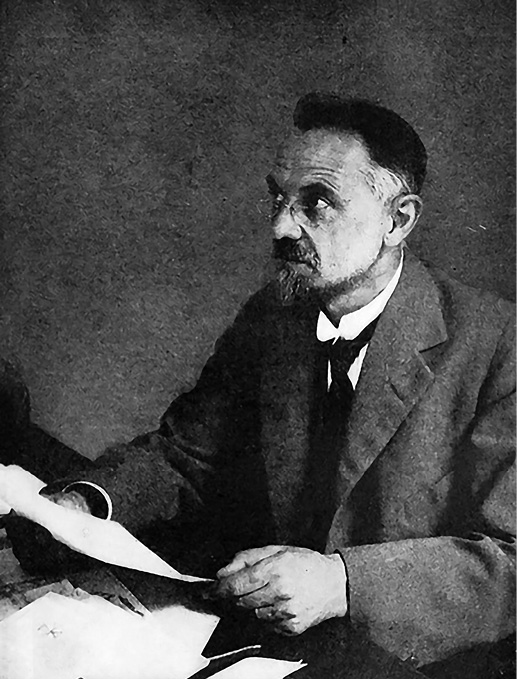
11. Leonid Krassin.
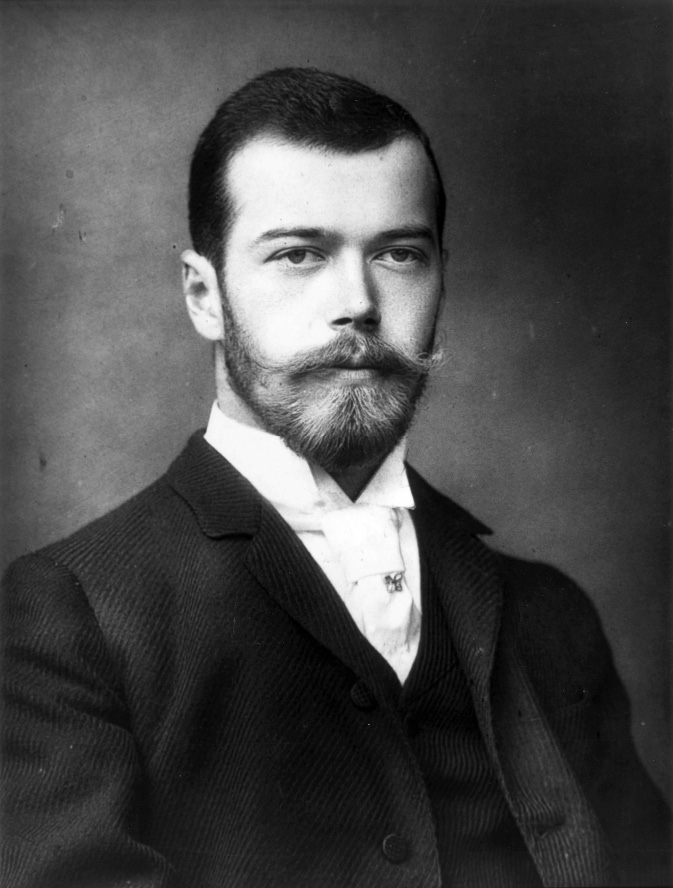
12. Tsar Nicholas II in 1893.
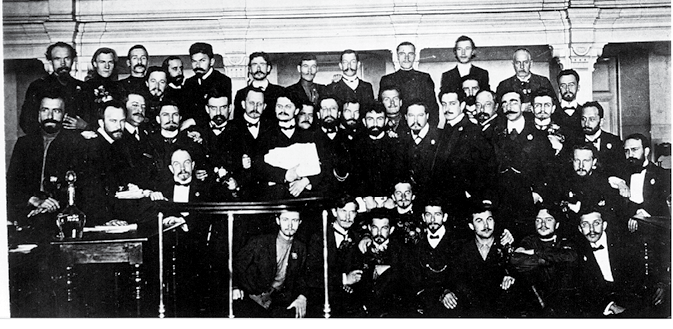
13. St Petersburg Soviet on trial, 1905. Trotsky is in the centre holding papers.