It was incredible how many on the Left were taken in by Gorbachev. Not just the right and left reformists, but even some self-styled ‘Trotskyists’ fell over themselves in their haste to pay tribute to this ‘great reformer and statesman’. These people were incapable of differentiating between shadow and substance. In reality, Gorbachev stood for the interests of the ruling caste. True, his image was different from that of the old Stalinist leaders. But the difference was more of style than content.
Gorbachev was an articulate, educated and well-travelled bureaucrat, quite unlike the coarse, narrow and ignorant upstarts of Stalin’s day. He realised the impasse in which the bureaucratic system found itself. Without the participation and enthusiasm of the masses, nothing can be done. Even under capitalism that is the case. Most big factories would grind to a halt if the workers did not apply their intelligence and initiative, sometimes bending the rules to keep the machinery running. Hundreds of millions of pounds are made out of the ‘suggestions boxes’ in Britain every year. That shows the enormous potential for a system based on workers’ control and management, which would give full reign to the workers’ creativity, intelligence and initiative.
There were many who nurtured illusions that the Russian bureaucracy could reform itself. One such was Roy Medvedev, a capable historian who, although he displayed great personal courage in standing up to the regime, failed to develop a really consistent Marxist analysis and fell into a trap. Roy Medvedev represented a ‘left’ wing of the bureaucracy. He wanted the regime to reform itself in a strictly legal and constitutional fashion.
As for ways and means of political struggle they must be absolutely legal and constitutional, there are certain extreme groups that believe in the use of illegal methods including for example the organisation of underground printing presses. (Medvedev, On Socialist Democracy, p. 314.)
He then quotes one of his opponents who evidently had a correct appraisal of the bureaucracy:
You believe that the leadership would support a certain degree of democratisation, but this would amount to the leadership liquidating itself and the whole of political history confirms the unreality of such an expectation. No government withdraws of its own free will. Your ideas are harmful as they create illusions about the ease with which your proposed programme of reforms might be realised. You suggest that because of a change in social and political conditions, fresh forces will become part of the ‘apparat’ and transform its bureaucratic style. But this only encourages the false idea of an automatic and spontaneous process – in reality these fresh forces will undoubtedly encounter fierce resistance. (Ibid., p. 313.)
Again, Medvedev gives the game away again by saying:
Overhasty reform can also cause problems with the Socialist bloc (as the experience of Czechoslovakia has shown.) (Ibid., p. 314.)
Clearly, any movement of the working class to throw off the yoke of the bureaucracy would ‘cause problems’. But to imagine that the ruling caste would give up without a fight was just wishful thinking.
Another example was Isaac Deutscher. His name is frequently linked to Trotsky’s on the strength of his three-volume biography of the great revolutionary. But politically, the two could not be further apart. In fact, in his political biography of Stalin, Deutscher attempts to glorify Stalin’s role. Rather than being portrayed as the leader of the counter-revolutionary bureaucracy, he is built up as some kind of great misunderstood revolutionary:
Stalin has been both the leader and exploiter of a tragic, self-contradictory but creative revolution. Like Cromwell he embodies the continuity of the revolution through all its phases and metamorphoses, although his role was less prominent in the first phase. Like Robespierre he has bled white his own party; and like Napoleon he has built his half-conservative and half-revolutionary empire and carried revolution beyond the frontiers of his country… But in order to save it (‘the better parts of Stalin’s work’) for the future and to give it its full value, history may yet have to cleanse and reshape Stalin’s work as sternly as it once cleansed and reshaped the work of the English revolution after Cromwell and of the French after Napoleon. (I. Deutscher, Stalin: a political biography, pp. 569-70.)
Deutscher never understood Trotsky or his great contribution to Marxism – his analysis of Stalinism. What is correct in Deutscher’s trilogy on Trotsky he borrowed from Trotsky, but his attempts at theorising are of no value whatsoever. He dismisses Trotsky’s “fiasco with the Fourth International” and “his fumblings about reform and revolution in the USSR” as mere flights of fancy. (Ibid., p. 513.) In reality, without an understanding of Trotsky’s ideas on Stalinism, it is impossible to grasp what is taking place in the former Soviet Union today. Far from being mere “fumblings”, his ideas have been entirely borne out by events. The same cannot be said of Isaac Deutscher’s own prognosis.
After Stalin’s death, Deutscher hailed the so-called de-Stalinisation of Khrushchev as a great step forward. Here is Deutscher’s conclusion in his third volume of his biography of Trotsky:
It is clear that even under Stalinism Soviet society was achieving immense progress in many fields, and that the progress, inseparable from its nationalised and planned economy, was disrupting and eroding Stalinism from inside. In Trotsky’s time, it was too early to try to draw a balance of this development – his attempts to do so were not faultless; and the balance is not yet quite clear, even a quarter of a century later. But it is evident that Soviet society has been striving, not without success, to rid itself of the heavy liabilities, and to develop the great assets, it has inherited from the Stalin era. There has been far less poverty in the Soviet Union, far less inequality and far less oppression in the early 1960s than in the 1930s or the early 1950s. The contrast is so striking that it is an anachronism to speak of the ‘new totalitarian slavery established by the bureaucratic collectivism’… It is still a matter of argument whether the Soviet bureaucracy is ‘a new class’ and whether reform or revolution is needed to bring its arbitrary rule to an end. What is beyond question is that the reforms of the first post-Stalin decade, however inadequate and self-contradictory, have greatly mitigated and limited bureaucratic despotism and that fresh currents of popular aspirations are working to transform Soviet society further and more radically. (Deutscher, The Prophet Outcast, pp. 511-2.)
All along, Deutscher had the illusion that the bureaucracy could ‘de-bureaucratise itself’, and introduce socialism. This was fundamentally false. No ruling class or caste in history has given away its power and privileges without a struggle. Trotsky was a thousand times more correct when he predicted that the bureaucracy would turn to capitalism as a means of reinforcing its privileges, rather than hand power to the working class. This was even more the case in the context of the temporary economic boom in the West which coincided with Gorbachev’s reforms.
Deutscher’s central thesis was entirely formalistic and un-Marxist in character. If the bureaucracy arose out of Russian backwardness, he reasoned, then as society advanced to a higher economic and cultural level, it ought to disappear painlessly of its own accord. This overlooks the basic class contradictions in society. In any class society, once the state arises, it acquires a momentum and a life of its own. The whole of history demonstrates precisely the opposite of Deutscher’s thesis. At a critical moment, when the productive forces have outgrown the existing property relations, the ruling class and its state by no means reconcile themselves to the logic of historical progress. They fight to maintain their power and privileges, even when these are in flagrant contradiction to the demands of progress. The capitalist system has long been a brake upon the development of the productive forces, which does not at all mean that the capitalist class will voluntarily surrender to the proletariat!
The development of the productive forces does not automatically determine the nature of the state. If that was so, revolution would be unnecessary, and not just in Russia. The whole of human history would be a smooth, gradual evolution in the direction of progress – something that every schoolboy knows is not the case. The inevitability of revolution arises precisely from the fact that no ruling class or caste ever surrenders in this way. The Russian bureaucracy is no exception, particularly after Stalin had exterminated the representatives of October. The way in which the bureaucracy established its power – wading through a sea of blood in the Purges – was an indication that this ruling caste would stop at nothing to maintain itself in power. As Trotsky put it:
No devil ever yet voluntarily cut off his own claws. The Soviet bureaucracy will not give up its positions without a fight. The development leads obviously to the road of revolution. (Trotsky, The Revolution Betrayed, p. 287.)
Deutscher’s entire line of argument was entirely in the tradition of Menshevism. It reflects the same logic as reformism, which seeks to show that revolution in general is an unnecessary inconvenience. His brand of ‘realism’ was, in effect a crude empiricism with no understanding of history whatever. It is the same kind of mentality which leads the Social-Democratic leaders in the West to abandon socialism and finally go over to the market economy, that is, from reforms to counter-reforms. Thus, this alleged realism turns out to be the worst kind of utopia.
Deutscher’s vision of a self-reforming bureaucracy provided a comforting hope for the radical ‘Friends’ of the Soviet Union, the dream of a painless transition to socialism. In reality, this was impossible without a mass movement of the working class. Success or failure depended not on the wishes and good will of the bureaucracy, but exclusively on the willingness of the working class to fight for their emancipation. The experience of Hungary shows how a mass revolutionary movement of the working class could split the bureaucracy and win over large numbers to the side of the political revolution. By contrast, the so-called reforms of Gorbachev, which aimed to prevent a revolution from below and preserve the rule of the bureaucracy, merely prepared the ground for the going over of a big section of the bureaucracy to capitalism, rather than accept the abolition of their privileges. Nowadays, Deutscher’s theories do not even have an historical interest. In all fairness, it is necessary to add that Isaac Deutscher’s widow, Tamara Deutscher, in a BBC television programme shortly before she died had the courage to admit publicly that Trotsky had been correct all along on this question.
Looking back on this period, it was incredible how anyone with the most elementary knowledge of Russian history, let alone Marxism, could have entertained the slightest illusion in Gorbachev and his policies. Yet we had so-called Marxists praising Gorbachev, and even travelling to Moscow to witness the strange spectacle of the bureaucracy ‘abolishing itself’! Of course, the advocates of the theory of state capitalism, were unimpressed, since, as far as they were concerned, capitalism already existed in Russia. What was all the fuss about?
When every other tendency was praising Gorbachev as the great Saviour, we alone pointed out that his reforms were bound to fail, and characterised him as an accidental petty bourgeois figure, doomed to be swept away. Admittedly, we thought that this would come as a result of political revolution and not a movement in the direction of capitalism which, at that stage, we erroneously considered to be ruled out. The only way to solve the problem was to reintroduce a Leninist regime of workers’ control and management, which would easily have been possible on the basis of a developed economy that now existed in Russia. But that was the last thing Gorbachev had in mind! Instead of improving things, Gorbachev’s reforms introduced a further element of destabilisation, hastening the dissolution of the system. Only two alternatives were possible. In the absence of a movement of the working class in the direction of a political revolution, the balance tilted sharply in the direction of a move towards capitalism.
Endnotes
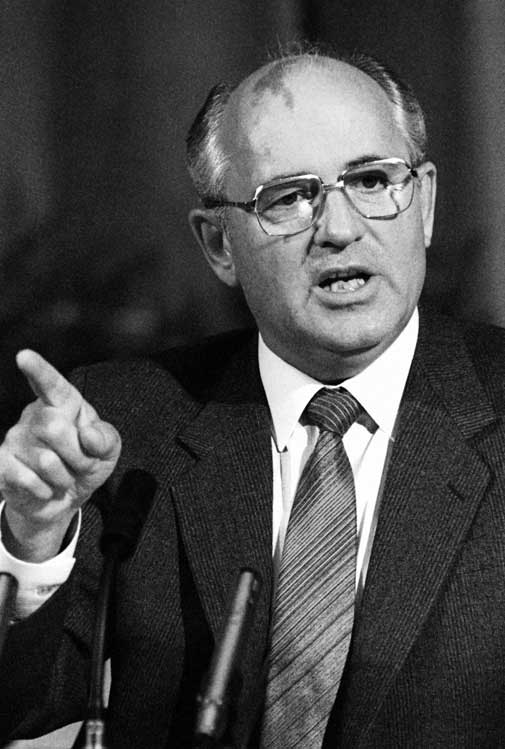
34. Mikhail Gorbachev.
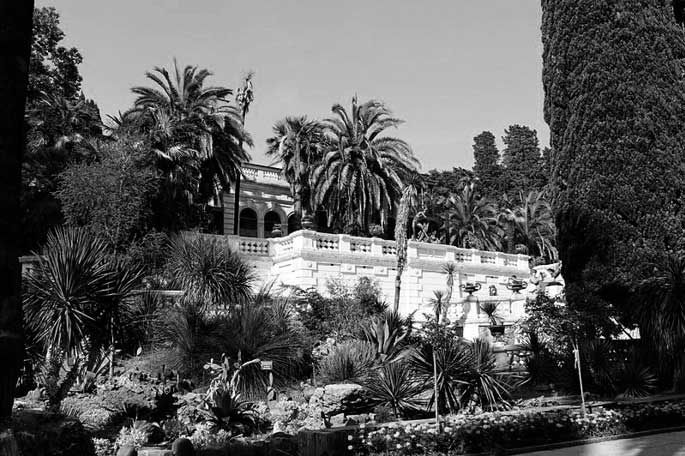
35. An example of a Dacha in Sochi.
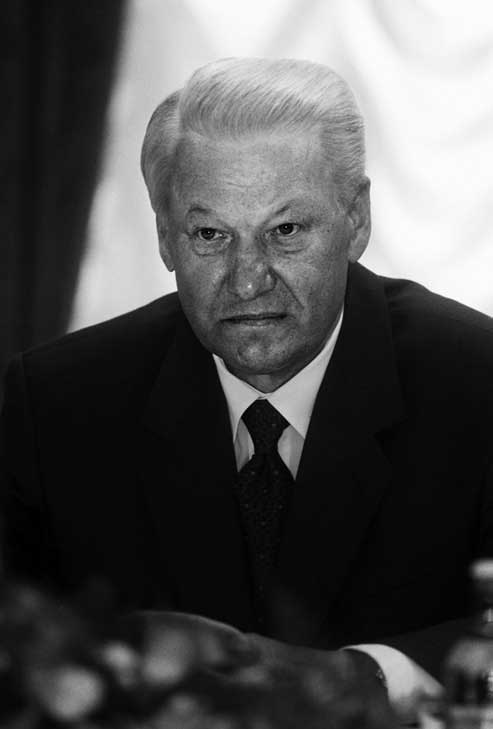
36. Boris Yeltsin.