After suppressing organized labour, Hitler then moved to crush the restless ideologues inside the Nazi party who were demanding a “Second Revolution” to achieve “Socialism” by nationalizing the monopolies, the banks, breaking up the department stores, etc. In reality, the reverse was happening as the bourgeois ruthlessly used its supremacy after the destruction of the trade unions to organize a regime of terror in the factories.
The only promise Hitler kept was the persecution of the Jews, who were used as a scapegoat and an outlet for the growing disillusionment of the petty bourgeois. Hitler had betrayed the middle class basis of fascism. The SA, under Roehm, made up of hard-line fanatics who demanded the “second revolution”, were disarmed and liquidated in June 1934 in the famous “Night of the Long Knives”. These mercenaries were ruthlessly murdered after their dirty work was done.
The Nazi state apparatus was now in place. All opposition had been crushed. The bourgeoisie had handed over its political power to the fascists as the price for destroying the workers’ organizations. But once in power, fascism began to lose its mass base and formed itself into a Bonapartist police state. Its mission had been accomplished with the destruction of organized labour and the atomization of the proletariat, which would take, as Trotsky predicted, some 15 years to fully recover.
The multi-million German labour movement – with a Marxist tradition extending over 75 years – was the most powerful and respected in the world. It possessed gigantic resources and held a powerful sway over the life of Germany. Its military republican organization – the Reichsbanner, which later went into the Iron Front – was well armed and extremely powerful. The German labour leaders possessed the authority and resources to sweep fascism off the streets.
Hitler could have been broken if the labour movement had acted swiftly. But its leadership was rotten. It acted as a brake at each stage of struggle. The KPD, the most powerful Communist Party outside of the USSR, in pursuing the ultraleft policy of the “Third Period”, deliberately split the workers’ organizations, paralyzing them on the eve of its most decisive battle against fascism. While many of its leaders were able to escape abroad, its rank and file faced the full brunt of the Nazi terror. Two-and-a-half thousand Communists were murdered on the spot. A further 130,000 were taken off to the concentration camps, to meet their death in the gas chambers, through beheadings, through the torture chambers of the SS, worked or starved to death, or simply shot. Jan Valtin, an eyewitness of the terror described the situation in Ploetzensee Prison:
Those among us who awoke early in the morning, waiting for the bell to command us to rise, soon learned to recognize the sounds accompanying an execution: the clatter of feet on Death Row at six in the morning, the creaking doors of the shed at the other end of the cobbled square facing Death Row – the shed where the guillotine stood hidden behind a canvas curtain: The sudden rattling of keys in ponderous doors, sometimes the sounds of a futile struggle, roars of rage and screams for help, or a booming voice singing the Internationale and ending with a hoarse shout of farewell from the hundreds who lay listening in their cells still alive.
A whole generation, composed of many of the best revolutionary fighters, paid dearly for the crimes of the bankrupt leadership of Stalinism and social democracy – whose actions and policies bear the complete responsibility for the victory of Hitler.
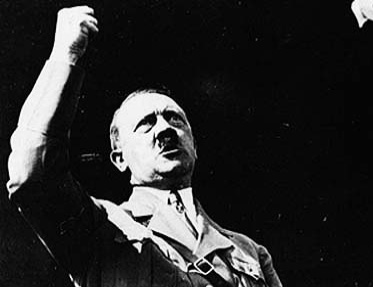
Hitler making a speech in 1936.