The theory of the ‘permanent revolution’, developed by Leon Trotsky in the 20th century, remains one of the most important and misunderstood ideas in all of Marxism. In this article, Joe Attard delves into the origins of Trotsky’s ideas, and how they were shaped by the events of the 1905 Revolution in Russia.
[This article was originally published as part of issue 51 of In Defence of Marxism magazine – the quarterly theoretical magazine of the Revolutionary Communist International. Subscribe and get your copy here]
The Russian Revolution of 1905 went off like a bombshell, blowing apart all scepticism about the fighting potential of the Russian masses toiling under the heel of tsarist absolutism. While the workers were ultimately crushed after a year of open combat with tsarism, they laid the foundations for even greater battles to come.
Leon Trotsky was virtually alone in understanding the real significance of 1905, which catalysed ideas he had already been developing into his greatest theoretical contribution: the permanent revolution.
There is a dialectical relationship between individuals, ideas and events. Lev Davidovich Bronstein (the birthname of ‘Leon Trotsky’) entered revolutionary activity as a teenager. But it was only after the 1905 Revolution, in which he personally led the St. Petersburg Soviet, that the mature ‘Trotsky’ emerged.
1905 was also when the young Russian working class entered decisively onto the stage of history. In a sense, Trotsky and the Russian proletariat made their first great leap in unison. Twelve years later, the process set in motion by the ‘dress rehearsal revolution’ would return on a higher level. As Trotsky later wrote:
“In 1905, the working class was still too weak to seize power; but subsequent events forced it to gain maturity and strength. […] The proletariat came to power in 1917 with the help of the experience acquired by its older generation in 1905.”[1]
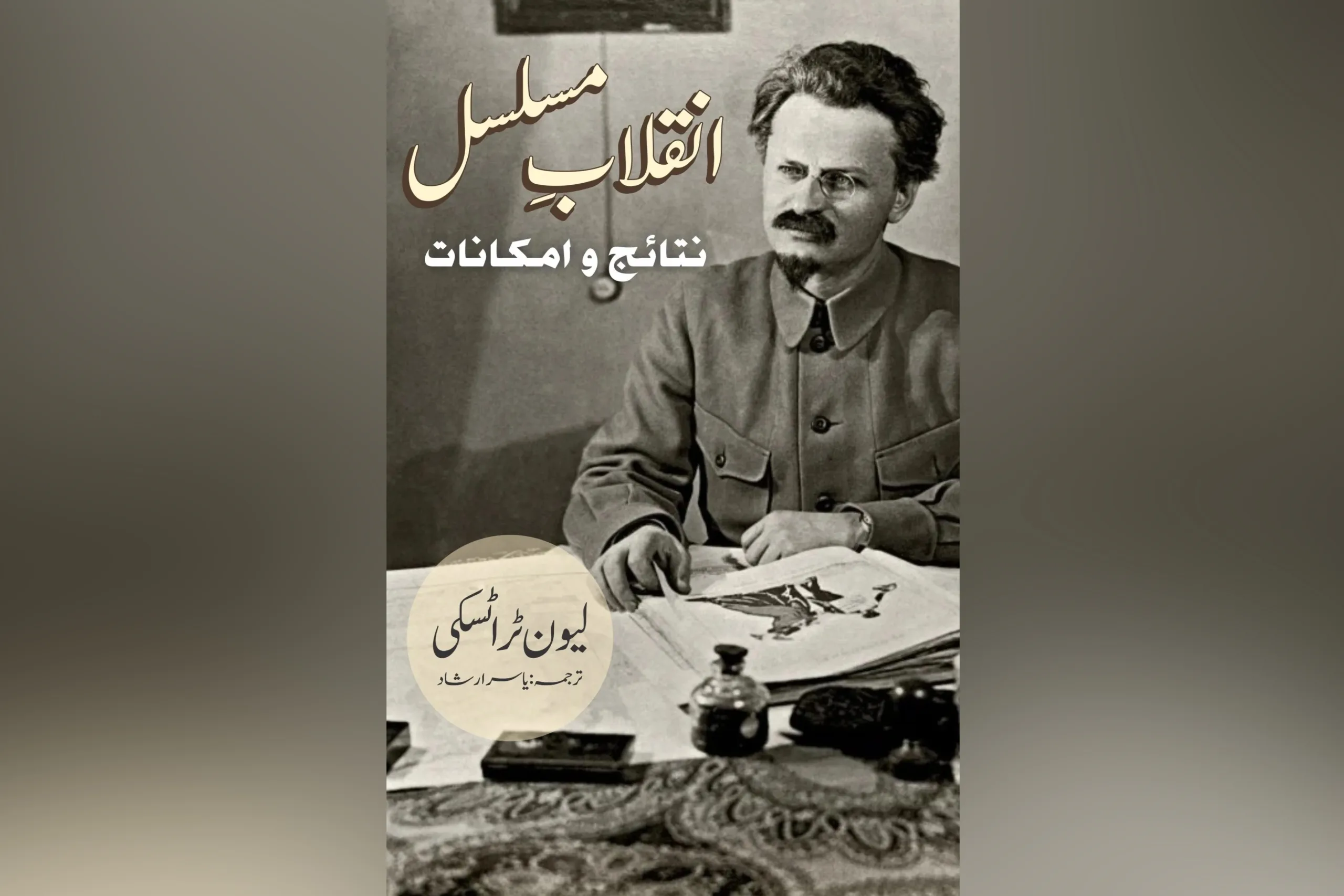
Lev Bronstein
The theory of permanent revolution did not simply spring from Trotsky’s mind in 1905, it was informed by his life experiences and the objective conditions surrounding him.
Lev Bronstein was born in 1879 to a family of well-off Jewish farmers in the Ukrainian village of Yanovka, (then part of the Russian Empire, now modern-day Bereslavka). The Russian countryside was a brutal environment, in which the Bronsteins occupied a ‘middle layer’. Lev witnessed the harsh realities of rural life, gaining sympathy for the oppressed peasant masses. At the same time, he acquired an unromantic, objective measure of the peasantry. He was also educated in urban Odessa along modern European lines, which highlighted the frightful backwardness of Yanovka, and raised his sights to a wider world.
Lev had few political opinions as a schoolboy, outside of a vague antipathy towards tsarism. Partly this was due to a lack of any political point of reference, as the 1880s were a period of reaction. However, the autocracy had become an enormous fetter on the development of society. Its days were numbered.
Agricultural production had barely developed since the Middle Ages. It was thrown into a deep crisis by the pressure of the world market, where it could not compete. The peasantry had been formally freed from serfdom in 1861 but were still looted by their landlords. Uprisings in the countryside increased in number and intensity as the nineteenth century wore on. The effect of competition and investment from more advanced economies drove rapid industrialisation, with mass migration from the country to the towns forging a sizeable urban proletariat.
In the 1890s all these developments, combined with crop failure and famine, caused society to heat up. “The year 1891”, Trotsky later wrote, “[…] marks the official date of the political breaking-point in the country.”[2]
In addition to unrest in the countryside and demands for democratic reform from the liberal intelligentsia, the young Russian working class was beginning to make itself known with a wave of strikes starting in the middle of the decade.
With the death of Alexander III in 1894, hopes placed by the liberals in the new Tsar Nicholas II were dashed when he affirmed the creed of ‘Orthodoxy, Autocracy, and Nationality’, and dismissed democratic aspirations as “nonsensical dreams”.[3]
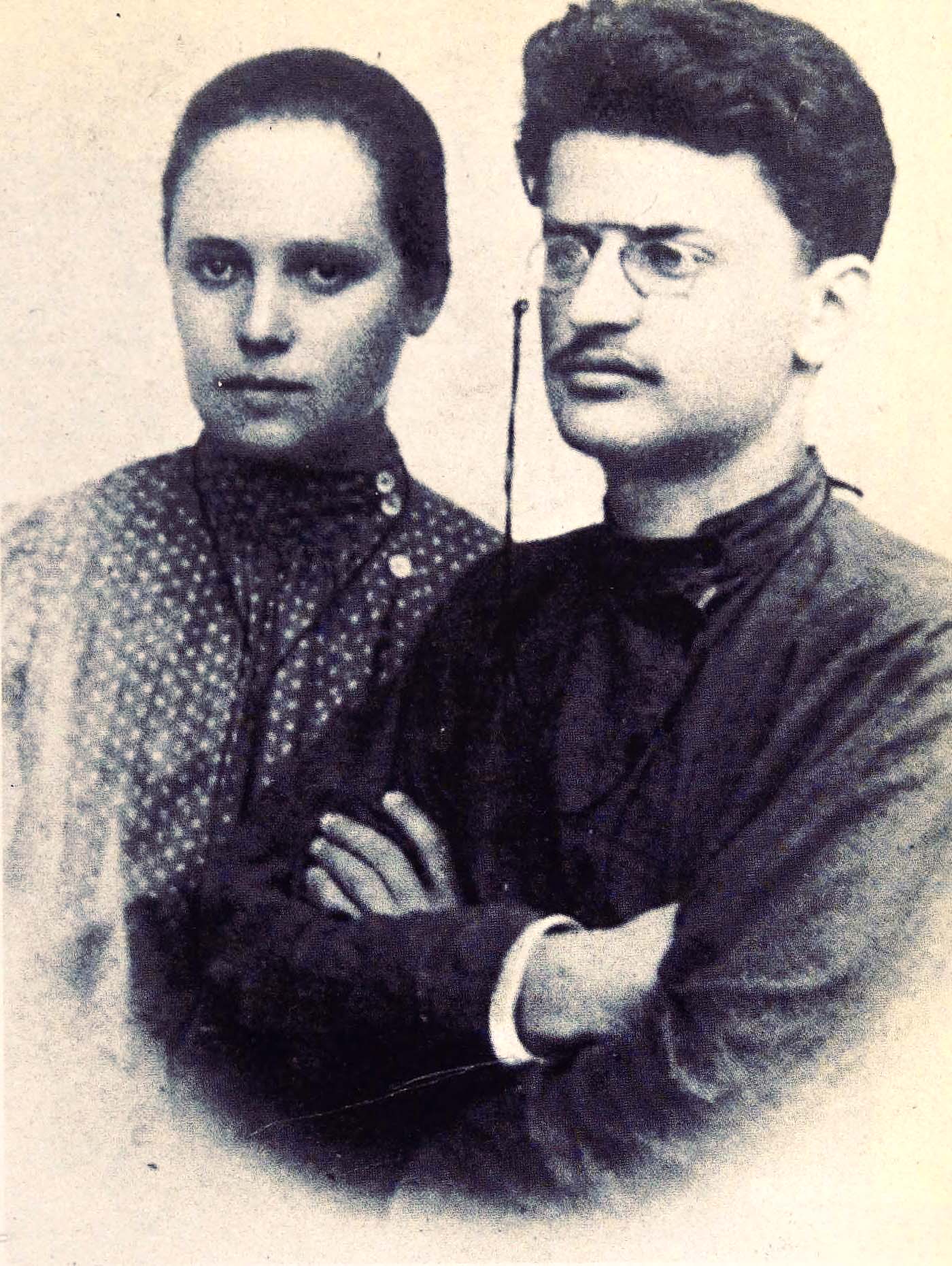
At the time, Lev Bronstein was living in Odessa: a bustling, working-class port town with a militant atmosphere. Events were radicalising the precocious teenager, though this process did not pass in a straight line. After a brief conservative phase, he shifted in an ultra-left direction. In 1896 he moved to the harbour town of Nikolayev, where he first started political activity. He abandoned his studies the following year, and lived in a squalid ‘commune’ amongst a small group of student Narodniks (a populist movement that looked to the peasantry as destined to lead a revolution).
Lev felt no attraction to Russian Marxism, which according to him “remained imprisoned by the conservative mood of the eighties […] shoving the revolution into the indefinite future, and inclining generally to regard socialism as a task for centuries of evolution”.[4] The so-called Legal Marxists around Peter Struve used pseudo-Marxist language to defend and encourage the development of Russian capitalism, opting for compromise over class struggle. These ideas enjoyed a vogue amongst the liberal intelligentsia, befitting their class outlook.
Lev’s first attempt at political writing was indeed a polemic against Marxism, rejected by a Populist (i.e. Narodnik) magazine in Odessa.
The development of the Russian proletariat continued apace. The urban population had ballooned by 97 per cent between 1863 to 1897. Big industrial plants were springing up, including two in Nikolayev that employed 8,000 workers collectively.
At the end of 1895, students in St. Petersburg, Moscow and Kiev refused en masse to declare an oath of loyalty to the new tsar. Strikes were becoming bigger and more radical. A high watermark was reached after Nicholas II’s coronation in 1896, when a stampede caused by the police left thousands dead and maimed. In response, a strike of 30,000 workers broke out in St. Petersburg, the biggest Russia had ever seen. Radical ideas were spreading rapidly amongst the intelligentsia and a layer of the working class.
The Union of Struggle for the Emancipation of the Working Class, founded by Lenin, Julius Martov, Plekhanov and Alexander Potresov, was starting to acquire a small circle of supporters. This was unknown to Lev Bronstein, who helped set up a small group called the South Russian Workers’ Union along vaguely ‘social democratic’ (i.e. Marxist) lines, showing his trajectory in response to the growing influence of the working class. The organisation was gutted by arrests in 1898, and Lev was sentenced to four years of Siberian exile.
Leon Trotsky
During a six-month stint in a Moscow transfer prison, Lev finally committed himself to a serious study of Marxism, including The Monist View of History by Georgi Plekhanov, and Lenin’s new book The Development of Capitalism in Russia. By the time Lev, his wife Aleksandra Lvovna and their baby daughter arrived in the mosquito-ridden peasant village of Irkutsk, Siberia in 1900, “Marxism had definitely become the basis of [his] philosophy”.[5]
He later reflected that railing against Marxism ultimately sharpened his understanding: “Only that is lasting which is gained through combat”.[6] On arrival in Irkutsk, he immediately started writing revolutionary articles under the pen name ‘Antid Oto’, picked from an Italian dictionary – with the quip that he wanted to be the ‘Marxist antidote’ to the bourgeois press.
As strikes, student protests and arrests increased, the radical exile community grew. This was an important environment of political clarification, in which Lev battled anarchist, reformist and terroristic ideas. He independently came to the same conclusion as Lenin about the necessity of building a professional revolutionary party, making the case in an essay that was hotly debated in Siberia.
When Lev learned of Iskra – the new all-Russian paper led by Lenin – and obtained a copy of his pamphlet, What is to be Done?, he decided, with his wife’s support, that it was necessary to link up with Lenin and Plekhanov’s group. With a false passport in the name of an Odessa jailer, Trotsky, he fled, hidden under coats in a peasant cart. He spent some time with the local Iskraites in Samara, writing under the name Pero (‘the Pen’): a mark of his prodigious output.
Trotsky, as he was now known, eventually travelled via Austria to London in 1903, where Lenin was living in exile. The talented youngster from Siberia impressed Lenin, who advocated bringing him onto Iskra’s editorial board. This was staunchly opposed by Plekhanov. By this time, the grandfather of Russian Marxism was feeling events passing him by, and his insecurity made him combative. He regarded the dynamic young revolutionary from Siberia as a threat.
Trotsky, meanwhile, lodged with and became close to Martov and Vera Zasulich in London. Even in 1903, these two future Menshevik leaders were showing signs of softness towards the liberals and petty-bourgeois hangers-on in the Russian Marxists’ orbit.
Much ink has been spilled over the 1903 Second Congress of the Russian Social Democratic Labour Party (RSDLP). We do not intend to revisit this episode in detail,[7] but Trotsky wound up opposing Lenin over the question of party membership, and the latter’s proposal to remove the inert ‘old leaders’ from Iskra’s editorial board.
Despite Lenin’s patient attempts to make his case at the congress, Trotsky was not persuaded: a fact he later put down to youthful naivete (he was 23 at the time), as well as his personal closeness to Martov, Zasulich and Axelrod, who were all leaders of the Minority (‘Mensheviks’, in Russian). But he would later acknowledge that what he had originally seen as a dictatorial power grab was simply Lenin doing what was necessary to weld the Russian Marxists into a unified and professional party.
Following the congress, Trotsky made several sharp attacks on Lenin, which alienated him from the ranks of the Majority (the ‘Bolsheviks’). But while Trotsky sided with the Mensheviks at the Second Congress, he was always far closer to Lenin on the central point of difference between the factions. Namely, their attitude towards the liberals, whom Trotsky (rightly) said feared the Russian workers and peasants more than they did the tsar.
In March, the Menshevik-controlled editorial board of Iskra refused to publish Trotsky’s article on the Russo-Japanese War, which scathingly attacked Russian liberalism. Trotsky formally left the Mensheviks in September by way of an ‘Open Letter to Comrades', which was sent to Iskra for publication, but never released. He remained outside of both factions (which became separate parties in 1912) until 1917.
While acknowledging that he had been mistaken in opposing Lenin at the Second Congress, Trotsky later reflected that he was not sorry for this, nor for the period of distance from Lenin that followed:
“I came to Lenin for the second time later than many others, but I came in my own way, after I had gone through and had weighed the experience of the revolution, the counter-revolution and the imperialist war. I came, as a result, more surely and seriously than those ‘disciples’ who, during the master’s life, repeated his words and gestures – not always at the right moment – but, after his death, proved to be nothing but helpless epigones and unconscious tools in the hands of hostile forces.”[8]
The limits of the liberals
The divisions between the ‘hards’ and ‘softs’, as the Bolsheviks and Mensheviks were respectively known, would only widen as events accelerated. A powerful strike had already broken out in Rostov in November 1902, and a wave of strikes raged in the south of Russia as the Second Congress was being held.
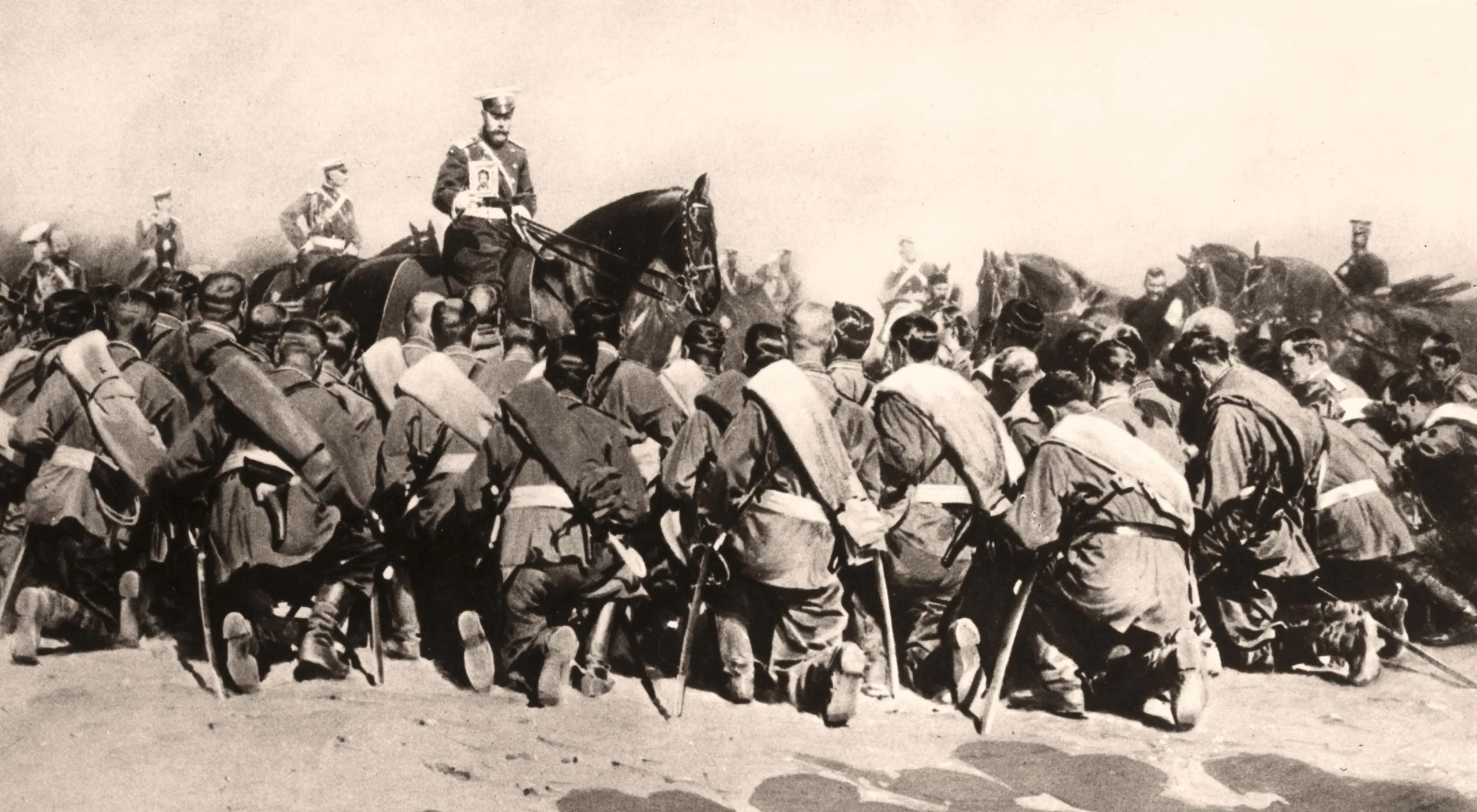
Social unrest intensified with the Russo-Japanese War, which soon turned into a humiliating disaster for tsarist Russia. The war was forcing a massive shift in consciousness, as Trotsky observed in a brilliant 1904 essay:
“Masses, yesterday primitive, today are confronted with the most tremendous events. They must seek to understand them. The very duration of the war has produced a desire for reasoning, for questioning as to the meaning of it all. Thus the war, while hampering for a period of time the revolutionary initiative of thousands, has awakened to life the political thought of millions.”[9]
The liberals began organising in zemstvos (local assemblies) to demand political reform, and launched a series of political meetings, disguised as ‘banquets’ to circumvent tsarist restrictions on the right to assembly.
In July, Minister of the Interior Plehve, who had banned the zemstvos, was assassinated. His successor, Svatopolk-Mirsky, allowed the zemstvos to hold a national convention in November 1904 as a safety valve for the oppositional mood of the intelligentsia.
This congress formulated a list of 11 demands, including for free speech, free assembly, and a representative parliament, though it meekly stopped short of calling for a constitution. The Mensheviks were excited by this development, following their mechanical perspective that the liberal bourgeoisie was destined to overthrow tsarism and lay the basis for a bourgeois democratic state: supposedly the next step in Russia’s political development.
Iskra withheld a series of articles in the autumn of 1904, later published as the pamphlet Up to the Ninth of January, in which Trotsky poured scorn on the liberal zemstvos and Legal Marxists alike for limiting themselves to supplicant appeals to the tsar for democratic rights. The autocracy could and would not coexist with democracy – any concessions granted now would be clawed back tomorrow. Taking the recent strike wave as his starting point, Trotsky argued that the working class, not the zemstvos, would initiate and lead this democratic revolution, drawing the poor peasants and a section of the radical intelligentsia behind them:
“The leading detachment must arouse every stratum of society, make its presence felt everywhere, and raise directly the questions of political struggle. It must sound the call, and reveal and unmask the hypocrites of democracy. It must knock together the heads of the democrats and the census liberals. It must awaken, appeal, unmask – and demand, time and again, an answer to the question: ‘What next?’ Never once retreating, it must compel the legal liberals to recognise their own impotence; it must detach any democratic elements from the liberals and turn them in the direction of the revolution.”[10]
This position is similar to that outlined by Lenin a decade earlier in What the “Friends of the People” Are and How They Fight the Social-Democrats. But Trotsky went further, predicting that the leading role of the working class meant the impending revolution was likely to begin with “a mass political strike – not a local strike, but an all-Russian strike”.[11] This would break the army, win over the best of the intelligentsia, and – combined with agitation in the countryside – pull the peasants behind the workers. This was a novel idea, as although the potential for such a development had been glimpsed at times in the advanced capitalist countries, nothing of the kind had been seen in Russia.
But by January, a strike at the Putilov works (started by a tsarist-approved police union) spread into a campaign of strikes, 140,000 workers strong.
Bloody Sunday
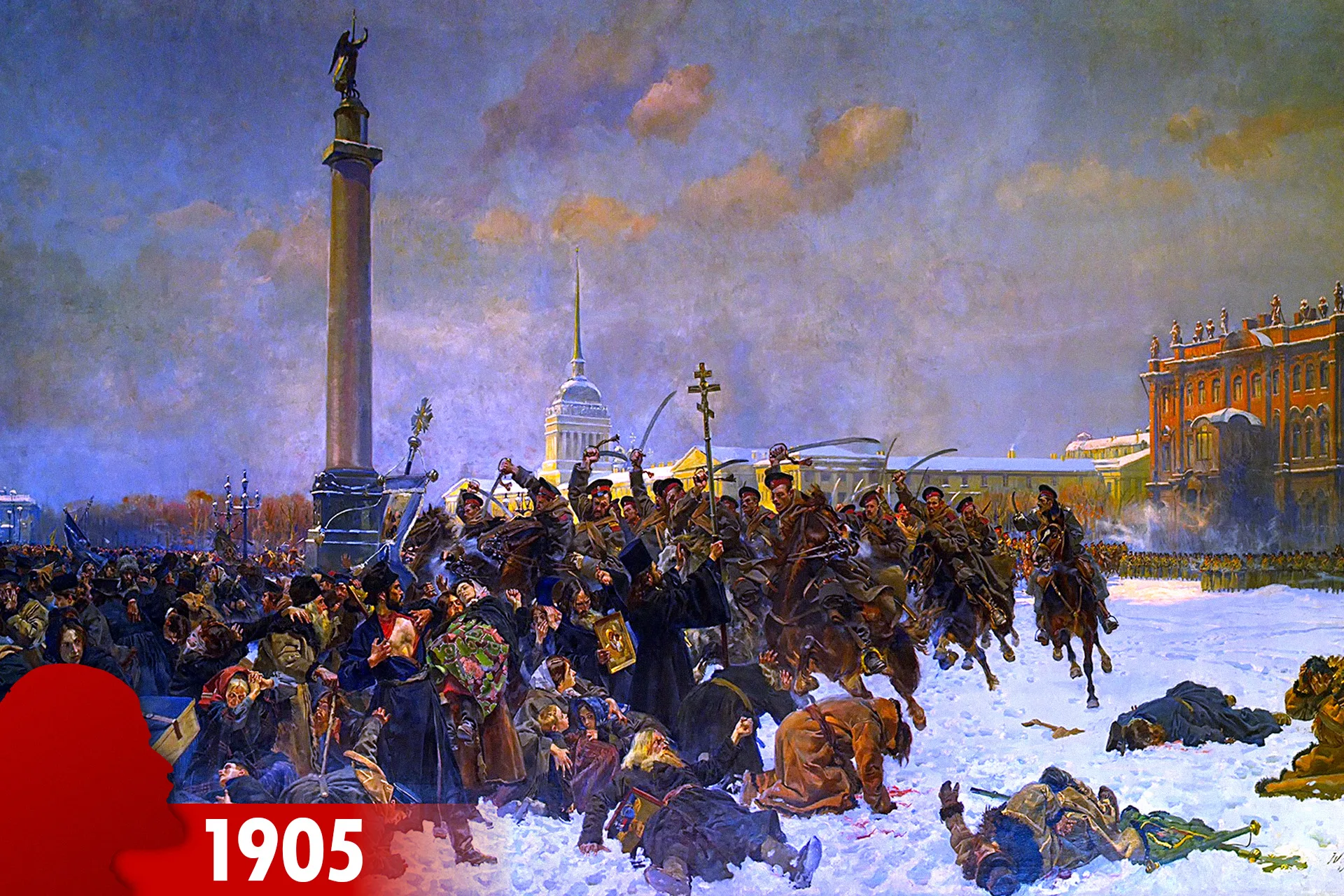
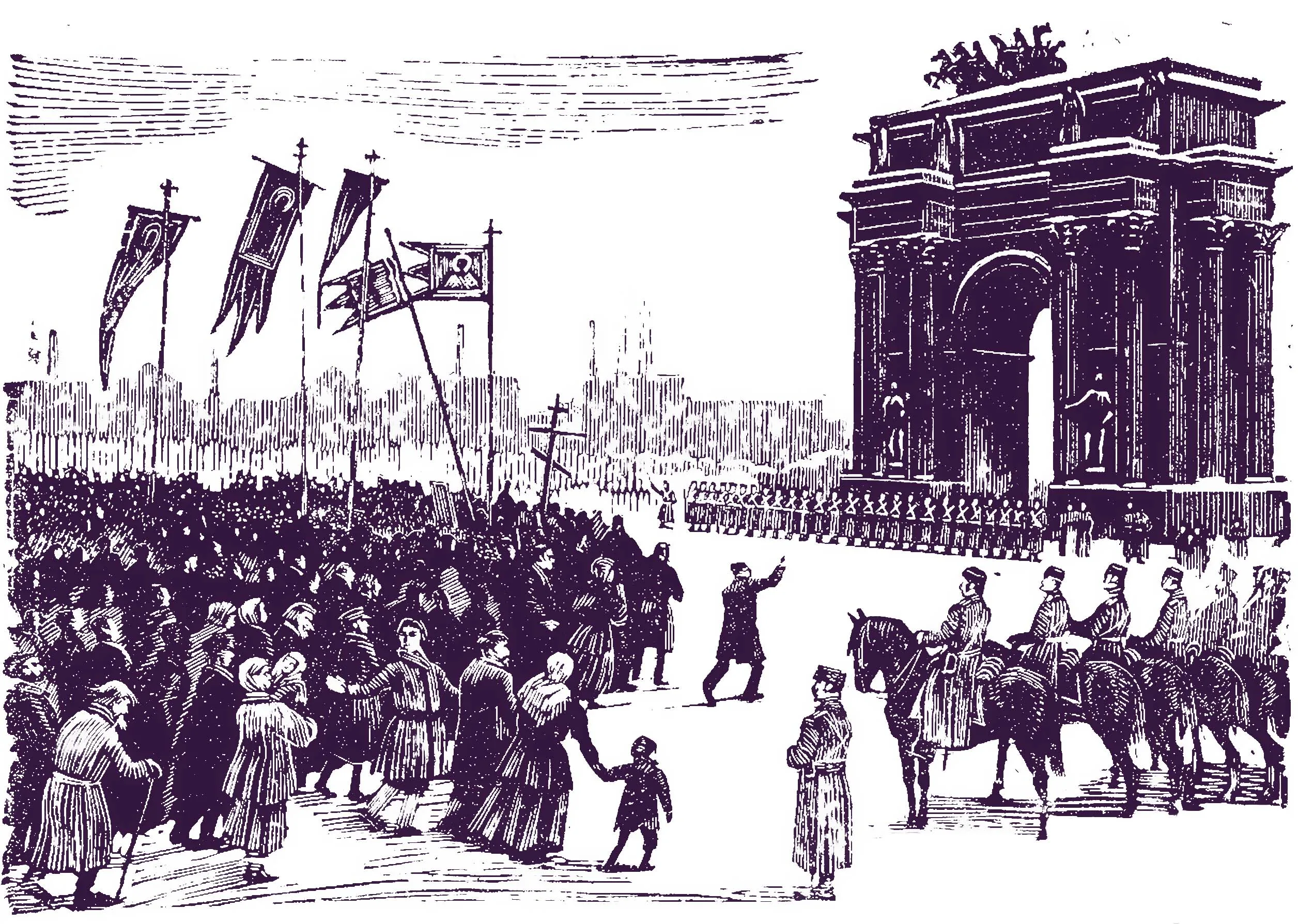
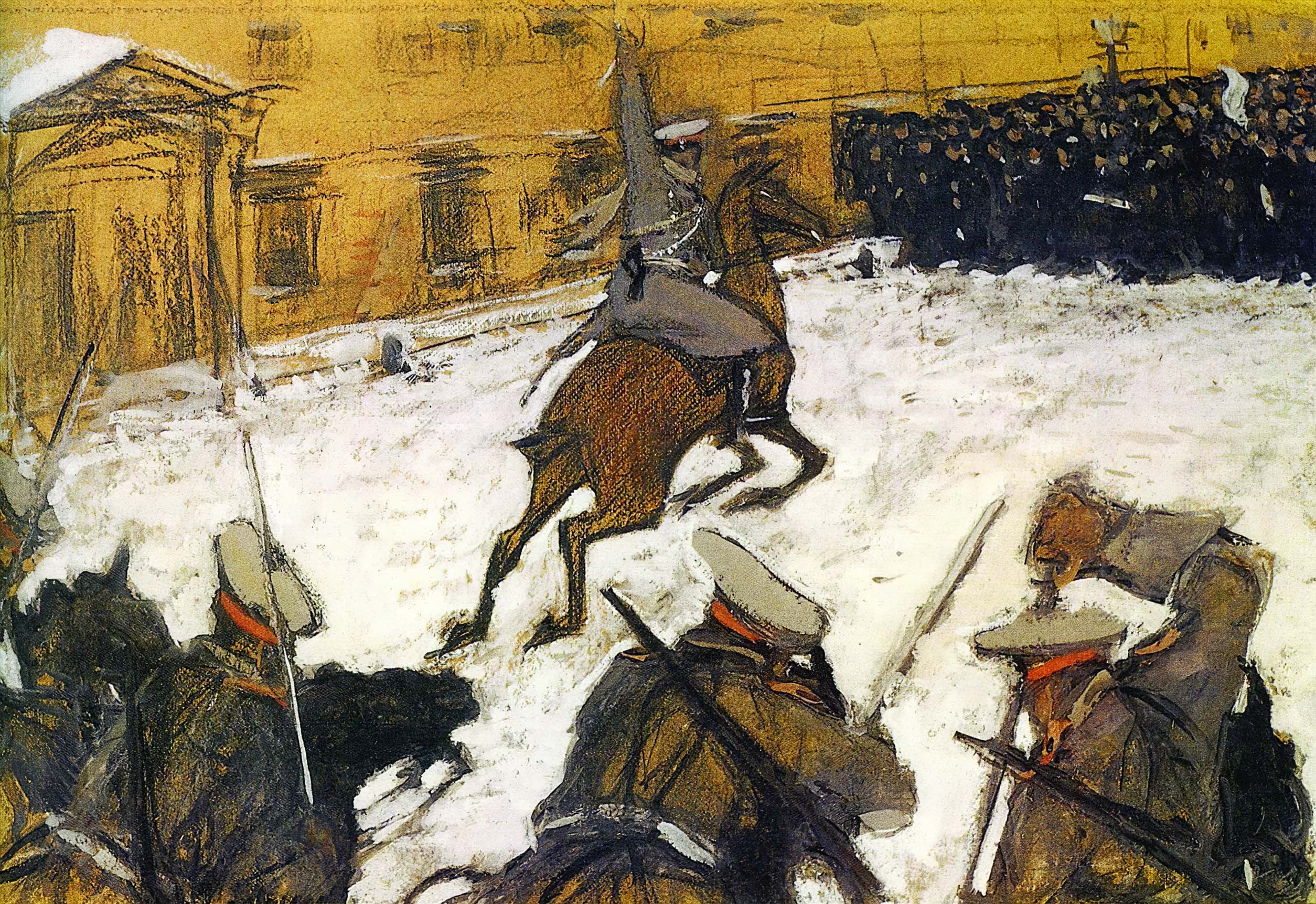
On 9 January (all dates in Russian ‘Old Style’ calendar), a peaceful march of workers and peasants, trying to present a petition to the tsar at the Winter Palace, was fired upon by armed Cossacks, killing hundreds. ‘Bloody Sunday’, as it became known, provoked a huge strike wave that spread to 122 towns and localities. The students also rose up, and the big universities in St. Petersburg and Kiev became open spaces of revolutionary organisation.
Trotsky was in Geneva when he received news that the 1905 Revolution had begun, as he had predicted, with an all-Russia strike. But what should happen next? For Trotsky, the workers who had started the revolution must lead any revolutionary government after the fall of tsarism:
“The victory of the uprising as well as the triumph of the revolution can be achieved only by the proletariat. […]
“Therefore the composition of the Provisional Government will mainly depend on the proletariat. To be more precise, if the uprising wins a decisive victory then the power will be given to those who led the proletariat.”[12] [i.e. the party of Social Democracy, our emphasis]
In a foreword to Before the Ninth of January, written in January 1905, Alexander Helfand, also known as Parvus, stated that, having liquidated the autocracy and taken power, the proletariat would expect the Social Democracy to carry out reforms in its interest. Such a regime “would propel revolutionary change to the furthest limits compatible with private property and bourgeois democracy”.[13] At this point, the workers’ liberal democratic ‘allies’ would turn on them, meaning “it will be necessary to struggle first against the autocracy and then against the bourgeoisie”.[14]
Trotsky and Parvus stood virtually alone in the Social Democracy with this perspective.
Lenin shared the view of Trotsky and Parvus that the feeble and cowardly Russian bourgeoisie was incapable of carrying out the democratic revolution. However, he thought their conception did not take sufficient account of the peasantry. While it is unclear whether he read the entirety of Before the Ninth of January, in March 1905 he called its author a “windbag”, its contents “bombastic”, and singled out Parvus’ foreword for special criticism.[15]
Lenin similarly objected to the crude slogan, “No tsar, But a workers’ government!” that emerged in 1905 – falsely attributed to Trotsky, and likely originating from Parvus – again, for excluding the peasantry.
As ever, Lenin was beginning with a sober, concrete analysis of the objective situation. He regarded the idea of a revolutionary democratic government that did not reflect the class composition of a majority-peasant country to be a contradiction in terms. Throughout 1905, Trotsky would refine his perspective on the relationship between the working class and the peasant masses.
Trotsky and Parvus
Parvus was at that time a theoretician of stature in the Marxist movement, with whom Trotsky had lived and worked closely in exile. He stood on the left of the German Social Democracy, along with Rosa Luxemburg. Drawing substantially on the work of liberal historian Pavel Milyukov, he predicted a Europe-wide process of war and revolution: the result of capitalism straining against the fetter of the nation-state. And he said it would begin in Russia.
He argued that the tsarist state evolved as a bureaucratic-military apparatus that relied on its large army to resist pressure from more advanced European economies. It was forced to invest in industry to preserve its military might, while leaving the rest of society in a backward state. In doing so, it was reliant on capital from abroad – he called Russia a “pensioner of the French Bourse [stock exchange]”.[16]
Parvus said the tsar was compelled to plunder his near abroad to assert independence against his creditors and whip up patriotic fervour to distract from the rottenness at home. But precisely because of the rottenness of tsarism, Russia was bound to lose these new wars, creating a national revolutionary crisis, which combined with its military blunders would destabilise the whole continent. He wrote an article in February 1904 arguing that the Russo-Japanese War and the resultant crisis were the beginning of this process:
“The worldwide process of capitalist development leads to a political upheaval in Russia. This in turn must have its impact on the political development of all capitalist countries. The Russian Revolution will shake the bourgeois world. […] And the Russian proletariat may well play the role of the vanguard of the social revolution.”[17] [our emphasis]
During the First World War, Parvus degenerated into a German national chauvinist and an arms dealer; but years later Trotsky still noted his influence on the theory of permanent revolution, and said their ideas at the outset of 1905 “bordered closely”.[18]
However, while they started in a similar position, Trotsky ultimately went far further. Parvus maintained that Russia’s backward and semi-feudal character could result only in a Social Democratic party operating as part of a bourgeois provisional government, along the lines of the Australian Labor Party at that time. He talked about the workers holding power “temporarily”, and straining but not breaking with the regime of private property.
Trotsky’s predictions about how far the workers could go were unclear in January 1905, but events sharpened his perspective.
The revolution’s first act
Trotsky arrived in Kiev in February 1905, using a passport in the name of a retired corporal. He eventually made his way to the centre of the growing strike movement, St. Petersburg, and quickly gained authority amongst striking workers with his speeches and articles. Following a betrayal by an agent provocateur in the Mensheviks’ ranks, he was soon forced to flee again to Finland.
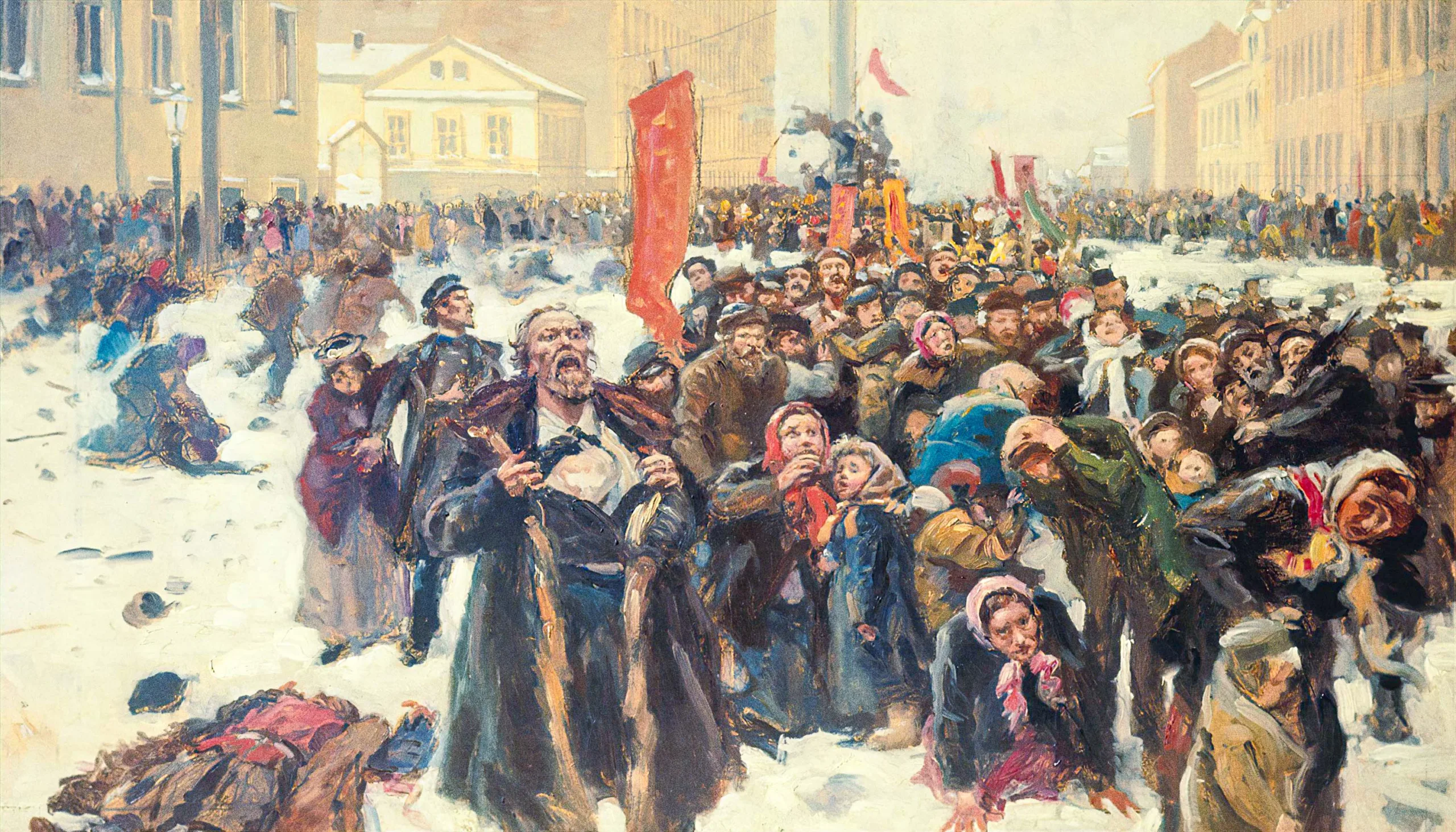
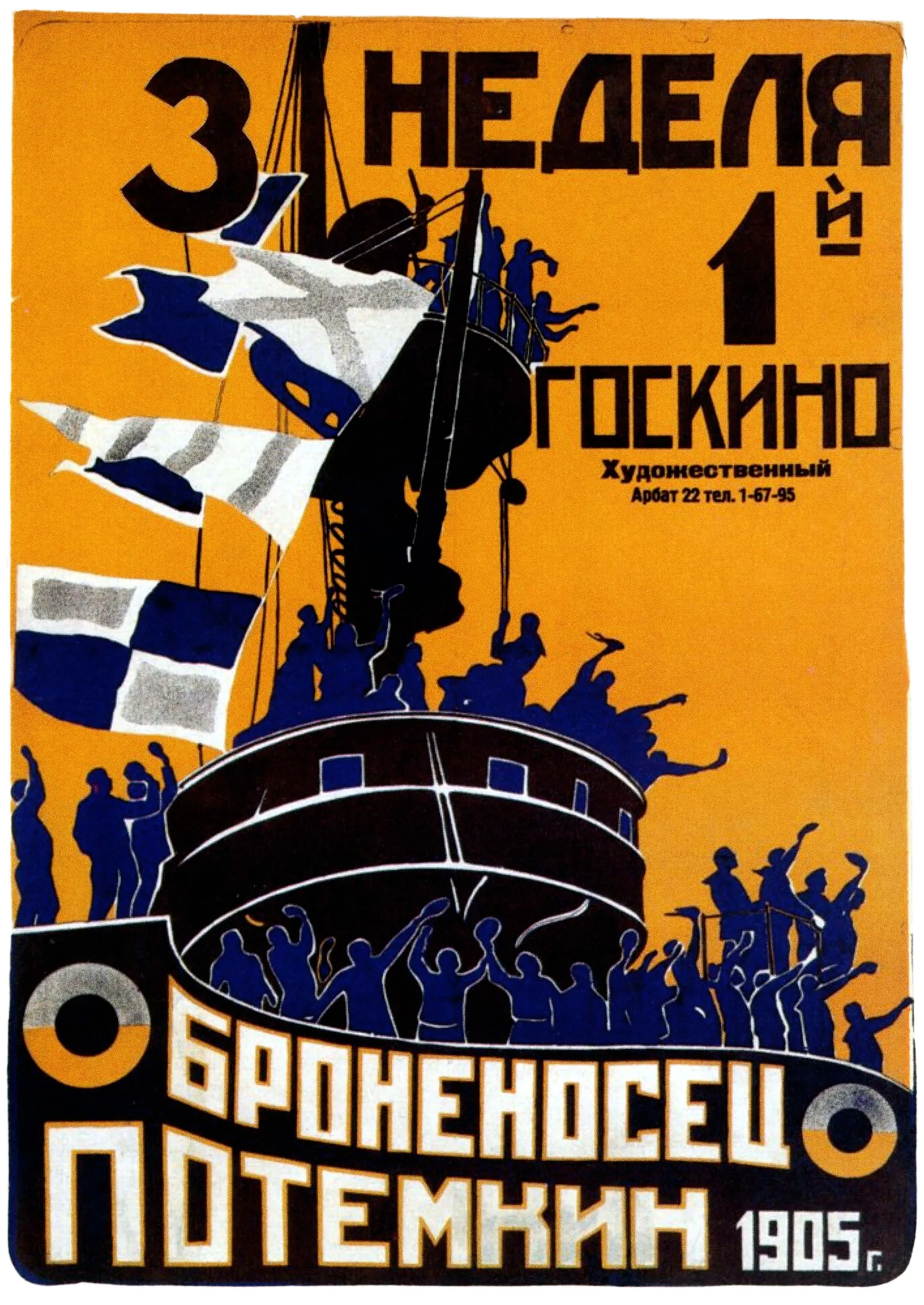
The 1905 Revolution unfolded over the course of several acts. The first wave of strikes culminated in the tsar’s approval of the ‘Bulygin Constitution’ on 6 August, which promised a Duma – an elected parliament.
The Bulygin Constitution was received positively by the leader of the liberal Constitutional Democratic Party (Cadets), Pavel Milyukov. Trotsky wrote an open letter to Milyukov in August 1905, attacking the liberals for trusting the autocracy to grant them democratic rights rather than fighting to extract them, a task, therefore, falling to the workers and peasantry:
“You draw the next tasks as the logical deepening and strengthening of the constitution on the fact of its lawful basis; whereas the tasks consist of the seizing of the material conditions of power from the hands of absolutism by the victory of the revolution. […] How unhappy would Russian freedom be if it depended on you!”[19]
In July, Trotsky wrote an essay on a famous 1862 speech by the German socialist Ferdinand Lassalle, in which he placed events in Russia within an international context:
“Political emancipation, led by the Russian working class, is raising the latter to heights that are historically unprecedented, providing it with colossal means and resources, and making it the initiator of capitalism’s worldwide liquidation, for which history has prepared all the objective preconditions.”[20] [our emphasis]
In other words, Trotsky saw the revolution in Russia as the beginning of a process that would end with the overthrow of capitalism on a world stage.
That same month, Lenin wrote Two Tactics of Social Democracy in the Democratic Revolution, which argued that the workers alone could defeat tsarism: a victory that would “carry the revolutionary conflagration into Europe”.[21] Events were already leading to a convergence between the two men.
The St. Petersburg Soviet
After a period of ebb, a new strike movement broke out in September, beginning with printworkers in Moscow demanding a higher piecework rate per 1,000 letters set, not excluding punctuation marks, and shorter hours.
Sympathy strikes had spread to the whole country by October. The factories, railways, banks, power stations and government offices all fell silent. Striking workers raided gun shops and set up barricades to defend themselves from gendarmes and Cossacks. Sympathetic troops attended workers’ meetings, claiming that one-third of the army was ‘with the people’.
The countryside was also in revolt. More than 2,000 landowners’ estates were wrecked and burned. The most politically advanced peasants held the first congress of All-Russian Peasant Union in August 1905, and another in Moscow in November, which called for a joint struggle and a general agrarian strike to be decided “by agreement with the working class”.[22]
Trotsky returned to St. Petersburg in October at the height of the general strike, with a plan for an elected non-party, delegate organisation to represent the workers. The Mensheviks in St. Petersburg had already made such a call. But the workers needed no urging.
The St. Petersburg Soviet started with a nucleus of workers from 50 print shops and rapidly developed into the citadel of the general strike. Further soviets sprang up in other cities and towns.
The Bolshevik Central Committee and their leaders in St. Petersburg initially held the sectarian position that the Soviet should adopt the Bolshevik programme before they would join. When Lenin returned to Russia in November, he corrected this blunder, which in any event had been ignored by the Bolshevik rank and file.
As Trotsky later explained:
“One could write an instructive chapter on the leadership of the Leninists without Lenin. […] When they happened to be separated from Lenin at a critical moment, they amazed one by their utter helplessness.”[23]
Trotsky addressed the St. Petersburg Soviet for the first time on 16 October at the Technological Institute. This meeting was attended by about 100 delegates elected by 200,000 workers, or about 50 percent of the proletarian population of the capital. Trotsky emerged as the Soviet’s political figurehead and later its elected chairman. He also wrote all of its proclamations and resolutions, and edited its organ, Izvestia (‘Tidings’).
Both factions of the RSDLP cooperated in the Soviet, alongside the Socialist Revolutionary Party (the political successors to the Narodniks). Lenin raised no objections to any of the Soviet’s resolutions, all of which were written by Trotsky, despite their past enmity. A telling episode is related by Lunacharsky in his memoirs:
“I remember somebody saying in Lenin’s presence: ‘[…] the strong man in the Soviet is Trotsky’. For a moment Lenin’s expression seemed to darken; then he said, ‘Well, Trotsky has won this by his tireless and striking work.’”[24]
Faced with the immense power of the general strike and the authority of the Soviet, the autocracy blinked. On 17 October, the tsar was forced to present a manifesto (written by the liberal Sergei Witte, first chairman of the Council of Ministers) promising universal suffrage, civil liberties and a constitution. In November, he tried to quell the peasants with a manifesto proclaiming the abolition of redemption payments for land allocations and the enlargement of the peasant bank funds.
Thus, Trotsky quipped: “the strike which started over punctuation marks […] ended by felling absolutism.”[25] These democratic concessions confirmed Trotsky’s premise in practice:
“The partial victory of the October strike had for me a tremendous theoretical as well as political importance. It was not the opposition of the liberal bourgeoisie, not the elemental risings of the peasantry or the terrorist acts of the intelligentsia, but the strike of the workers that for the first time brought tsarism to its knees.”[26]
Still, Trotsky called for there to be no illusions. He gave a speech from the balcony of the University of St. Petersburg in which he tore up a copy of the October Manifesto, warning it wasn’t worth the paper it was written on, as it could be revoked at any time while the autocracy remained.
The revolution peaks
The promise of a constitution nonetheless created divisions in the revolution, whose conservative layers felt things had gone far enough. “What were the Cadets, those frock-coated politicians, those tribunes of the rural assemblies, to do in such a situation?” Trotsky later asked. “They passively waited for the constitutional waters to start flowing.”[27] They also voted for the government plan for army recruitment and promised to vote for the imperial budget.
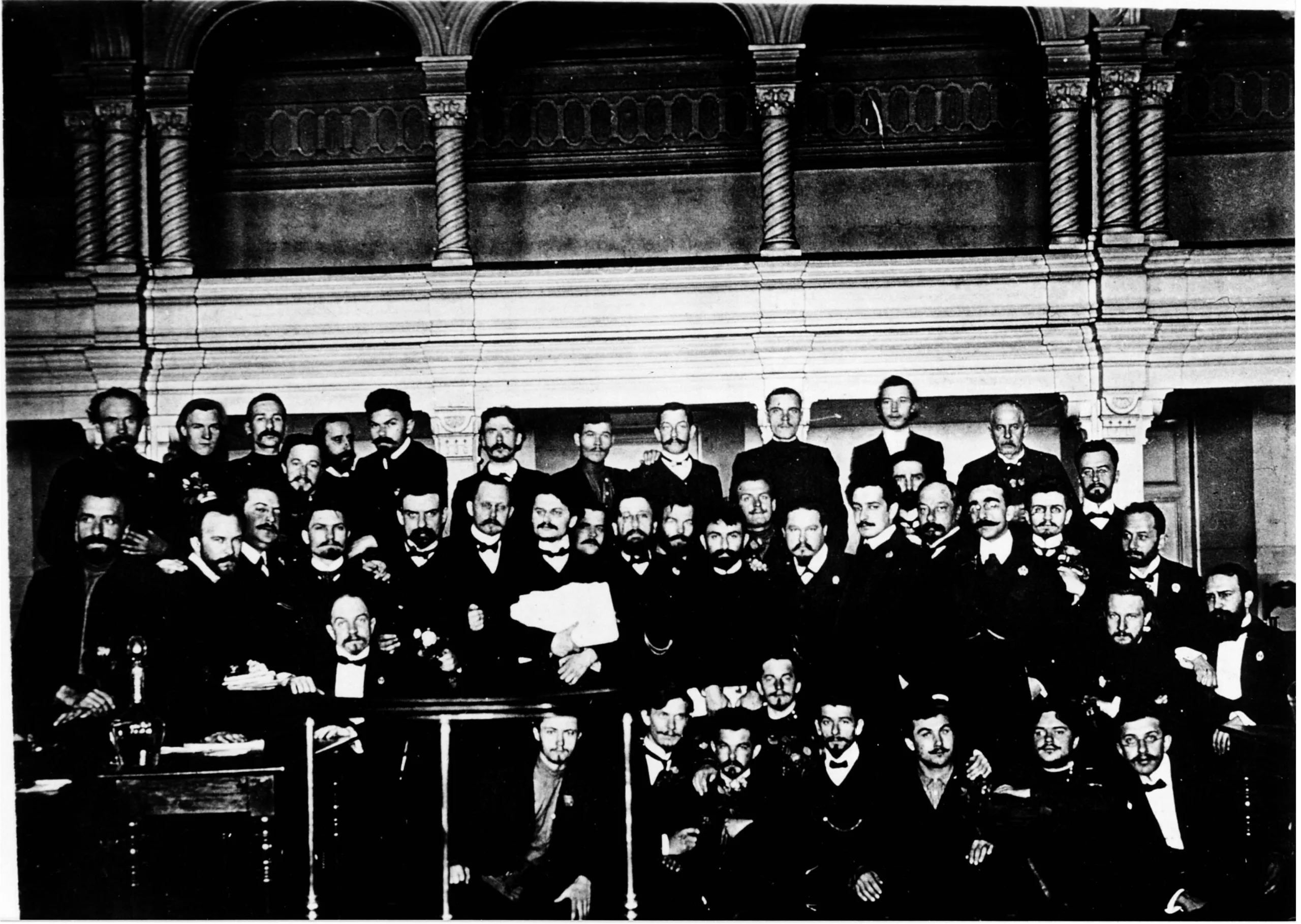
The tsar took advantage of the divisions and unleashed the fascist Black Hundreds against the workers and peasants. These ‘patriotic’ thugs murdered 3,500 to 4,000 people and maimed as many as 10,000 in 100 towns. “Thus,” Trotsky writes, “did the old order avenge its humiliation!”[28]
While the liberals capitulated, there was pressure from within the most radical rank-and-file elements of the Soviets to go further. On 26 October, delegates from one of the St. Petersburg districts spontaneously decided to introduce the eight-hour working day at their factories by revolutionary means. Following their lead, the Soviet called on all factories and plants to introduce the eight-hour working day by whatever means necessary. The workers were spontaneously advancing their own demands.
That same day, a revolutionary mutiny broke out at the Kronstadt naval base, which was swiftly put down following the declaration of martial law. The ringleaders were threatened with execution.
Russian-annexed Poland had seen major strikes and workers’ struggles throughout the year, with an insurrection in Łódź that was put down in blood in June. The entire Russian Partition of Poland was placed under martial law on 28 October. On 29 October, the same measure was carried out in districts of the Chernigov, Saratov and Tambov provinces, which had seen agrarian unrest.
Mass meetings of workers were immediately convened to demand drastic measures from the St. Petersburg Soviet. On 2 November, a unanimous general strike was launched in the city demanding that the arrested sailors be spared the death penalty, and that martial law be lifted in Poland and throughout Russia. In the face of this overwhelming pressure, the government once again backed down and the victorious strike ended on 7 November.
While the St. Petersburg workers justly celebrated their success, the revolution had already passed its peak. The demand for an eight-hour day was preparing a decisive showdown. As October rolled over into November, workers across St. Petersburg began leaving their factories and plants en masse after eight hours. In some cases, they enforced the eight-hour day through ‘takeovers’; seizing control of their workplaces from the bosses. This was a major escalation.
Fulfilling Trotsky and Lenin’s warnings that they were not to be trusted, the liberal bourgeoisie immediately denounced the movement for the eight-hour day in their press. The proletariat stood alone as the forces of reaction became more intransigent.
The turning tide
The capitalists were recovering their senses from the suckerpunch of the October and November strikes. Starting with the civil service and state-owned companies, the bosses in St. Petersburg counterattacked with a universal lockout, throwing thousands of workers into the streets.
At the head of the St. Petersburg Soviet, Trotsky saw that the workers had taken the tactics of strikes and walkouts to their limit. At this point, only insurrection could win the eight-hour day, which would necessarily advance the revolution to its logical conclusion: the conquest of power. But this posed a number of difficulties.
For one thing, it required arms, which necessitated support from a sizable layer of the armed forces, i.e. the peasants in uniform. This had not been accomplished, despite a significant layer expressing sympathy with the revolution, particularly in the navy. Indeed, loyalist troops were being aggressively deployed to break up workers’ meetings.
The primary problem was that, while the authority of the Soviet was formidable in St. Petersburg, this was not the case elsewhere in Russia. The real movement of the peasantry would not take off until 1906, by which time the revolution had suffered defeats in the cities. As such, the workers would have been left prosecuting the battle for the eight-hour day (in reality a battle for state power) without the support of the rest of the country. This could only have ended in crushing defeat, dealing a demoralising blow to the entire Russian working class.
Thus, on 12 November, after a four-hour debate, the Soviet resolved to end the struggle for the eight-hour day. The decision was met with outrage by many rank-and-file workers, who were ready and willing to fight until the end. It was only the immense authority of the Soviet that permitted a dignified retreat in good order, thus preserving the revolution’s forces and avoiding a total rout. The Executive Committee summed up the campaign with the following words:
“We may not have won the eight hour day for the masses, but we have certainly won the masses for the eight-hour day. Henceforth the war-cry: ‘Eight hours and a gun!’ shall live in the heart of every Petersburg worker.”[29]
The wisdom of this organised withdrawal, and unripe conditions for a successful uprising, were tragically illustrated in December.
In a final attempt to reclaim the political initiative, the St. Petersburg Soviet published a ‘Financial Manifesto’, written by Parvus, calling for a financial boycott, criticising the regime’s corruption, and demanding that it open its books. This was the final straw: the autocracy decided to decapitate the revolution, arresting the entire leadership of the Soviet on 3 December.
The St. Petersburg workers responded to the arrests and the publication of the Financial Manifesto with a general strike on 8 December. But it was far weaker than the November strike, involving only two-thirds of the city’s workers, and collapsed after four days. With its leadership in custody and the strike wave ebbing, it was clear the revolution had been dealt a mortal blow.
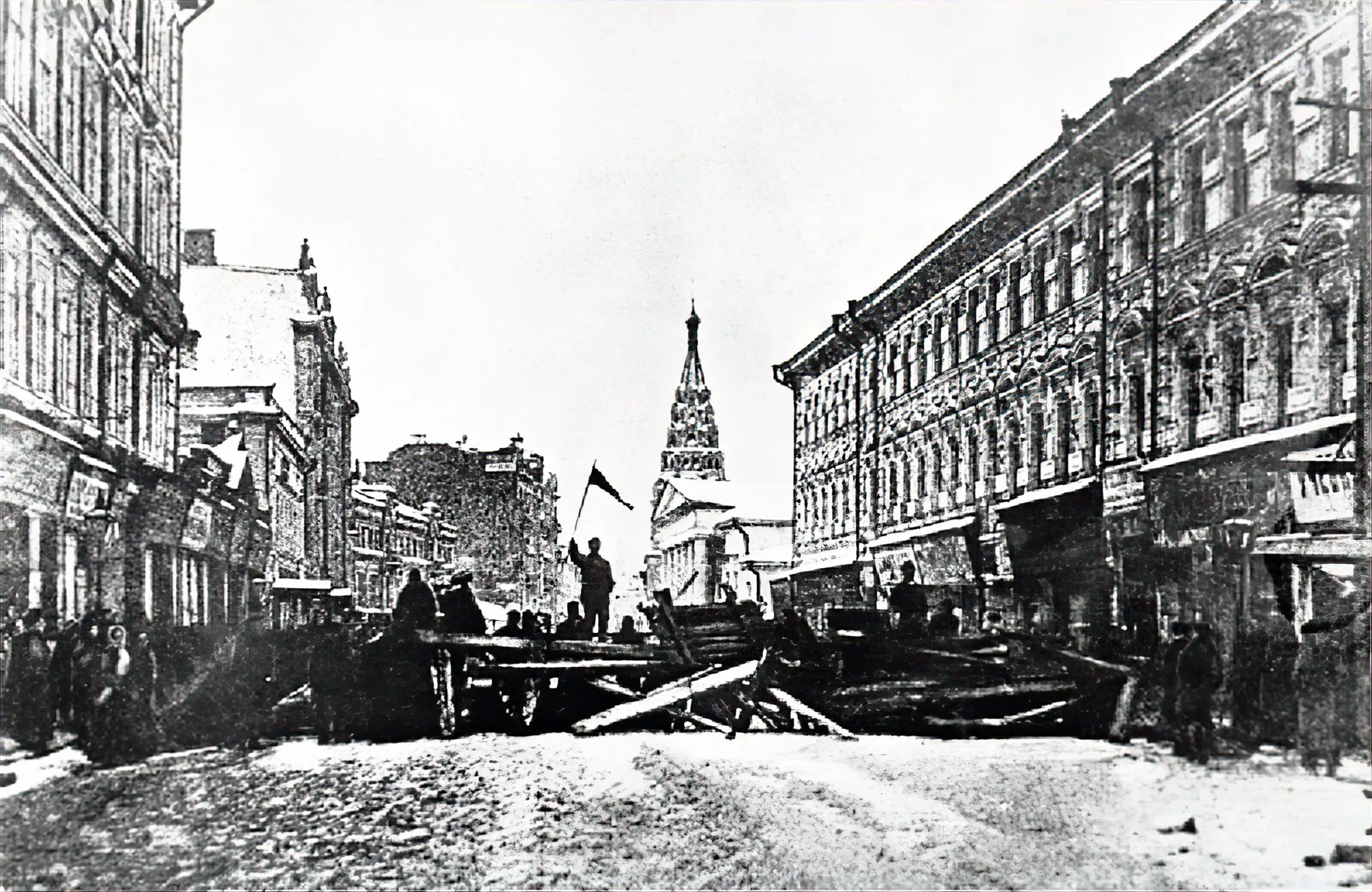
The denouement came when the Moscow Soviet heard news of the arrest of the St. Petersburg Soviet and called a general strike on 7 December, which rapidly turned into an uprising. After 10 days of street fighting, and unsuccessful attempts to fraternise with the loyalist soldiers deployed against them, the isolated workers were crushed.
Results and prospects
Trotsky spent the next 15 months in prison, during which he wrote, among other things, Results and Prospects, and his account of the 1905 Revolution. Unlike in his previous prison stays, where he had been a student of Marxism, now he was a teacher.
In Results and Prospects, he finally articulated his theory of permanent revolution, forged in the furnace of revolution. As he later wrote:
“It was precisely in the interval between January 9 and the October strike of 1905 that those views which came to be called the theory of ‘permanent revolution’ were formed in the author’s mind.”[30]
The essence of Results and Prospects is a defence of dialectical materialism, the philosophical method of Marxism, grounded in Trotsky’s direct experience of 1905. It tears down the Social Democrats who robotically cited fragments of Marx and Engels’ analysis of the revolutions of 1848 to ‘prove’ that a socialist revolution in Russia was ‘impossible’. In particular, they fixated on a paragraph from Engels’ pamphlet, Revolution and Counter-Revolution in Germany (originally published in Marx’s name with his permission), quoted by Trotsky in Results and Prospects:
“The working class in Germany is, in its social and political development, as far behind that of England and France as the German bourgeoisie is behind the bourgeoisie of those countries. Like master, like man. […] The working-class movement itself never is independent, never is of an exclusively proletarian character until all the different factions of the middle class, and particularly its most progressive faction, the large manufacturers, have conquered political power, and remodelled the state according to their wants.”[31]
Trotsky objected that this statement was “considerably abused by the textual Marxists” to argue that, since the Russian capitalists (like their German counterparts in 1848) had yet to conquer power and remodel the state in their image, the workers would simply have to get in line and wait their turn. In short, they reduced Marx and Engels’ ideas to a stale and mechanical ‘formula’ of historical development in discrete, identical stages. But these scholastics lacked any understanding of the Marxist method. As Trotsky explained:
“Marxism is above all a method of analysis – not analysis of texts, but analysis of social relations. Is it true, for Russia, that there cannot be an independent labour movement until the bourgeoisie has conquered power? It is sufficient merely to put these questions to see what a hopeless formalism lies concealed beneath the attempt to convert a historically-relative remark of Marx’s into a supra-historical axiom.”[32]
Throughout all of their works it is easy to see that the real method of Marx and Engels was completely alien to that of the ‘textual Marxists’. In fact, Marx and Engels talked about the bourgeoisie having outlived its progressive historical role in the aftermath of 1848. Indeed, in the same work quoted by the Mensheviks, Engels ruled out bourgeois rule as “forever impossible in Germany”.
It is not an accident that Trotsky cribbed the name ‘permanent revolution’ from Marx’s 1850 address to the Communist League, where he talked about the need to make the revolution ‘permanent’ until the workers had seized the means of production in all the main economies.
In relation to Russia, Marx and Engels even suggested that far from having to go through a stage of capitalist development, the Russian peasant commune could pass directly to the “higher form of Communist common ownership”: on the condition of a victorious proletarian revolution in the West.[33]
Developing the theory
Marx’s permanent revolution was based on his analysis of the revolutions of 1848, particularly those of France and Germany, where the politically bankrupt European bourgeoisie leaned on the masses in their fight against the remnants of feudalism, only to unite with the forces of ‘order’ to crush them. Neither the workers nor the urban petty bourgeoisie were capable of throwing aside the ‘political corpse’ of the bourgeoisie at the decisive moment, and the proletariat was too weak to accomplish this by itself, being still in its infancy.
The conditions in Russia in 1905, however, were different. Trotsky developed Lenin and Parvus’ writings about the peculiarities of the Russian economy and state with the concept of combined and uneven development. He argued that, under the pressure of the world market, Russian industry was forced to develop to a high level in the urban centres.
Trotsky argued that, unlike in the West, the native Russian bourgeoisie did not emerge out of urban guilds into a class with their own independent interests in developing Russian capitalism. Instead, industry was financed by foreign capital, whose investments were guaranteed by the autocracy, wielding the brutal repressive state apparatus:
“Thus large-scale capital achieved economic domination without a struggle. But the tremendous part played in this process by foreign capital has had a fatal impact on the Russian bourgeoisie’s power of political influence.”[34]
As a result, the Russian bourgeoisie, weak and parasitic from the outset, could not independently accomplish its historic tasks. At their backs, the bourgeoisie felt the threat of a powerful industrial proletariat, the urban class destined to lead Russia’s democratic revolution.
Although the Russian workers were a minority, their outsized economic role and natural organisational structures gave them strength and influence well beyond their numbers. In 1905, they shoved aside the bourgeoisie, set up the soviets, went to war with the autocracy and alone extracted democratic concessions. Trotsky explained the character of the revolution as follows:
“So far as its direct and indirect tasks are concerned, the Russian revolution is a ‘bourgeois’ revolution because it sets out to liberate bourgeois society from the chains and fetters of absolutism and feudal ownership. But the principal driving force of the Russian revolution is the proletariat, and that is why, so far as its method is concerned, it is a proletarian revolution.”[35]
In other words, it was precisely the backwardness of Russia that compelled the working class to play the decisive role in the revolution. And having won democratic concessions, Trotsky argued, the workers would not ‘respect’ historical formulas and hand power to the bourgeois liberals, but advance their own class interests. This in turn would push the liberals into the camp of counter-revolution. 1905 and the battle for the eight-hour day offered a glimpse of this.
Logic of revolution
Trotsky argued that ‘minimum’ demands like the eight-hour day would inevitably be met with implacable resistance from the bosses, who could not grant such concessions based on underdeveloped Russian capitalism. Again, this was illustrated in the November strike. Similarly, any serious attempt to resolve the agrarian question would provoke a backlash from the capitalists and the semi-feudal landowners, both of whom profited from the status quo. Indeed, many capitalists were themselves landlords.
Hence, the proletariat – the class that had led the revolution – would need to take power for itself. Having done so, the development of industry and the resolution of the land question could only be achieved through democratic management of the economy by the workers and poor peasants. Thus, the revolution would grow over from the bourgeois to the socialist in a ‘permanent’ revolutionary process.
Furthermore, Trotsky argued that the impact of the revolution would not be confined to Russia’s borders, but become the spark for an all-European revolution:
“The influence of the Russian Revolution upon the European proletariat is tremendous. Besides destroying Russian absolutism, the main force of European reaction, it will create the necessary prerequisites for revolution in the consciousness and temper of the European working class.”[36]
Trotsky's prediction was fully confirmed after the October Revolution in 1917, which was followed by revolutionary upsurges in Hungary, Germany, Italy and beyond.
The revolution spreading internationally was not only likely but also necessary for its survival. Trotsky emphasised that, while the objective conditions for socialist revolution existed on the world stage, and political prerequisites for the workers and peasants taking power existed in Russia, a fledgling proletarian regime resting on backward economic conditions could neither survive for long nor build socialism. Thus:
“[The proletariat] will have no alternative but to link the fate of its political rule, and, hence, the fate of the whole Russian revolution, with the fate of the socialist revolution in Europe.”[37]
The role of the peasantry
In Results and Prospects, Trotsky highlighted the revolutionary potential of the peasant masses and the necessity of winning them to the workers’ side with a programme of expropriating the landlords, ending the burden of taxation on the rural poor, and recognising all revolutionary land expropriations. Both he and Lenin agreed that a victorious revolution would end with the conquest of power of the proletariat in alliance with the peasantry, with a subtle but important difference in their conceptions.
In the first half of 1905, Lenin argued (in opposition to the Mensheviks) that the RSDLP should participate in any revolutionary government following the fall of the autocracy, and strive to build a “democratic dictatorship of the proletariat and the peasantry”. He said the course of history “posed before the Russian proletariat precisely the task of carrying through the democratic bourgeois revolution”, a task that “confronted the people as a whole, i.e. the entire mass of the petty bourgeoisie and the peasantry”.[38]
A revolutionary dictatorship of the proletariat and the peasantry would not only represent the democratic aspirations of the great majority of the country, but would lay the most favourable foundations for the development of socialism. He explained in Two Tactics:
“While recognising the uncontestably bourgeois nature of the revolution, which is incapable of directly overstepping the bounds of a mere democratic revolution, our slogan pushes forward this particular revolution and strives to mould it into forms most advantageous to the proletariat; consequently, it strives to make the very most of the democratic revolution in order to attain the greatest success in the further struggle of the proletariat for socialism.”[39]
Again, Lenin was trying to take account of the composition of Russia, with its overwhelming peasant majority, in his perspective for the democratic revolution. For his part, Trotsky interpreted the ‘democratic dictatorship’ slogan as intentionally vague and “arithmetic”,[40] allowing for the possibility that the peasantry might outnumber the workers in a revolutionary government. This in turn obscured the question of which of the two classes would lead such a regime.
Trotsky was more categorical: the workers must lead the peasantry, who had never in history played an independent role, and whose loyalty would be earned by the class that liberated it from landlordism and could modernise the countryside. If this was not achieved, the peasantry would become a base for counter-revolution, as demonstrated by the crushed uprising in Moscow. By the spring of 1917, Lenin abandoned his old slogan in favour of “All Power to the Soviets”, which was to all intents and purposes the same as Trotsky’s position.
Legacy
Years later, Trotsky summarised the theory of permanent revolution in the following way:
“The complete victory of the democratic revolution in Russia is inconceivable otherwise than in the form of the dictatorship of the proletariat basing itself on the peasantry. The dictatorship of the proletariat, which will inescapably place on the order of the day not only democratic but also socialist tasks, will at the same time provide a mighty impulse to the international socialist revolution. Only, the victory of the proletariat in the West will shield Russia from bourgeois restoration and secure for her the possibility of bringing the socialist construction to its conclusion.”[41]
After 1905, although the autocracy superficially appeared triumphant, things had changed. Despite a period of black reaction, the masses had gained direct experience of revolutionary combat. They had learned new methods of struggle and had begun acquiring leaders. By generalising the lessons of the year and developing the theory of the permanent revolution, Trotsky provided an essential guide to action.
We cannot say whether Trotsky’s analysis swayed Lenin, or whether Lenin arrived at his conclusions independently. What can be said is this: Trotsky was the first to draw the correct conclusions from 1905, which reflected the objective logic of the revolutionary process in Russia. And had Lenin not waged a struggle to re-arm the Bolsheviks’ programme in accordance with the essence of this theory in April 1917, they would not have taken power. This was confirmed by the experience of the Mensheviks after February 1917, who tied their fate to the bourgeois Provisional Government of Kerensky and almost wrecked the revolution.
Trotsky used his theoretical mastery and experience of leading the revolutionary masses to break decisively with schematism, asserting the real essence of dialectical materialism as a method for understanding the revolution as a living organism and identifying its real tasks. This was nothing short of an immortal conquest, which Marxists today inherit as an essential tool for understanding the dynamics of revolutionary struggle. The lessons of 1905 are therefore key to the eventual victory of the working class in the future world socialist revolution.
References
[1] L Trotsky, 1905, Penguin Books, 1973, pg 9
[2] L Trotsky, My Life, Wellred Books, 2018, pg 80
[3] Quoted in ibid.
[4] ibid. pg 82
[5] L Trotsky, My Life, Wellred Books, 2018, pg 110
[6] ibid. pg 83
[7] This is covered in depth in R Sewell & A Woods, ‘In Defence of Lenin’, Vol. 1, Wellred Books, 2024
[8] L Trotsky, My Life, Wellred Books, 2018, pg 143
[9] L Trotsky, ‘The Proletariat and the Revolution’, Our Revolution, Henry Holt and Company, 1918, pg 39
[10] R B Day, D Gaido (ed., trans.), ‘Up to the Ninth of January’, Witnesses to Permanent Revolution: The Documentary Record, Haymarket Books, 2009, pg 324
[11] ibid. pg 331
[12] L Trotsky, O Gluschenko (trans.), ‘Political Letter II’, Iskra, No. 93, 17 March 1905, Marxist Internet Archive, our emphasis
[13] R B Day, D Gaido (ed., trans.), ‘Up to the Ninth of January’, Witnesses to Permanent Revolution: The Documentary Record, Haymarket Books, 2009, pg 255
[14] ibid. pg 267
[15] V I Lenin, ‘Social-Democracy and the Provisional Revolutionary Government’, Collected Works, Vol. 8, Progress Publishers, 1977, pg 289
[16] Quoted in I Deutscher, The Prophet Armed, Verso, 2004, pg 104
[17] Quoted in I Deutscher, The Prophet Armed, Oxford University Press, 1945, pg 112
[18] L Trotsky, The Permanent Revolution and Results and Prospects, Wellred Books, 2020, pg 66
[19] L Trotsky, ‘Open Letter to Professor P.N. Miliukov’, Revolutionary Russia, Vol. 3, No. 2, 1990, pg 236
[20] R B Day, D Gaido (ed., trans.), ‘Introduction to Ferdinand Lessalle’s Speech to the Jury’, Witnesses to Permanent Revolution: The Documentary Record, Haymarket Books, 2009, pg 455, our emphasis
[21] V I Lenin, ‘Two Tactics of Social-Democracy in the Democratic Revolution’, Collected Works, Vol. 9, Progress Publishers, 1977, pg 57
[22] L Trotsky, 1905, Penguin Books, 1973, pg 210
[23] L Trotsky, My Life, Wellred Books, 2018, pg 156
[24] A Lunacharsky, Revolutionary Silhouettes, Hill and Wang, 1968, pg 60
[25] L Trotsky, 1905, Penguin Books, 1973, pg 102
[26] L Trotsky, My Life, Wellred Books, 2018, pg 159
[27] L Trotsky, 1905, Penguin Books, 1973, pg 176
[28] ibid. pg 153
[29] L Trotsky, 1905, Penguin Books, 1973, pg 201
[30] ibid. pg 8
[31] K Marx, ‘Germany: Revolution and Counter-Revolution’, Selected Works of Karl Marx, Vol. 2, Progress Publishers, 1942, pg 46
[32] L Trotsky, The Permanent Revolution and Results and Prospects, Wellred Books, 2020, pg 209
[33] K Marx, F Engels, ‘Preface to the Second Russian Edition of the Manifesto of the Communist Party’, Collected Works, Vol. 24, Progress Publishers, 2010, pg 426
[34] L Trotsky, 1905, Penguin Books, 1973, pg 56
[35] ibid. pg 66
[36] L Trotsky, The Permanent Revolution and Results and Prospects, Wellred Books, 2020, pg 262
[37] ibid. pg 263
[38] V I Lenin, ‘The Revolutionary-Democratic Dictatorship of the Proletariat and the Peasantry’, Collected Works, Vol. 8, Progress Publishers, 1977, pg 298
[39] V I Lenin, ‘Two Tactics of Social-Democracy in the Democratic Revolution’, Collected Works, Vol. 9, Progress Publishers, 1977, pg 87
[40] L Trotsky, The Permanent Revolution and Results and Prospects, Wellred Books, 2020, pg 164
[41] L Trotsky, ‘The Character of the Russian Revolution’, Fourth International, Vol. 3, No. 11, November 1942, pg 333