Noske’s counter-revolutionary actions were clearly revealed when he was sent to Kiel to put down the naval revolt. Ebert made no secret of his undying support for the monarchy. These new leaders of the SPD clearly saw their role as doing everything in their power to hold back the revolution. Their scandalous actions were not the product of naivety but conscious treachery.
The head of the government, Prince Max von Baden approached Ebert and asked, “If I should succeed in persuading the Kaiser, do I have you on my side in the battle against the social revolution?” Ebert replied, “If the Kaiser does not abdicate the social revolution is inevitable. I do not want it – in fact I hate it like sin.”
But the Kaiser was determined to hang on. He had completely lost touch with the situation and talked of the impertinence of his subjects towards their King and the need, if necessary, to repress them with “smoke-bombs, gas, bombing squadrons and flamethrowers!” General Groener told him bluntly, “Sire, you no longer have an army.”
Armed soldiers were roaming the streets of Berlin but still the Kaiser dithered, and refused to abdicate. The ruling class had to act fast as the SPD, under pressure, resigned from the newly appointed government. Without delay Prince Max, anticipating the Kaiser’s reply, announced the King’s abdication. Wilhelm II was astonished to hear the news secondhand!
The revolutionary wave sweeping Germany was similar to the events of that of February 1917 in Russia. Workers, soldiers and sailors took power into their own hands and spontaneously formed councils which took charge of the situation. As yet the masses did not differentiate between the different shades of rival socialists. “Out of sheer loyalty, hundreds of thousands of workers stuck to their old party which they had helped to build, no matter how violently they disagreed with its policy…loyalty to his organization has become a matter of instinct to the worker.” (Evelyn Anderson in Hammer or Anvil). In February 1917 in Russia the masses made no distinction between the Bolsheviks, Mensheviks and Social Revolutionaries (SRs). Trotsky explained how the Mensheviks and SRs had more resources at their disposal, more agitators, more propagandists, more links with the intelligentsia, and were able to use these points of support to influence the masses who had moved into struggle. In Germany as in Russia, only direct experience would put the workers’ loyalties to the test. In the short term, despite the treacherous role of the SPD leaders, who opposed the revolution, the masses saw their traditional organization as the embodiment of the party that had awakened them to political life. In this context, the USPD played an important but secondary role.
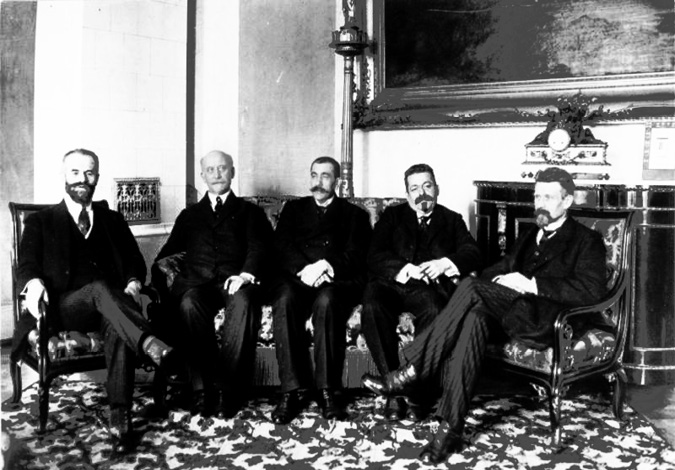
The right-wing leaders of the SPD in 1918 after the USPD split: (left to right) Otto Landsberg, Scheidemann, Noske, Ebert and Rudolf Wissell.