Years later in 1988, Yevtushenko made a courageous speech against the bureaucracy at the Writers’ Union, in which he denounced the privileges of the Party elite, quoted at the beginning of this chapter. Under Brezhnev, the position of artists and writers got steadily worse. At least under Khrushchev the ‘de-Stalinisation’ campaign left the window of artistic expression half open. But, for reasons we have already explained, a totalitarian regime cannot tolerate the slightest concessions to free speech. The experiments of Khrushchev proved to the ruling caste that this was dangerous terrain. The window was slammed shut. A series of notorious trials of writers like Sinyavsky and Daniel were a grim warning to the whole artistic community not to step out of line. They were once more compelled to grit their teeth and keep their heads down – or suffer the consequences. The result of this persecution was to push a section of the artists and intellectuals into anti-Soviet attitudes, thus further undermining the system.
Scandalously, the Party hacks attempted to attribute to Lenin the doctrine that writers must only put forward ideas which reflect the ‘General Line’. This is false from start to finish. A simple glance at the articles by Lenin show that they have been taken completely out of context. Lenin was referring to the party press, which is entirely different from general literature. A party is a voluntary union. Nobody is obliged to join it. But it is reasonable to expect that articles in the public journals of the party should in general reflect the ideas of the party. But Lenin never dreamed of applying this principle to the state.
As a matter of fact, Lenin wrote little on art and literature, being absorbed by other matters. His literary tastes were generally rather conservative, mainly the classics. For example, he did not like Mayakovsky’s poetry, which was too modern for his liking. On one occasion, after the Revolution when paper was in very short supply, he was appalled to discover that Mayakovsky’s verse was to be published in a large edition, but it never entered his mind to use his influence to stop it. Under Lenin and Trotsky, the artists and writers enjoyed the widest freedom to work and experiment. This explains the extraordinary blossoming of art and literature in the early period of Soviet power.
Stalinist totalitarianism had a baneful influence on art and literature. It succeeded in pushing a section of the cultural intelligentsia into the arms of the pro-capitalist reaction. The demand for ‘freedom’ struck a responsive chord. But the movement towards a market economy has meant that the world of Russian culture jumped from the frying pan into the fire. In the world of the jungle, culture has no place. The crooks, Mafiosi and get-rich-quick merchants are no less philistine than the old bureaucrats. The slashing of state expenditure on education and culture has the character of blatant vandalism. The effects were immediate and predictable.
Unemployment and poverty affects the intelligentsia as well as the workers. National institutions like the Bolshoi theatre saw artistic standards plummet. Promising young musicians emigrated abroad to find a living in second-rate provincial orchestras in Spain and Ireland. It was even possible to see professors from Ukrainian conservatories busking for a few francs before the tourists on the streets of Paris. Thus, in place of the old chains, the world of culture found itself bound fast with new ones. For it is just as easy to enslave, oppress and silence the individual using the monopoly of wealth as it is through control of the state. It means the exchange of one slavery for another. That is all.
Meanwhile, a new generation of cultural spivs and opportunists cater for the tastes of the mafia capitalists. Some became millionaires, like the Georgian sculptor Zural Tsereteli who, for obscure reasons appears to have a monopoly on contracts for putting up monumental sculptures in public places in Moscow. His work is of such dubious value that the managers of one park decided to quietly shunt it into a corner where it could go unnoticed. Tsereteli now lives in what used to be the German embassy. On this road, there is no real future for art, science and literature. Only a genuine regime of socialist democracy offers a fertile ground for the free flourishing of culture. Socialism was once defined by Trotsky as “human relations without greed, friendship without envy and intrigue, love without base calculation”. The struggle for such a society is a worthy objective for men and women who have dedicated their lives to the search for harmony, truth and beauty.
Trotsky, unlike Lenin, did write a great deal on art and literature. He somehow found time to participate in the lively debates between the different schools of literature in the 1920s. His writings, which defend a Marxist, class attitude to art, appeared under the title Literature and Revolution. But, while giving his opinions on each school from a Marxist standpoint, he never attempted to foist his views, or those of the Bolshevik Party on artists, much less demand “filial love” and “unshakeable trust” of them. Love and trust must be earned, not demanded or imposed by laws and censorship.
Years later, when Trotsky was in exile in Mexico trying to regroup the forces of Bolshevism-Leninism, he did not forget the creative intelligentsia. In a letter dated 1 June 1938, he wrote the following:
The dictatorship of the reactionary bureaucracy has stifled or prostituted the intellectual activity of a whole generation. It is impossible to look without physical repugnance at the reproductions of Soviet paintings and sculpture, in which functionaries armed with brushes, under the surveillance of functionaries armed with guns, glorify as ‘great’ men and ‘geniuses’ their chiefs, who in reality are without the slightest spark of genius or greatness. The art of the Stalinist epoch will go down in history as the most spectacular expression of the most abysmal decline that the proletarian revolution has ever undergone.
Only a new upsurge of the revolutionary movement can enrich art with new perspectives and possibilities. The Fourth International obviously cannot take on the task of directing art, that is to say, give orders or prescribe methods. Such an attitude toward art could only enter the skulls of Moscow bureaucrats drunk with omnipotence. Art and science do not find their fundamental nature through patrons; art, by its very existence, rejects them. Creative revolutionary activity has its own internal laws even when it consciously serves social development. Revolutionary art is incompatible with falsehood, hypocrisy, and the spirit of accommodation. Poets, artists, sculptors, musicians will themselves find their paths and methods, if the revolutionary movement of the masses dissipates the clouds of scepticism and pessimism which darken humanity’s horizon today. The new generation of creators must be convinced that the face of the old Internationals represents the past of humanity and not its future. (Trotsky, Writings 1937-38, pp. 351-2.)
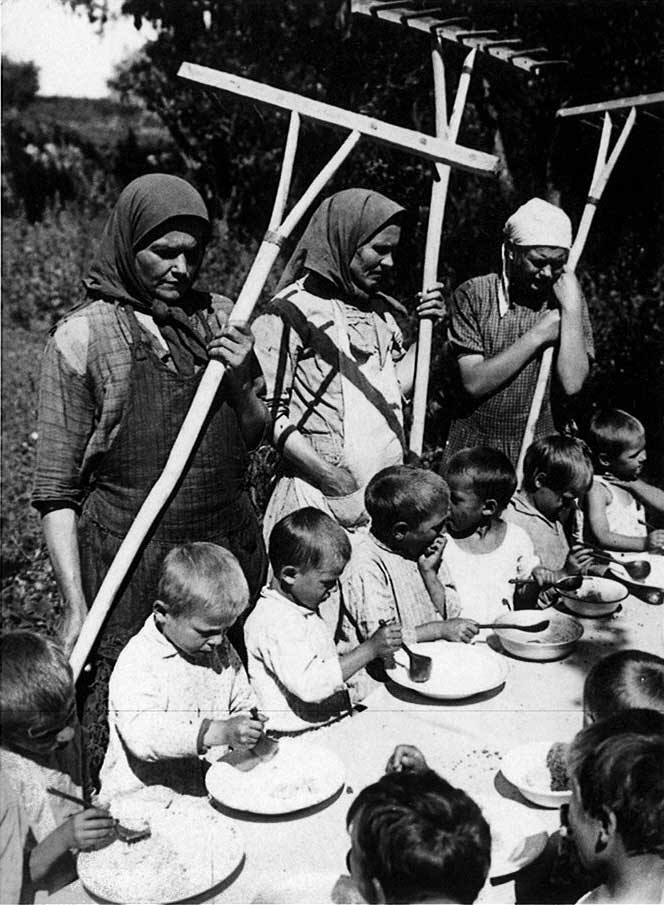
30. Lunchtime at a collective farm.
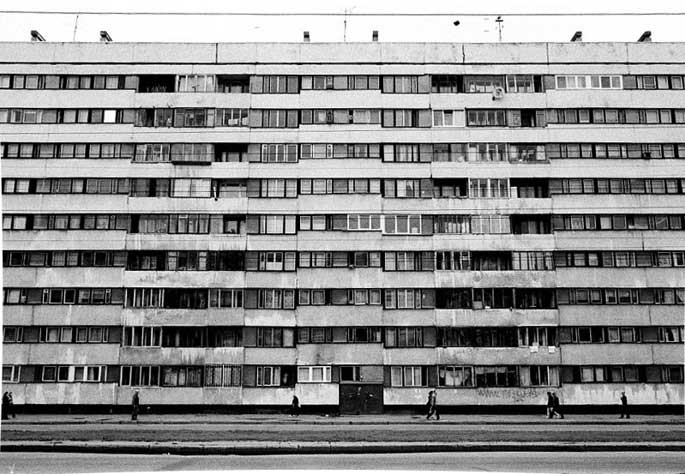
31. An apartment bloc in St Petersburg.
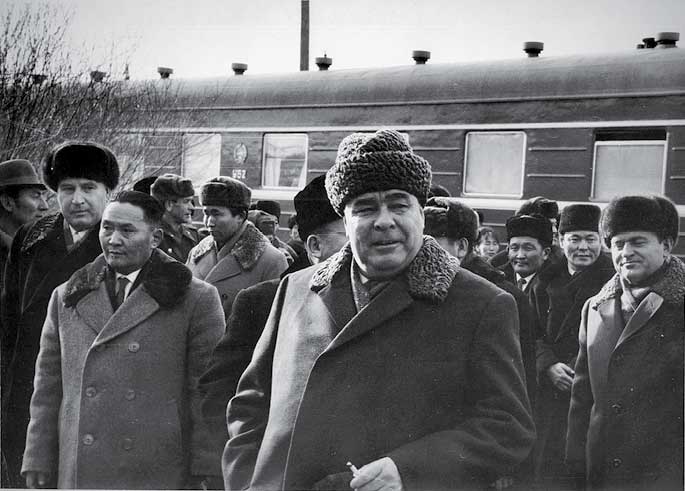
32. Leonid Brezhnev
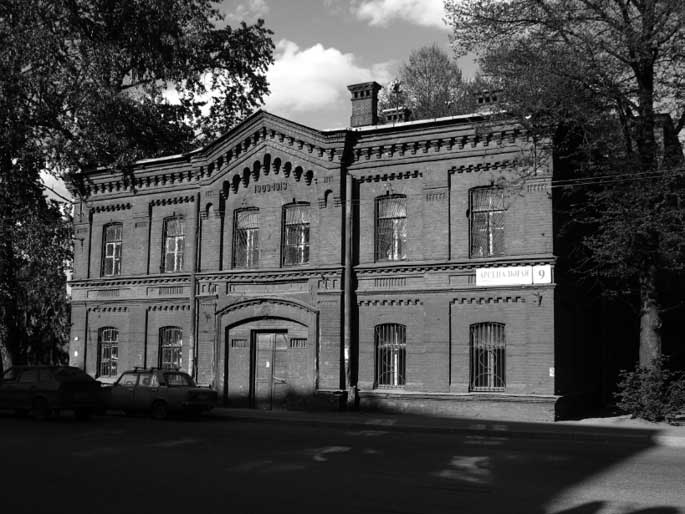
33. St Petersburg Psychiatric Hospital.