The debate over the class nature of the USSR is not an academic exercise, but has very serious practical consequences. Trotsky had previously warned that the tendency that adopts the false theory of state capitalism runs the risk of becoming “the passive instrument of imperialism”. But at the very time of a move to restore capitalism in Russia and Eastern Europe, the theories of state capitalism play the most pernicious role imaginable. The thinness and lack of theoretical insight of Cliff and his supporters is shown by their complete inability to explain the processes that are unfolding before our eyes in Russia. The whole thing is dismissed with the threadbare, flippant phrase that the bureaucracy just took a ‘step sideways’ (!), which, typically, explains nothing about the social regime in Russia either before or after. It tells us nothing about the relations of production, the class nature of the state, or the social content of the counter-revolution that is taking place. This is logical. Having denied the revolutionary significance of state ownership, the defenders of the theory of state capitalism are, in effect, compelled to deny that a counter-revolution is taking place at all! Thus, the concept of state capitalism stands revealed in the moment of truth as not merely theoretically bankrupt, but disastrous in practice.
In arguing his case Cliff dismissed Trotsky’s analysis of the class character of the Soviet Union as ‘contradictory’ to Marxism. According to him, Trotsky’s analysis “suffered from one serious limitation – a conservative attachment to formalism, which by its nature is contradictory to Marxism that subordinates form to content”. (Cliff, Russia: A Marxist Analysis, p. 145.) This view is also upheld by another prominent colleague of Cliff, Duncan Hallas, who states: “Trotsky’s analysis of the class struggle in the USSR after 1927 has clearly been shown to be erroneous.” (T. Cliff and others, The Fourth International, Stalinism and the Origins of the International Socialists, p. 8.) Again, “there can be no doubt that by 1928 a new class had taken power in Russia…” says another supporter of Cliff’s theory, Chris Harman. “The Left Opposition was far from clear about what it was fighting. Trotsky, to his dying day, believed that the apparatus that was to hunt him down and murder him was a degenerated workers’ state.” (Binns, Cliff and Harman, op. cit., p. 35.) Trotsky and his supporters resisted Stalinism, but, claims Harman, their “own theories about Russia made this task more difficult…” (Ibid., p. 36.)
As early as 1936, Trotsky, in a brilliant deduction, predicted that the bureaucracy would inevitably turn to individual ownership of the means of production, if the workers did not take power. How about the advocates of state capitalism? The move to restore individual ownership caught these ladies and gentlemen completely by surprise. What alternative could they offer to the denationalisation of industry and the abolition of the plan? This is not merely a theoretical question, but a vital one for the interests of the Russian working class. It is necessary to give a concrete answer. How does this square with state capitalism?
Despite the fact that all the bourgeois commentators in the West and the bourgeois press are expressly behind the moves for capitalist restoration, Chris Harman claims that, “the move from the command economy to the market is neither a step forward nor a step backwards, but a step sideways, from one way of organising capitalist exploitation to another”! (C. Harman and E. Mandel, The Fallacies of State Capitalism, p. 79.) For Tony Cliff, “privatisation was an irrelevant question”.
This position is, of course, quite logical if you accept that the capitalist counter-revolution had happened decades ago. Belatedly they now say they are opposed to privatisation in the ex-Stalinist states, in the same way they are opposed to privatisation in the West, although why they should do so remains a mystery. Is ‘state capitalism’ progressive after all? In this way, the advocates of this position proceed from bad to worse! The resulting contradictions are not lost on at least some of them. A leading speaker at their summer school in 1990 put forward the view that Trotsky “had a fetish about the nationalised economy”. To call into question the very notion of a nationalised planned economy as the prior condition of a movement in the direction of socialism is, indeed, implicit in their whole position. But what conclusions are we supposed to draw from this?
If nationalisation is ‘irrelevant’ and what has taken place in Russia is only a ‘step sideways’, then why oppose it? Surely it should be a matter of indifference whether the nascent bourgeoisie takes over from state capitalism? Of course, for the workers threatened with privatisation, things do not look so simple! But from the standpoint of the theory of state capitalism, there is absolutely nothing to choose between the two, and thus the only consistent position would be complete neutrality. (This would also apply to the question of privatisation in the West.) However, the last thing the proponents of this theory can be accused of is consistency!
Whether East or West, it is the elementary duty of every class-conscious worker to defend the gains of the past. The only remaining historic gain of the Russian Revolution is the nationalised planned economy. The pro-bourgeois government of Yeltsin, backed and promoted by Western imperialism, is attempting to destroy the nationalised economy, break it up, and sell it off through privatisation. If they succeed in this, it will represent the complete elimination of the gains of the October Revolution. It will mean the destruction of the deformed workers’ state and the establishment of a new capitalist state. That is after all the aim of the nascent bourgeois in Russia and the Western imperialists. The situation could not be clearer. And yet the theory of state capitalism seeks to turn things on their head and sow the maximum confusion.
Since the success of the October Revolution, Marxists have consistently defended the nationalised property rights that issued from the revolution. We did not support the Stalinist reaction or the policies of the Stalinist regime. These policies, far from defending the revolution, were assisting to weaken and undermine it. Eventually, as envisaged by Trotsky, the bureaucracy would move to consolidate its position by capitalist restoration. That is what has been taking place for the last six years or so in Russia and Eastern Europe. For Cliff and his supporters, state capitalism not only existed in the USSR, Eastern Europe and other Stalinist states where private property has been abolished, but apparently was also widespread in Asia, Africa, and Latin America during the 1930s, 40s, and 50s. In the words of Harman, “state intervention went further in many so-called developing countries, where the individual capitalist groups were too weak to stop the state dominating the industrial sector of the economy”. He gives the examples of Egypt, Syria, Brazil, Argentina, Spain, Ireland and South Korea as varied forms of state capitalism.
“It [the state] behaved very much as the East European states did…” states Harman. “It was an expression of a tendency throughout the world, from the 1930s through to the mid-1970s to resort to administrative, state capitalist interventions in economies prone to crisis. That phase of capitalist history is, however, drawing to a close. The state still intervenes, but with decreasing effectiveness. In the West that has meant a return to the classic slump; and in the East, it means that the bureaucracies find it increasingly difficult to avoid going down the same path.” (C. Harman, Class Struggles in Eastern Europe 1945-83, p. 327.)
Harman tortuously twists the facts to fit the theory of state capitalism. Countries like Argentina under Perón and Egypt under Nasser, were not new state capitalist societies, but were capitalist economies that used state intervention, which is characteristic of all capitalist countries in the epoch of imperialism, to protect the interests of the national bourgeois against competition from the big imperialist powers. Given the extent of state intervention, using Harman’s logic, the system of state capitalism would be practically universal! It appears that the cold war and the hostile relations between the USSR and the West was simply a big misunderstanding as state capitalist countries were on either side of the Iron Curtain, instead of a fundamental antagonism between two social systems. If they were basically the same, why all the fuss, the diplomatic and military tensions and the arms race?
“How are we to view the end of the cold war, the collapse of the USSR and Russia’s initial orientation on the US?” asks Dave Crouch, Cliff’s co-thinker in Moscow. According to him, the collapse of Stalinism was no victory for US imperialism – despite what all the bourgeois commentators internationally said. “There was no ‘capitulation’ to the Americans. When the Russian ruling class stopped reeling from the defeats inflicted on it by the population after 1989 it set about strengthening its position both at home and abroad. The big show of post-cold war friendship between Russia and the US was necessary to both sides. The Kremlin needed to persuade its people that the bad old days were over and that reform would take them to an affluent market future.” (International Socialism, No. 66, Spring 1995, pp. 12-4.)
How muddled can you get? According to Dave Crouch, the collapse of Stalinism has resulted in strengthening of state capitalism “both at home and abroad”! Crouch, despite being based in Moscow, evidently lives on another planet. He does not see the collapse of the productive forces, the chaos, the misery of the masses, the political convulsions, the military catastrophe that has overtaken the Russian people. No. Not only has there been no real change, but by some mysterious means which only Dave Crouch understands, the former regime has actually strengthened itself! Here we take leave of Marxism altogether and enter the realm of science fiction.
Apparently, the ‘state capitalists’ of Russia and Eastern Europe, in an attempt to overcome their problems, were forced to move towards a more conventional form of market capitalism. In other words, the upheavals in Russia and Eastern Europe are purely ‘tactical’ problems for different sections of the capitalist class to sort out. Privatisation, the key note of the bourgeois counter-revolution, is considered a trick of some kind because ownership was not really being transferred at all; selling shares was merely a ‘device’ by which the ‘state capitalists’ could raise revenue! According to these gentlemen, socialists could not defend one form of capitalism against another. In the early 1950s, this position resulted in Tony Cliff remaining neutral during the Korean war when the deformed workers’ state of North Korea was under imperialist attack. But in the Vietnam war, due to the pressure of the students and petty bourgeois in their ranks, it was fashionable to support ‘state capitalist’ North Vietnam against American imperialism. Today it is unfashionable to defend the planned economies of the former USSR and Eastern Europe against counter-revolution, but is fashionable to support the Romanian student’s demands for capitalist restoration.
Life always takes its revenge on a false theory. The whole artificial construction of state capitalism lies in ruins. Yet instead of honestly admitting their mistake, they attempt to cling to the wreckage by their fingernails. They now try to maintain that no real change has taken place. This immediately leads them into a small error – that of being unable to distinguish between revolution and counter-revolution! According to the theory of Tony Cliff and others, capitalist counter-revolution in Russia today is impossible. Since the bureaucracy ‘owned the state’ and played the same role as the capitalist class, where is the difference? From this point of view, it is a matter of indifference whether state property is privatised or not, since it is all ‘capitalism’! Thus, the so-called theory of state capitalism, if it were accepted by the Russian workers today, would completely disarm them in the face of the nascent bourgeoisie. This fact alone is sufficient to underline the vital importance of theory, which, sooner or later must be manifested in practice.
Trotsky made the Marxist position clear in the Manifesto of the Fourth International:
To be sure, the nationalisation of the means of production in one country, and a backward one at that, still does not insure the building of socialism. But it is capable of furthering the primary prerequisite of socialism, namely, the planned development of the productive forces. To turn one’s back on the nationalisation of the means of production on the ground that in and of itself it does not create the well-being of the masses is tantamount to sentencing a granite foundation to destruction on the grounds that it is impossible to live without walls and a roof. The class-conscious worker knows that a successful struggle for complete emancipation is unthinkable without the defence of conquests already gained, however modest these may be. All the more obligatory therefore is the defence of so colossal a conquest as a planned economy against the restoration of capitalist relations. Those who cannot defend old positions will never conquer new ones. (Trotsky, Writings 1939-40, p. 199.)
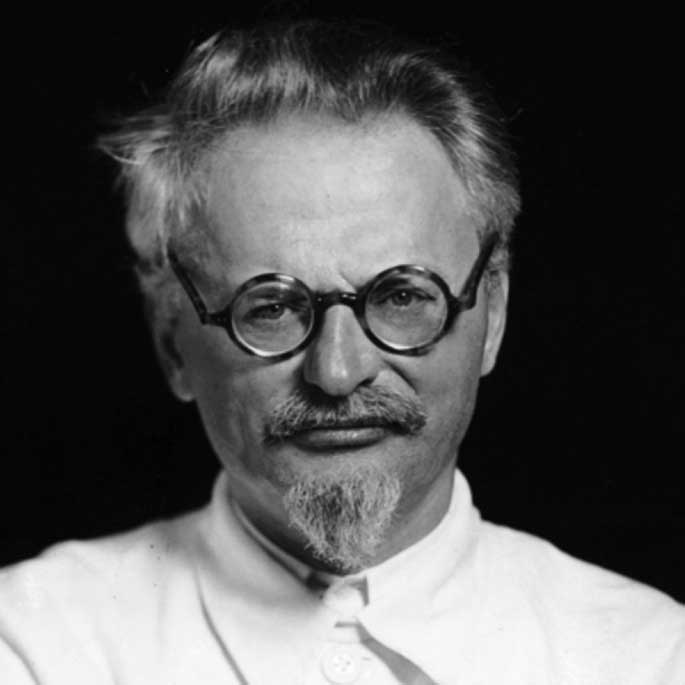
21. Leon Trotsky.
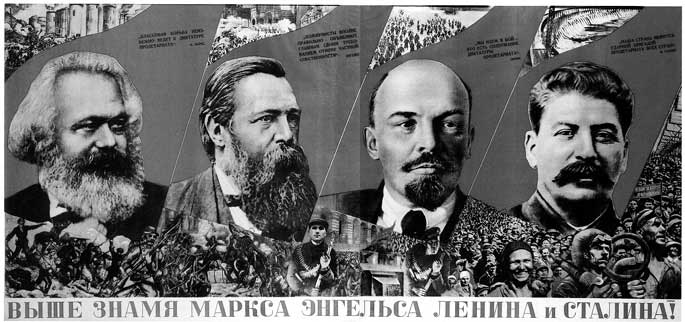
22. Under the Banner of Marx, Engels, Lenin and Stalin. A poster by Gustav Klutsis from 1933 published to commemorate the fiftieth anniversary of Karl Marx’s death.
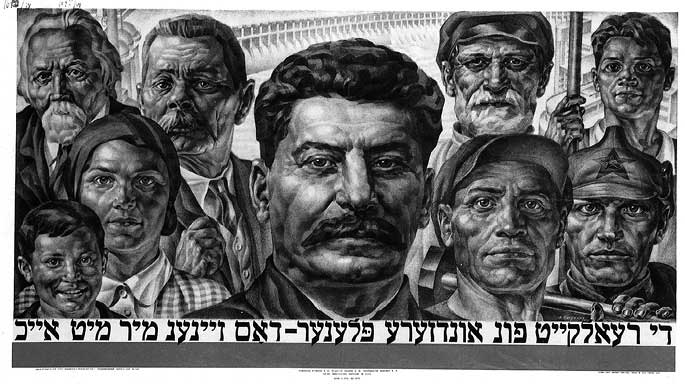
23. We are the Realisation of the Plan. A poster in Yiddish with Hebrew script illustrated by Adolf Strakhov in 1933-4. Stalin is flanked by Maxim Gorky (behind him to the left) and some participants of the second Five-Year Plan.
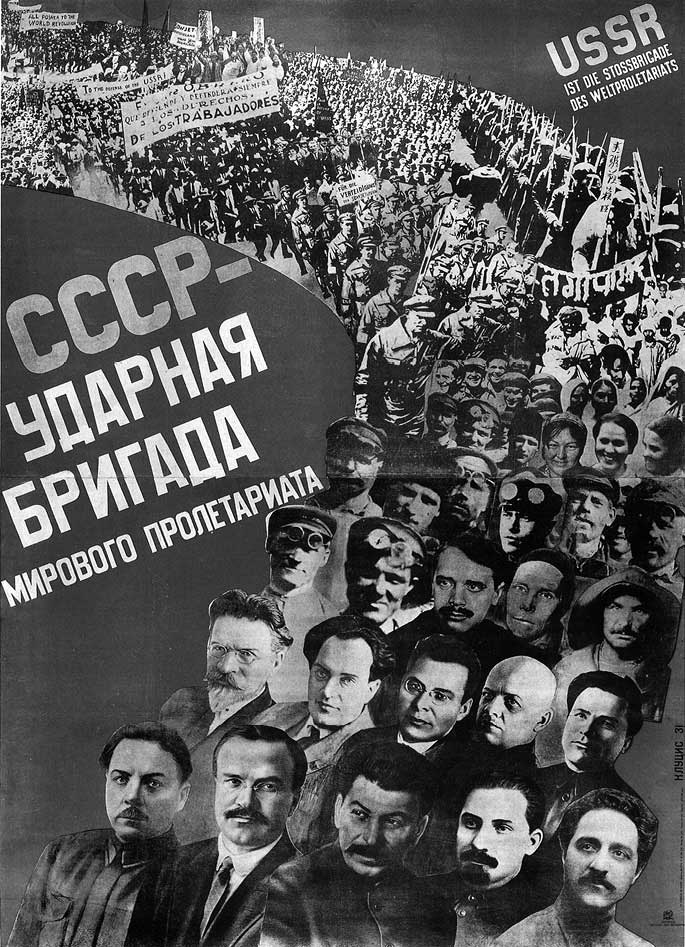
24. A 1931 poster by Gustav Klutsis, which depicts the Politburo leading the world’s workers in a column the shape of the Dnieper Dam. Front row, left to right: Voroshilov, Molotov, Stalin, Kaganovich, Ordzhonikidze. Second row: Kalinin, Kuibyshev, Rudzutak, Kossior, Kirov. Third row, centre: Andreyev. Before the end of the decade, Kirov had been assassinated, Rudzutak and Kossior shot, and Ordzhonikidze had committed suicide.