Without doubt the role of individuals, with all their strengths and weaknesses, plays an important role, but we can only understand this role in the context of the struggle of social forces. The role of the individual in history is not more decisive than the objective conditions that they live in, although the personal ability, intellect and character of individuals certainly does affect the historical process, and, at critical points, may be decisive. Without Lenin and Trotsky, the October Revolution would never have taken place. This is a concrete fact. There can be no doubt that the policies of Zinoviev, Kamenev and Stalin would have led to defeat and the triumph of reaction in 1917, after which we would have been treated to a large number of doctoral theses ‘proving’ beyond all doubt that the idea of a successful socialist revolution in Russia was completely utopian.
Historical materialism does not deny the role of the individual in history. It merely explains that individuals are not absolutely free agents, as idealists imagine, but must operate on the basis of given social and economic conditions which are not chosen by themselves and operate according to laws created independently of the will of men and women. Once we understand these laws, we are in a position to arrive at a scientific analysis of the real scope and significance of the actions of the individual player on the historical stage. The same Lenin and Trotsky who led the Russian workers to victory in 1917 remained isolated and powerless for decades before this. For all their personal abilities and theoretical knowledge, they did not stand above the general conditions of society. Just as Lenin and Trotsky set their stamp on the October Revolution and the regime that emerged from it, so the bureaucratic counter-revolution has become so closely linked with the name of Stalin that the two have become synonymous. But of course, the political counter-revolution in the USSR did not depend upon one man. That would be a mechanical interpretation of history. With or without Stalin, if the revolution remained isolated in a backward country, reaction was inevitable, sooner or later, in one way or another. This, however, does not exhaust the question. In politics, as in warfare, the question of ‘sooner or later’ and ‘one way or another’ is not at all secondary, and can be decisive.
In the first period Stalin had no idea where he was going. He did not want the defeat of the Chinese workers in 1927, or the German workers in 1923 or 1933, yet his policies guaranteed defeat in each case. This, in turn, meant the further isolation of the revolution in Russia, which was the real material basis for the victory of the bureaucratic counter-revolution, which Stalin had initially neither anticipated nor desired. Furthermore, the monstrous form which the counter-revolution took was certainly affected by Stalin’s personal character and psychology. Helvétius remarked long ago: “Every period has its great men, and if these are lacking, it invents them.” The apparatus was discovering that Stalin was the flesh of its flesh. He was a secondary figure in the October Revolution, narrow in vision, and a creature of the apparatus. Thus, in his whole mentality and outlook, Stalin embodied the views and aspirations of the rising layer of functionaries and administrators in the offices of the state, the trade unions and even the Communist Party.
These people had done quite well out of the Revolution, enjoyed certain privileges which, while very modest in comparison to the later life-style of the ruling caste, under the prevailing conditions of appalling misery, were important enough to set them apart from the masses. These functionaries – many of them recruited from the enemies of Bolshevism, Mensheviks, non-party elements and not a few tsarist officials – automatically gravitated to those elements in the ruling party who were closest to their outlook. In the ranks of the Bolsheviks there were many who, while sincerely devoted to the cause of socialism, were insufficiently steeped in the ideas and principles of Marxism. They were the notorious ‘committeemen’, the organisers, the Party practicos with their traditional contempt for theory and impatience with broad generalisations and inclination towards administrative solutions.
After the Revolution, there was a pressing need for able administrators to run the state. Many people were thrust into positions of responsibility without having the necessary preparation. Many of the best elements were killed in the civil war, and replaced by less able people. Once in positions of responsibility, they found themselves in close contact with the old tsarist officials who knew the ropes. Often it was difficult to know who was leading whom, as Lenin bitterly complained. The demobilisation of the Red Army after the civil war added to the problem. Although the Red Army had been thoroughly democratised, the low cultural level of the mass of peasant soldiers meant that many of the officers and NCOs had got used to the method of command. In the prevailing conditions of industrial collapse and the partial atomisation of the proletariat, the working class was no longer able to exercise the same degree of control. Gradually, the state apparatus slipped out of control.
It would be naïve to imagine that Stalin, previously unknown to the masses, suddenly issued from the wings fully armed with a complete strategic plan. No indeed. Before he felt out his own course, the bureaucracy felt out Stalin himself. He brought it all the necessary guarantees: prestige of an Old Bolshevik, a strong character, narrow vision, and close bonds with the political machine as the sole source of his influence. The success which fell upon him was a surprise at first to Stalin himself. It was the friendly welcome of the new ruling group, trying to free itself from the old principles and from the control of the masses, and having need of a reliable arbiter in its inner affairs. A secondary figure before the masses and in the events of the revolution, Stalin revealed himself as the indubitable leader of the Thermidorian bureaucracy, as first in its midst. (Trotsky, The Revolution Betrayed, p. 93.)
What was decisive here was the shift in the balance of class forces. The working class was exhausted and weakened by the years of war, revolution and civil war. The delay of the international revolution had a depressing effect on the Russian workers. On the other hand, the rising layer of bureaucrats increasingly felt themselves masters of the situation. The theory of socialism in one country was merely the ideological expression of a petty bourgeois reaction against October, which arose from the vague yearning of these elements for an end to the storm and stress of the revolution, for order which would allow them to get on with the tasks of administering society – from above. When a worker would occasionally protest against the arrogant behaviour of the officials, he would be asked ironically: “What year do you think this is? 1919?”
Even if Lenin had lived, it would not have made a fundamental difference. It required a favourable turn in the objective situation to alter the balance of forces within the party. It is entirely false, superficial, and, in fact, stupid, to believe that such a profound historical transformation could be explained in terms of the supposed cleverness or otherwise of intriguers at the top. This is merely a variant of the conspiracy theory of history, which has nothing in common with Marxism, which explains history in terms of the struggle between classes. As Trotsky explained: “Numerous critics, publicists, correspondents, historians, biographers, and sundry amateur sociologists have lectured the Left Opposition from time to time on the errors of its ways, saying that the strategy of the Left Opposition was not feasible from the point of view of the struggle for power. However, the very approach to the question was incorrect. The Left Opposition could not achieve power, and did not hope even to do so – certainly not its most thoughtful leaders.
A struggle for power by the Left Opposition, by a revolutionary Marxist organisation, was conceivable only under the conditions of a revolutionary upsurge. Under such conditions the strategy is based on aggression, on direct appeal to the masses, on frontal attack against the government. Quite a few members of the Left Opposition had played no minor part in a struggle and had first-hand knowledge of how to wage it. But during the early twenties and later, there was no revolutionary upsurge in Russia, quite the contrary. Under such circumstances, it was out of the question to launch a struggle for power. (Trotsky, Stalin, p. 403.)
Endnotes
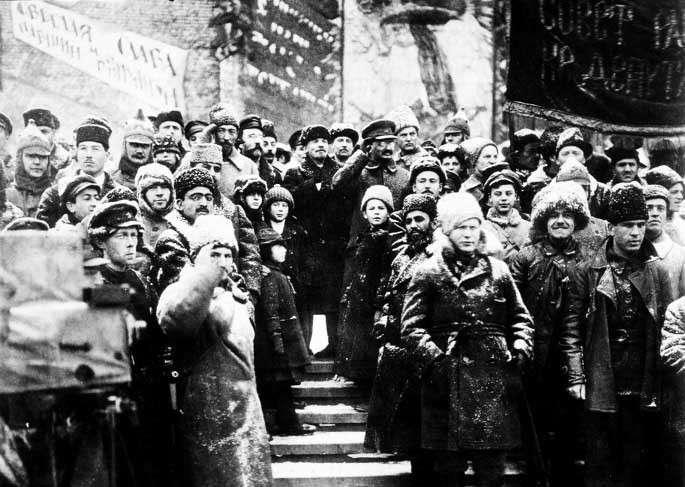
8. Lenin and Trotsky celebrating the second anniversary of the October Revolution in Red Square, Moscow, 1919. Kamenev is left of Lenin with cap and beard.
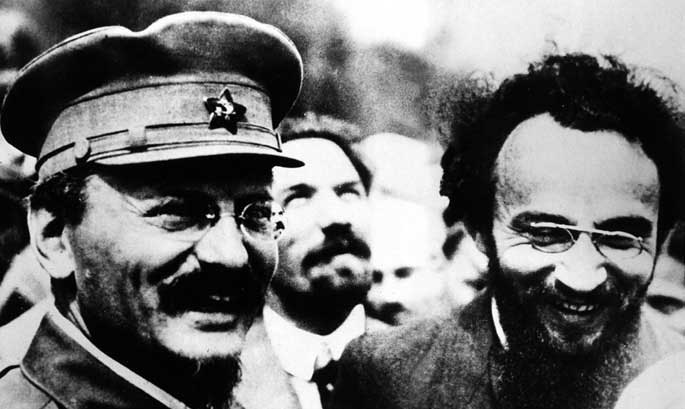
9. Trotsky, Rykov (behind) and Secretary of the Executive Committee of the Third International Jules Humbert-Droz celebrating the victory of the Red Army in the Civil War at a demonstration in Red Square, Moscow, 1920.
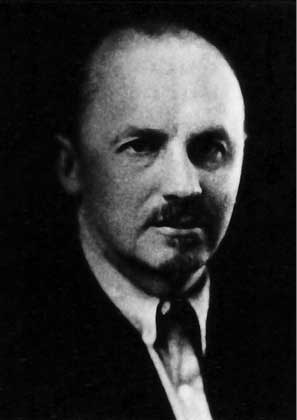
10. Nikolai Bukharin
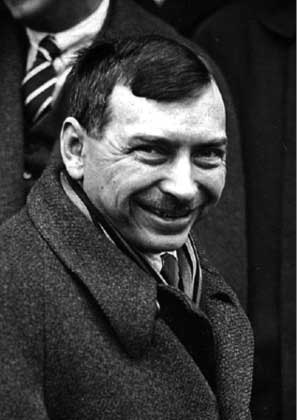
11. Mikhail Tomsky
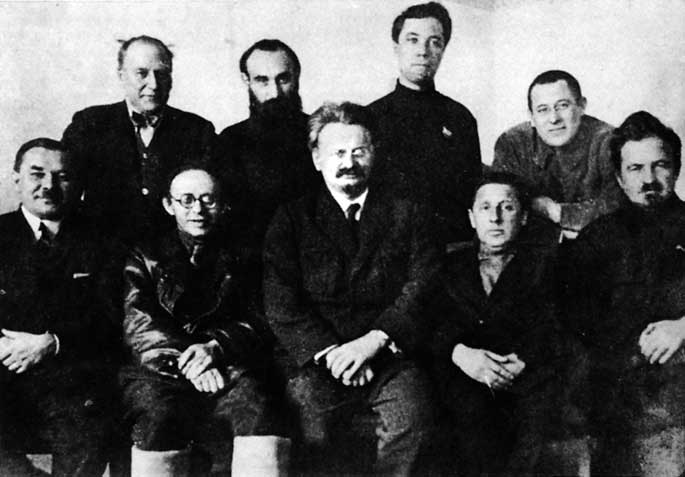
12. The principal leaders of the Left Opposition in 1927 (left-to-right by row): Rakovsky, Drobnis, Beloborodov, Sosnovsky, Serebryakov, Radek, Trotsky, Boguslavsky, Preobrazhensky.
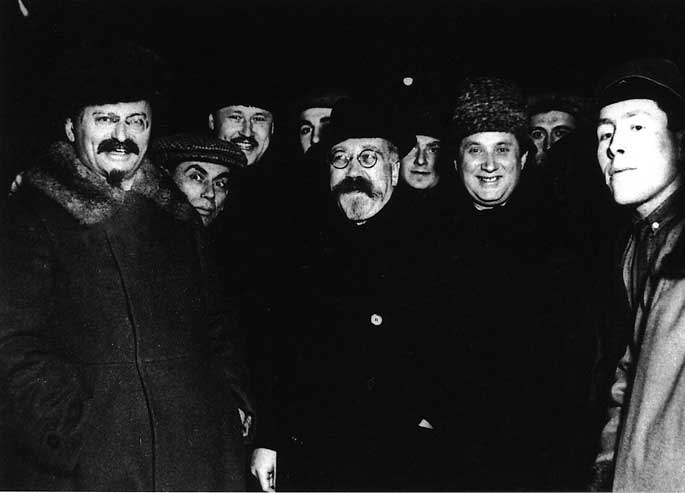
13. Trotsky, Kamenev and Zinoviev with United Oppositionists.