On 2 June 1962, the army opened fire on the strikers and inhabitants of the south Russian city of Novocherkassk during a mass rally in the central square. A large but unknown number of men, women and children were killed. Even at the time, news of the rebellion was suppressed so thoroughly that even the local radio station failed to report it. Only many years later, during the period of glasnost did reports begin to circulate from survivors of the camps. Even then, they were not always believed. Such is the power of a totalitarian state to conceal information so as to prevent a movement from spreading.
The ferocity of the repression and the total suppression of information shows that the authorities were seriously alarmed by these events. This strike was part of a wider protest movement against the increase in prices announced by the government the same month. There had been other movements, in Karganda, Temirtau, Alexandrov, Murom and other cities. But none reached the same proportions as Novocherkassk. Here were all the elements of a political revolution at least in embryo.
The most detailed eyewitness report was written by one of the participants, Piotr Siuda, a worker and the son of an old Bolshevik who had perished like so many others in Stalin’s Purges. After several years in KGB prisons and labour camps, Siuda painstakingly collected all the available information which was published in the underground press (samizdat) in the 1980s. Although at the end of his life, Siuda turned towards anarchism, at the time of the events and for most of his life he considered himself a Leninist and a “non-Party Bolshevik”.
From this account, it is clear that the strike had an entirely spontaneous character. How could it be otherwise, when the workers were denied all rights to organise outside the Communist Party and the official state unions, which defended management not the workers? On 1 January, wages at the big electro locomotive plant at Novocherkassk (NEVZ) were lowered by 30 to 35 per cent. On the same day, the government announced that the price of meat and dairy produce would go up by up to 35 per cent. This was the last straw for the workers, who had many other grievances, particularly the housing shortage. The stupidity and insensitivity of the management when confronted with the workers’ complaints added oil to the flames. Siuda recalls:
There was no need to campaign for the strike among the workers of the plant. It was enough for the group which called for a strike to appear, and work stopped immediately. The mass of strikers was growing like an avalanche. At that time, there were about 14 thousand workers at the plant. The workers went out to the plant grounds and filled the square near the plant management office. The square could not hold all the strikers. (Russian Labour Review, no. 2, 1993, p. 45.)
The immediate demands were economic in character, slogans appeared like: “Give us meat and butter!” and “We need apartments!” The movement spread but maintained a disciplined character. Instinctively, the workers fraternised with the soldiers. The local garrison was sympathetic and could not be used:
By the end of the work day the first military detachments of the Novocherkassk garrison arrived at the square but they were not armed. Having approached the people, the soldiers were immediately absorbed by the crowd. The soldiers and the strikers began to fraternise, to embrace and kiss each other. Yes, they kissed each other. It was difficult for the officer to separate the soldiers from the people, to gather them and to take them away from the strikers. (Ibid., p. 46.)
As in Hungary, Moscow had to draft in backward peasant troops (in this case from the Caucasus) to use against the workers. The strikers’ anger was increasingly directed against the government. There were demands to seize government offices. Then for the release of arrested strikers. The size of the movement kept growing:
Columns of marchers were converging on the city from everywhere and there appeared red flags, portraits of Lenin. The demonstrators were singing revolutionary songs. Everybody was excited, full of belief in their power and in the fairness of their demands. The column of demonstrators was becoming larger and larger.
While approaching the bridge across the railway and the Toozlov river, the demonstrators noticed a cordon of two tanks and armed soldiers on the bridge. The column slowed to a standstill and the revolutionary singing died down. Then the dense mass of people moved slowly forward. Outcries were heard: “Give way to the working class!” Then the shouts merged into a powerful, unified chant. The soldiers and the tank-men not only did not try to stop the column of marchers, but actually helped the people get over the tanks. The stream of people flowed on both sides of the bridge cordon. The excitement grew. The revolutionary songs grew louder, more harmonious and more powerful. (Ibid., p. 48)
Finally, the strikers brushed aside the soldiers and occupied the CPSU committee building. At this point, the order was given to fire on the demonstrators. Even at this point, there was wavering among the troops. One officer committed suicide rather than issue such an order:
Several witnesses reported that the officer who had been ordered to open fire, refused to give the order to the soldiers and shot himself in front of the formation. But nevertheless, the soldiers opened fire. First upwards, at the trees, then at the children who fell down, killed, wounded, frightened. In such a way, the party, the state and the army were eradicating different trends of thought, asserting the unity of the party and the people, proving the democratic character of the socialist state. Then the machine guns were pointed at the crowd. (Ibid., p. 49.)
In the secret trials that followed, seven people were accused of ‘banditry’ and ‘mass riot’ and sentenced to be shot. The number of those sent to labour camps for between ten and fifteen years is unknown, as is the number of people killed and crippled. Those arrested were forbidden all links with the outside world. Novocherkassk was placed under curfew. All news of the uprising was strictly suppressed. That the Kremlin took these events very seriously was shown by the fact that A.I. Mikoyan, Khrushchev’s number two, was sent to the city. In the absence of leadership and a clear plan of action, the uprising could not succeed. But it undoubtedly played a role in hastening the overthrow of Khrushchev.
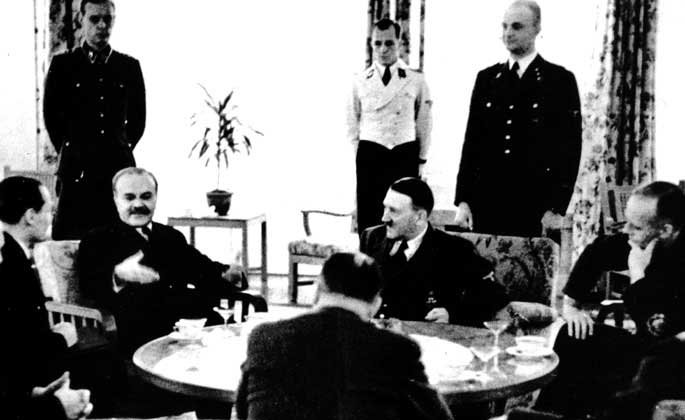
25. A cocktail party in Berlin in 1940. Soviet foreign minister Molotov with Hitler, von Ribbentrop and General Keitel.
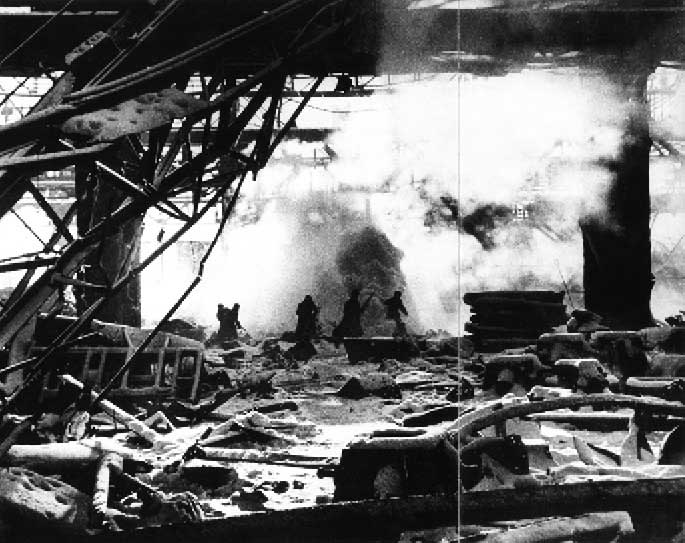
26. Fighting in the Red October factory, Stalingrad, 1942.
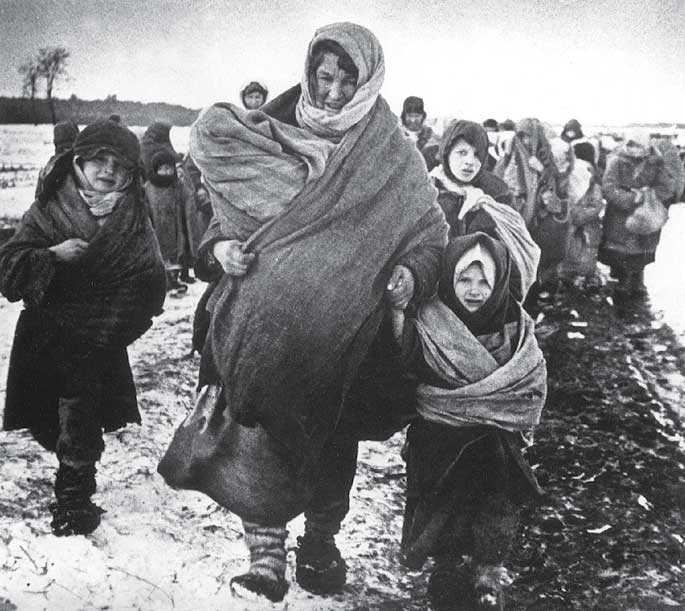
27. Russian refugees fleeing the battle zone in the early days of the war.
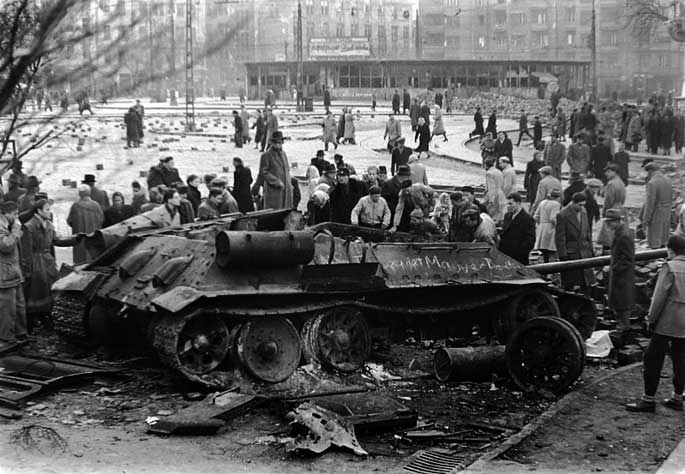
28. A destroyed T-34-85 tank at the Móricz Zsigmond Square.
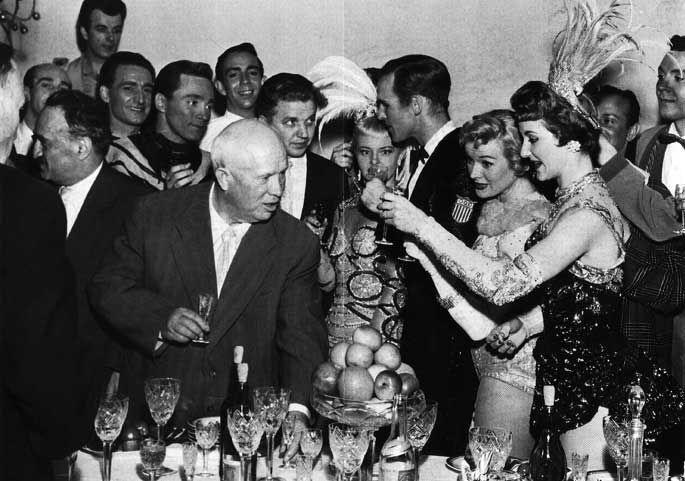
29. Nikita Khrushchev at a party for the stars of the American Holiday on Ice, 1959.