In its heyday, the Communist International moved hundreds of millions. Apart from the early Christians who led the oppressed masses against the Roman Empire, and Islam which roused the Arab nation, this was the biggest revolutionary movement in human history. Lenin and Trotsky had anticipated that the Russian Revolution would be followed by a wave of revolutions which would put an end to the isolation of the Russian workers’ state. To this end, they established the Communist International (Comintern). The first four Congresses of the Communist International were an extraordinary compendium of revolutionary theory, for the purpose of educating the newly formed and inexperienced Communist Parties of Western Europe, the USA and Asia. Even today these writings remain a rich mine of Marxist ideas and theory.
Had the Communist International remained on these lines, it would undoubtedly have ended in victory in one or more countries, thus changing the fundamental relationship of forces. But the Stalinist reaction made a fundamental difference, not only in Russia, but in all the Communist Parties. Here we see the superiority of the Marxist method over empiricism. As early as 1928, at a time when the leaders of the Communist Parties were genuinely trying to act as a revolutionary Marxist international, Trotsky predicted that, if the Communist International adopted the theory of socialism in one country, this would inevitably be the beginning of a process which could only end in the national-reformist degeneration of every Communist Party in the world. Trotsky’s prediction was greeted with derision by the leaders of the Communist Parties. But now, history has taken a cruel revenge. Seventy years later, the mighty Communist International is no more, and the Communist Parties have everywhere degenerated on nationalist and reformist lines, just as Trotsky predicted.
This process did not begin yesterday. Even before the Second World War, under the pernicious influence of Stalin, the Communist Parties had been steeped in opportunism of the worst sort. There was one zig-zag after another – from conciliating the Social Democrats to the ultra-left madness of the Third Period. Today, not one of the basic ideas of Marxist-Leninism are defended by the Communist Party leaders. Before the war, the Communist Parties developed the ‘anti-fascist alliance’ between the Soviet Union and the so-called democracies. Under this banner, they betrayed the revolution in Spain and France in 1936, when the working class could have come to power. Slavishly following the dictates of Stalin’s foreign policy, the revolution had to be sacrificed on the altar of the ‘alliance’.
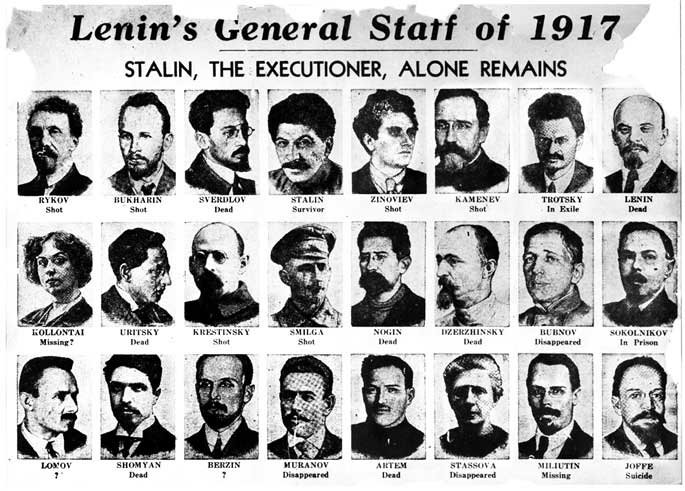
With the rise of Hitler, again due to the policies of Stalin, the stranglehold of the bureaucracy within the Soviet Union was further increased. Higher and higher over the Soviet masses the bureaucratic caste raised itself, increasing its power. But this progressive degeneration has had qualitative changes. From merely being incapable of insuring anything but defeats for the world working class, Stalinism has become opposed to the workers’ revolution in other countries. The Moscow trials, the murder of the Old Bolsheviks, the Purges, the murder and exile of tens of thousands of the flower of the Russian Communist workers, completed the Stalinist counter-revolution within the Soviet Union.
Events in France and Spain were fresh in every revolutionary’s mind. The Comintern played the main role in destroying the revolution which could have been accomplished. Indeed, it revealed itself as the fighting vanguard of the counter-revolution. The defeats of the world working class inevitably led to the new world war. Ironically, the war was ushered in by a pact between Hitler and Stalin. Thus, Stalin dealt new blows to the world working class and the Comintern. It now executed a somersault and conducted a campaign for peace in the interests of Hitler, with a skilful counterfeit of a ‘revolutionary’ policy. As Trotsky forecast in his prediction of the Stalin-Hitler agreement in an article written in March 1939:
“The fundamental trait of Stalin’s international policy in recent years has been this: that he trades in the working-class movements just as he trades in oil, manganese and other goods.” In this statement, there is not an iota of exaggeration. Stalin looked upon the sections of the Comintern in various countries and upon the liberating struggle of the oppressed nations as so much small change in deals with imperialist powers.
When he requires the aid of France, he subjects the French proletariat to the Radical bourgeoisie. When he has to support China against Japan, he subjects the Chinese proletariat to the Guomindang. What would he do in the event of an agreement with Hitler? Hitler, to be sure, does not particularly require Stalin’s assistance to strangle the German Communist Party. The insignificant state in which the latter finds itself has moreover been assured by its entire preceding policy. But it is very likely that Stalin would agree to cut off all subsidies for illegal work in Germany. This is one of the most minor concessions that he would have to make and he would be quite willing to make it.
One should also assume that the noisy, hysterical and hollow campaign against fascism which the Comintern has been conducting for the last few years will be slyly squelched. (Trotsky, Writings 1938-39, pp. 202-3.)
These prophetic lines were strikingly confirmed by the Hitler-Stalin pact of 1939.
After five years of vociferous demands for an agreement between the Soviet Union and the ‘democracies’ of Britain, France and the USA, Stalin did a 180 degree turn to reach an agreement with Hitler in 1939. Trotsky warned that this would prepare the way for big fascist victories, as it would disorient the workers of Britain, France and other countries. This ushered in the Second World War, which Stalin thought he could avoid by this diplomatic trick of switching alliances. The Communist Parties then reversed the position of ‘collective security’ and began attacking the ‘allied warmongers’. The British Daily Worker for example, in the so-called phoney war of 1939-40 was demanding peace on Hitler’s terms. Even the illegal German Communist Party had this position. After the German invasion of France, the French Communist Party (PCF) sent a delegation to the Germans asking permission to publish L’Humanité legally under the German occupation. They were shot. In Norway, however, the CP was actually allowed to publish legally for some months under the Nazi occupation, demanding ‘peace’, etc., while the Social Democrat papers were suppressed. Naturally, having done the dirty work, they in turn were suppressed when Hitler was preparing his invasion of Russia.
This policy of Stalin and the ‘stinking corpse’ of the Comintern suffered irretrievable ruin when the Nazis invaded the Soviet Union. After 1941, the line was changed again. After Hitler’s invasion of Russia, the Communist Parties were once again mobilised to support the ‘Democracies’ in their ‘war against fascism’. The British Daily Worker published a two-inch headline with the words: “The only good German is a dead one.” The Comintern had to execute a right about turn and convert itself once again into a doormat for Roosevelt and British imperialism. But with the increased dependence of Stalin on American and British imperialism, had come the increased pressure on the part of the capitalist allies. In particular, American imperialism was demanding the dissolution of the Comintern as a final guarantee against the danger of social revolution in Europe after the downfall of Hitler.
The long-drawn-out pretence was over. In 1943, Stalin dissolved the degenerate Comintern, in an attempt to gain the ‘good will’ of the imperialists. This criminal policy did not have the effect that Stalin wanted. The rank and file of the Communist Parties did heroic work in the resistance throughout occupied Europe after 1941. But when the Communist Party had the possibility of coming to power in France, Italy, Belgium, etc., they entered coalition governments. Having saved capitalism, they were then unceremoniously booted out. This opened up the cold war – a period of heightened superpower tensions and rivalries between Stalinism and the West.
Endnotes
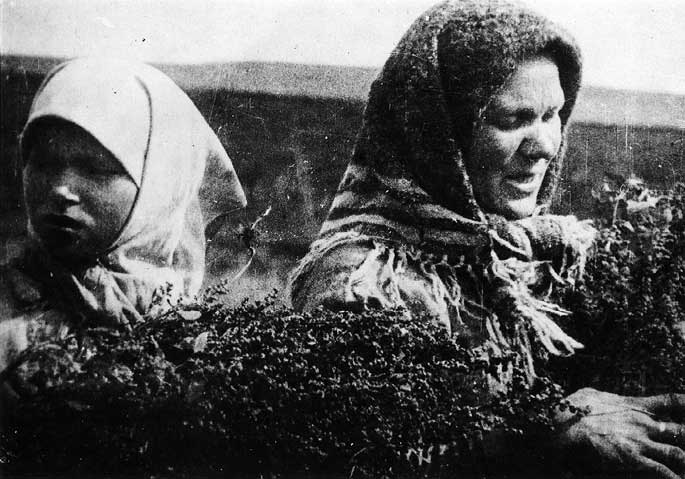
14. Peasants on a collective farm.
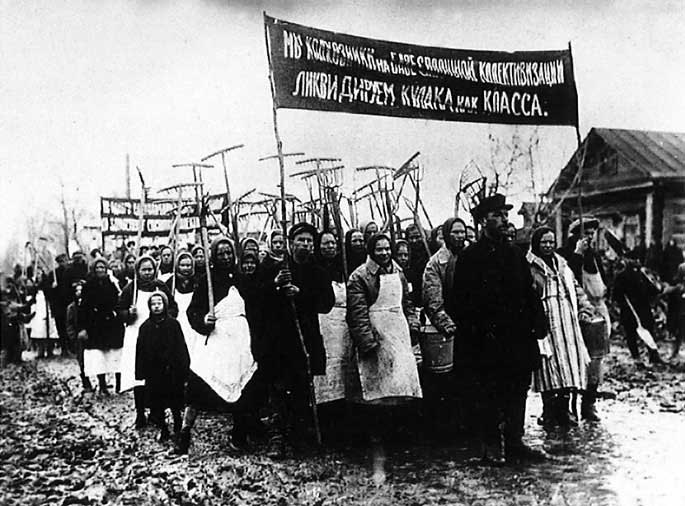
15. Workers demonstrate on a collective farm in 1929. The banner reads ‘Liquidate the Kulaks as a Class’.
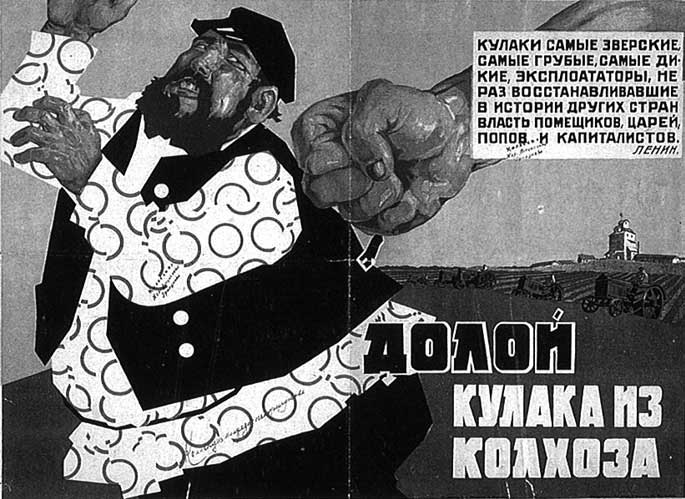
16. Bash the Kulak off the Kolkhoz, a poster from 1930.
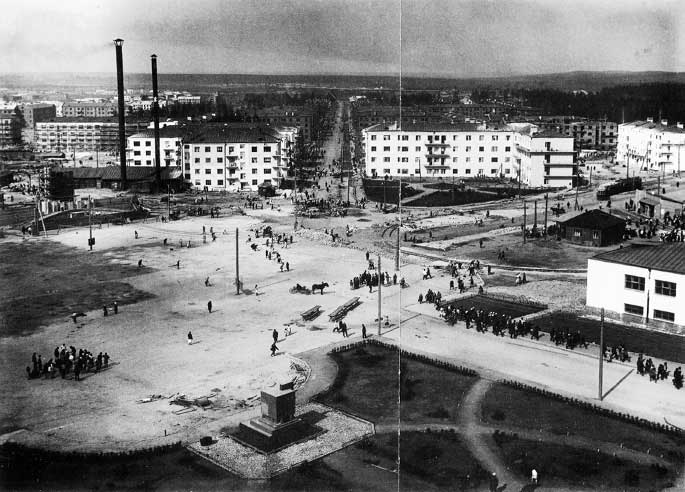
17. Uralmashstroi in early 1933. A city constructed in the Urals for workers at the Soviet machine-building plant with the same name. The white apartment blocks would have been reserved for the foreign specialists and factory management, whilst ordinary workers would have to make do with much less.
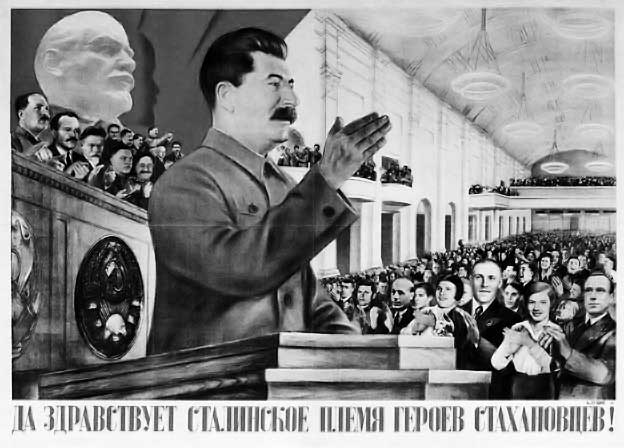
18. Long live Stalin’s breed of Stakhanovite heroes!: A Stalin cult poster from 1935 with bizarrely montaged heads in the audience and Stalin’s pose emulating the bust of Lenin in the background.
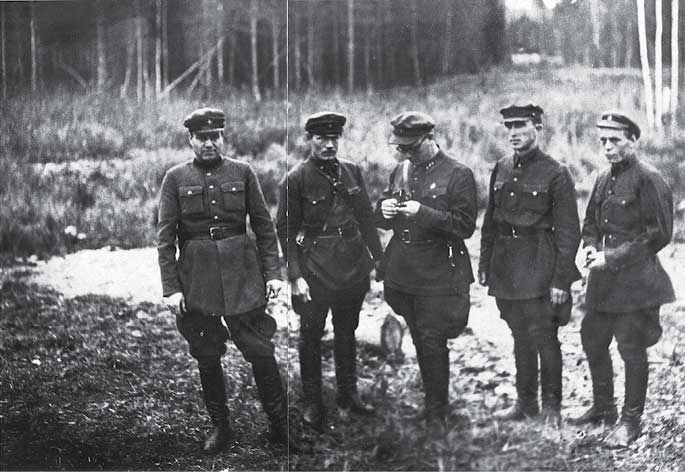
19. An NKVD Death Squad.