What failed in Russia and Eastern Europe was not communism or socialism, in any sense that this was understood by Marx or Lenin, but a bureaucratic and totalitarian caricature. Lenin explained that the movement towards socialism requires the democratic control of industry, society and the state by the proletariat. Genuine socialism is incompatible with the rule of a privileged bureaucratic elite, which will inevitably be accompanied by colossal corruption, nepotism, waste, mismanagement, and chaos.
The nationalised planned economies in the USSR and Eastern Europe achieved astonishing results in the fields of industry, science, health and education. But, as Trotsky predicted as early as 1936, the bureaucratic regime ultimately undermined the nationalised planned economy and prepared the way for its collapse and the return of capitalism.
What is the balance sheet of the October Revolution and the great experiment in planned economy that followed it? What implications do they have for the future of humanity? And what conclusions should be drawn from them? The first observation ought to be self-evident. Whether you are in favour or against the October Revolution, there can be no doubt whatsoever that this single event changed the course of world history in an unprecedented way. The entire twentieth century was dominated by its consequences. This fact is recognised even by the most conservative commentators and those hostile to the October Revolution.
Needless to say, the author of these lines is a firm defender of the October Revolution. I regard it as the greatest single event in human history. Why do I say this? Because here for the first time, if we exclude that glorious but ephemeral event that was the Paris Commune, millions of ordinary men and women overthrew their exploiters, took their destiny in their own hands, and at least began the task of transforming society.
That this task, under specific conditions, was diverted along channels unforeseen by the leaders of the Revolution does not invalidate the ideas of the October Revolution, nor does it lessen the significance of the colossal gains made by the USSR for the 70 years that followed.
The enemies of socialism will reply scornfully that the experiment ended in failure. We reply in the words of that great philosopher Spinoza that our task is neither to weep nor to laugh but to understand. But one would look in vain in all the writings of the bourgeois enemies of socialism to find any serious explanation for what occurred in the Soviet Union. Their so-called analysis lacks any scientific basis because they are motivated by blind hatred that reflects definite class interests.
It was not the degenerate Russian bourgeoisie, but the nationalised planned economy that dragged Russia into the modern era, building factories, roads and schools, educating men and women, creating brilliant scientists, building the army that defeated Hitler, and putting the first man into space.
Despite the crimes of the bureaucracy, the Soviet Union was rapidly transformed from a backward, semi-feudal economy into an advanced, modern industrial nation. In the end, however, the bureaucracy was not satisfied with the colossal wealth and privileges it had obtained through plundering the Soviet state. As Trotsky predicted, they passed over to the camp of capitalist restoration, transforming themselves from a parasitic caste to a ruling class.
The movement towards capitalism has meant a big step backwards for the people of Russia and the former Republics of the USSR. Society was thrown back and had to learn all the blessings of capitalist civilization: religion, prostitution, drugs, and all the other ‘blessings’ of capitalism. For the time being the Putin regime has succeeded in consolidating itself. But its appearance of strength is illusionary. Russian capitalism, like the hut in the Russian fairy tale, is built on chicken’s legs.
The Achilles heel of Russian capitalism is that it is now linked with an umbilical cord to the fate of world capitalism. It is subject to all the storms and stresses of a system that finds itself in a terminal crisis. This will have a profound impact on Russia, both economically and politically. Sooner or later the Russian workers will recover from the effects of the defeat and move into action. When that happens, they will quickly rediscover the traditions of the October Revolution and the ideas of genuine Bolshevism. That is the only way forward for the workers of Russia and the entire world.
London
7 January 2017
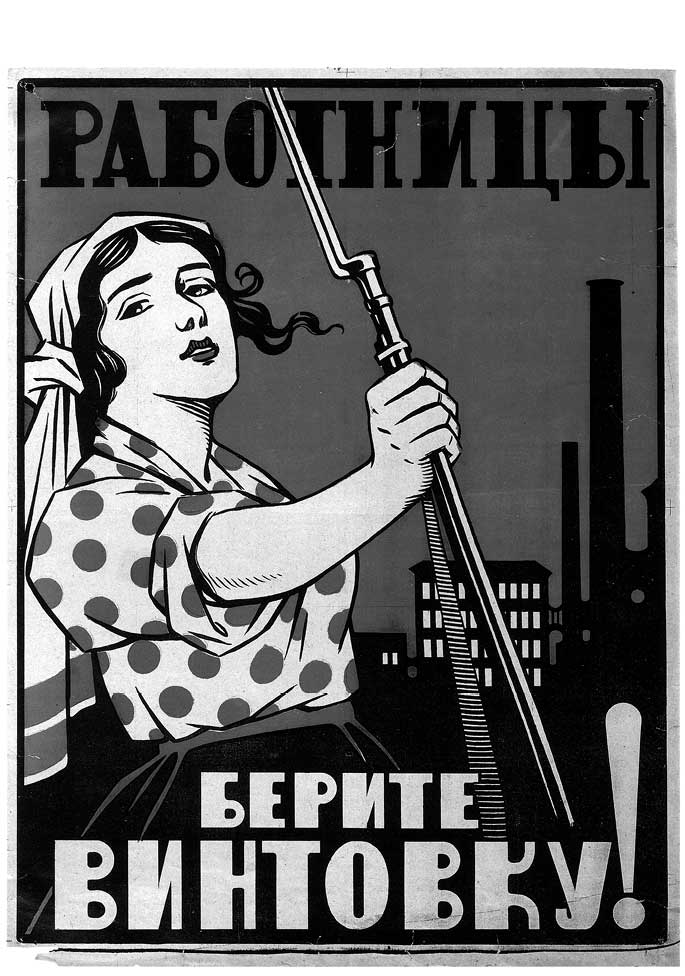
2. Women Workers, Take Up Your Rifles! An early Civil War poster, artist unknown.