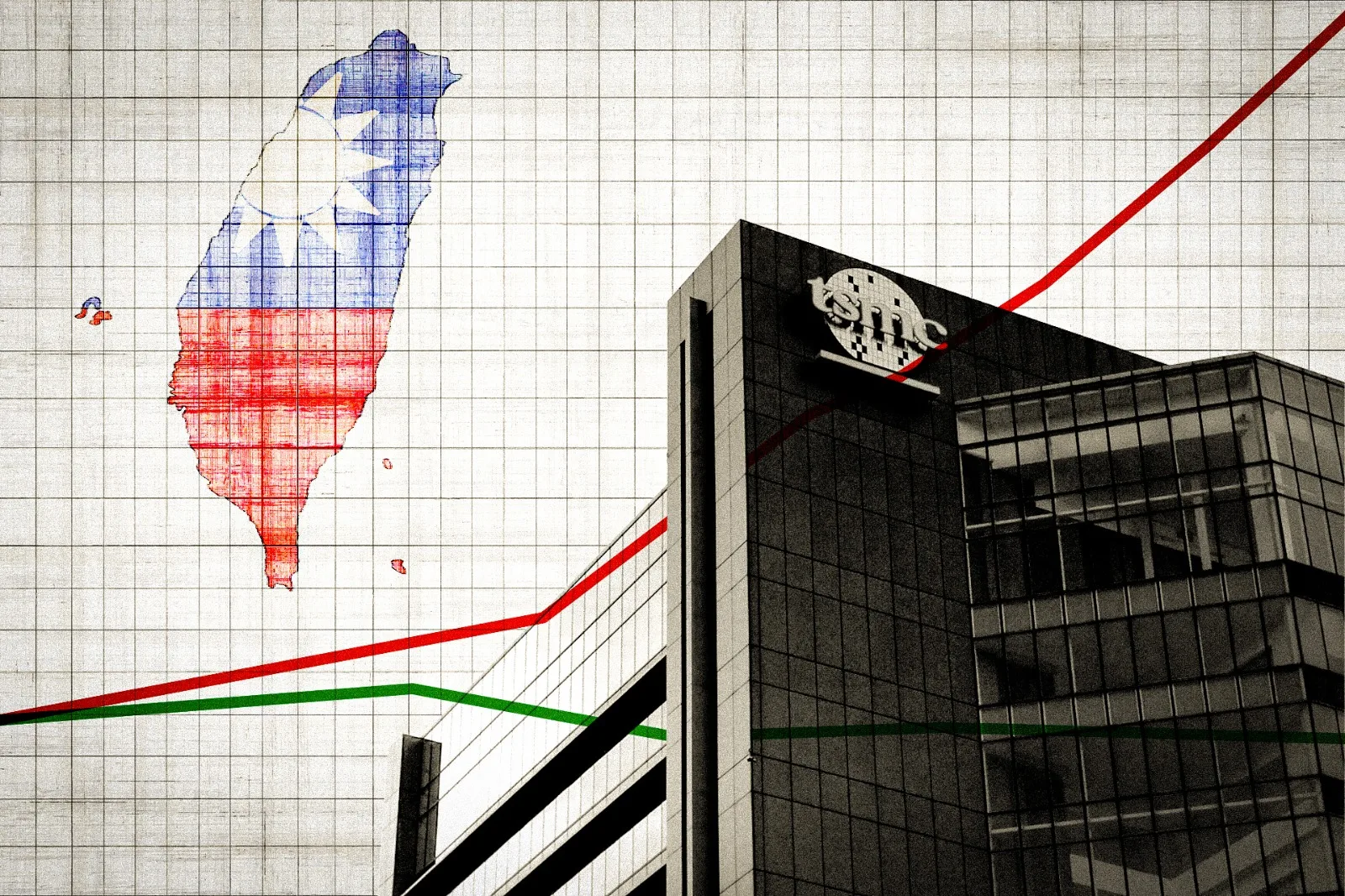
This month, Taiwan’s central bank announced that GDP growth this year could reach around 11.48 percent, with a further 5.82 percent next year. At a time when the advanced capitalist countries are all facing a rapid slowdown in growth, this is a miraculous figure. But does it mean that Taiwan is experiencing unprecedented social development, progress and prosperity?
This article was originally published on 3 October 2026, on The Spark, the website of the RCI in Taiwan.
Dazzling figures
While the whole world is suffering from war and mounting global tensions, Taiwan’s GDP growth rate has soared almost tenfold in three years, from 1.08 percent in 2023. GDP per capita has leapt ahead, overtaking Japan and South Korea. The market capitalisation of the Taiwan stock market has overtaken India’s, making it the fifth-largest stock market in the world.
How was this almost physics-defying economic performance achieved? By one thing alone: AI.
TSMC still controls 90 percent of the market for the most advanced semiconductor chips, and related high-tech electronics firms, such as the memory-chip maker Micron, have long operated in Taiwan. So when the AI giants, mostly American companies, began large-scale preparations to build data centres in recent years, the vast majority of the new orders went to South Korean and Taiwanese manufacturers capable of producing the necessary hardware. This investment frenzy has also inflated Taiwan’s economic figures.
The extent to which Taiwan’s economy has come to rely on the AI boom in recent years also explains why TSMC’s shares alone now make up around 44 percent of the benchmark TAIEX index, while its output accounts for 10 percent of the entire country’s output.
So what does Taiwan’s economy look like without the AI boom? A study by the Lowy Institute, an Australian think tank, shows that if all AI-related exports are excluded, Taiwan’s exports have in fact fallen by 40 percent since 2022. The Reporter has also pointed out that manufacturing growth over the past five years was not spread evenly across the period, but was heavily concentrated in 2024 and 2025 – precisely the two years in which the AI boom took off.
In other words, AI-driven growth is heavily masking all the industries that are stagnating or even contracting. Yet it is these very industries that employ the overwhelming majority of Taiwan’s working class, around 93 percent of the employed population. That is why, although average regular earnings appear to be rising, reaching almost NT$49,000 a month in the first half of this year, this average is pulled up by the pay of a tiny minority, while a record 70 percent of employees earn less than that average.
Fewer than one in ten employed people work directly in the main growth chains of AI, semiconductors and the electronics supply chain. Adjusted for inflation, only the electronics industry has seen total real monthly wages rise by as much as five percent over the past two years. After all, bosses in industries unconnected to AI have no incentive to raise wages, even though Taiwan’s inflation has now been above two percent for four consecutive months.
An article in The Reporter sums all this up well:
“When the media report every day on AI business opportunities, TSMC, dazzling export figures and record highs on the stock market, a worker outside the electronics supply chain will ask: ‘What has any of this growth got to do with me?’ The owner of a metalworking factory will ask: ‘Why is the economy as a whole doing so well, when I have fewer orders than in previous years?’ A young family living on wages alone will ask: ‘Why are rent, house prices and the cost of raising children becoming harder and harder to afford?’
“All these questions point to the same core problem: growth has not been adequately transmitted to most industries, businesses and households.”
This is why most Taiwanese still have to take on debt just to get by. The scale of personal debt in Taiwan is climbing at an unprecedented rate. According to the latest data from the Joint Credit Information Center, both the total amount of personal loans and the average loan per borrower have been hitting new highs in tandem over the past decade. Today, roughly one in every four to five Taiwanese is carrying a loan.
Even more strikingly, the total value of personal loans (including mortgages, personal credit loans, car loans and so on) rose by nearly 80 percent between 2016 and 2025, and now stands at NT$24.06 trillion. The average debt per borrower also rose sharply, from NT$2.894 million to NT$4.657 million, showing that Taiwanese society is rapidly entering a new era of ‘high assets, high debt’.
Going all in
So how are the majority of Taiwanese, whose wages remain pitifully low and who frequently have to borrow, supposed to save or turn their personal finances around? One word: stocks. The only part of Taiwanese society that is flourishing is the stock market, which currently seems to be heading in a straight line for the moon.
Buying shares has thus become all the rage. And people are not just spending their meagre savings on shares, but borrowing money to buy them, hoping to make a killing in a market that currently looks like a sure bet. In June, Bloomberg reported that margin trading in Taiwan had grown by nearly 20 percent in the first half of the year compared with the previous six months, while outstanding margin loans had soared by 160 percent since the start of the year, approaching the peak reached before the bubble burst in 2000.
In August, the Lai Ching-te government, claiming it wanted to share the AI dividend with the whole of Taiwan, decided to give every person a universal cash handout of NT$10,000 (a bit more than USD$300) at next year’s Lunar New Year. It is not hard to imagine that, once the money is paid out, most people will turn around and pour it into the stock market.
Is any of this sustainable? Of course not.
Sooner or later, the AI bubble will burst. American AI is facing a serious challenge from cheap, energy-efficient Chinese AI models. And around 80 percent of Taiwan’s exports now consist of chips and AI hardware, up from about half five years ago, overwhelmingly supplying the very western tech companies that are now facing this challenge from China. Once the bubble bursts, this demand will be hit hard, share prices will plunge, and those who borrowed to buy shares will be left up to their necks in debt, having lost everything.
Readers may ask: doesn’t everyone know that none of this can last? The governor of Taiwan’s central bank, Yang Chin-long, has also publicly voiced his concern and urged young people not to over-leverage. Many of the working people now buying shares probably understand, to some degree, that the party cannot go on. But precisely because the stock market is the only chance they have right now of turning their lives around, many are still willing to take the gamble.
Taiwanese capitalism is intensifying its ‘four highs’: high concentration, high dependency, high instability and high unsustainability. As a result, the Taiwanese economy as a whole has developed along an extremely K-shaped path, with all the economic gains concentrated in the hands of an ever-narrower layer of people.
The western AI bubble, compounded by a whole series of crises of western capitalism, is likely to burst within the next few years, with an impact comparable to the Wall Street Crash of 1929 – and Taiwan’s economy will bear the brunt.
Class struggle in Taiwan
But the AI boom has not only reinforced the dependent character of Taiwan’s economy. The soaring fortunes of the industries involved have also produced an upswing in the class struggle.
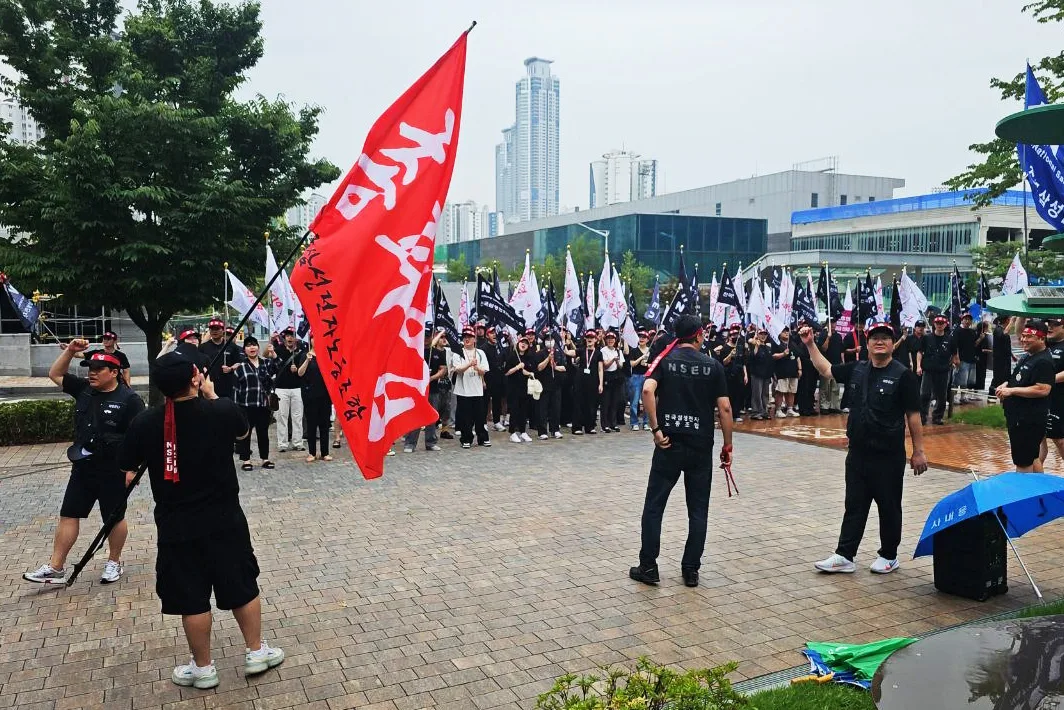
We are seeing Taiwanese workers, especially those connected to the electronics industry, beginning to launch offensive struggles, possibly following the example of the current labour movement in South Korea. In fact, after the Samsung strike in South Korea came to an end, there were calls at one point among TSMC employees to form a union.
But the first shot was fired by the workers of Micron, the US-owned memory-chip maker, where the two main unions representing workers at the Taoyuan and Taichung sites have grown rapidly, and a strike is now brewing. The two unions representing workers at Micron’s Taoyuan and Taichung sites now have a combined membership of over 10,000, around two-thirds of the roughly 15,000 employees at the two sites. In the past, Micron’s plants were very difficult to unionise. Apart from obstruction by management, this was often because engineers believed they had no need to join a union.
But while Micron’s revenue this year has soared 3.5-fold compared with last year, and its share price has risen by 488 percent, its employees have been offered nothing beyond the promise of a one-off bonus.

In an internal online survey conducted by the unions in August, more than 80 percent of participating members backed strike action. Micron’s management has now panicked and announced ‘thank-you’ bonuses of NT$1 million for staff hired before 29 August last year, in an attempt to weaken the workers’ will to strike. So far, the unions and the workers have quite correctly seen through this ploy, and are insisting that profit-sharing be made a regular arrangement: they want the present bonus scheme scrapped and 15 percent of operating profit distributed quarterly, on the model won at Samsung and SK Hynix.
We will have to watch how this struggle develops. At the same time, we must remember the lessons of Samsung in South Korea, and warn in the strongest terms that the bosses in Taiwan may try to copy the tactics Samsung used to divide the workers.
A pay dispute has also broken out at AGC Display Glass Taiwan in Yunlin, part of the Japanese-owned AGC Group.
On 4 September, the union announced that it had obtained the legal right to strike, with a remarkable 96 percent voting in favour. The AGC union in Yunlin said it would demand that the company introduce a concrete and meaningful across-the-board pay rise of five percent, failing which the union would take legal strike action. This is the first time in Yunlin County’s history that a legal strike ballot has been passed.
There is also a strike being prepared by the Chunghwa Telecom Workers’ Union, which shares a common organising leadership with the AGC union in Yunlin. All of these are connected to the Taiwan Workers’ Solidarity Confederation, a newer and more militant national union federation. At a press conference, Hung Hsiu-lung, convenor of the strike committee, even stated bluntly: “I would also ask President Lai Ching-te to be careful that he does not become the first president in Taiwan’s history to trigger a joint general strike by the unions.”
These unions are organised in industries of pivotal importance to the economy as a whole. In other words, these are sections of the working class that genuinely hold the levers of society in their hands. That they are now gradually becoming conscious of this power is in itself an important step in the history of the class struggle in Taiwan.
The domino effect of class struggle
As mentioned above, the present class struggle of Taiwan’s electronics workers is inseparable from recent developments in the South Korean labour movement.
The South Korean and Taiwanese economies are practically in the same boat. South Korea’s economy has likewise been rapidly propped up by the AI boom, and the ruling class’ windfall profits have likewise spurred workers to stand up and fight for their fair share – beginning at Samsung, the world’s other giant of high-end chip manufacturing.
The strike originally planned by Samsung workers ended with the union colluding with management to divide the workers. But merely seeing the fear that the Samsung capitalists initially showed in the face of the workers was enough to encourage other workers to follow their example.
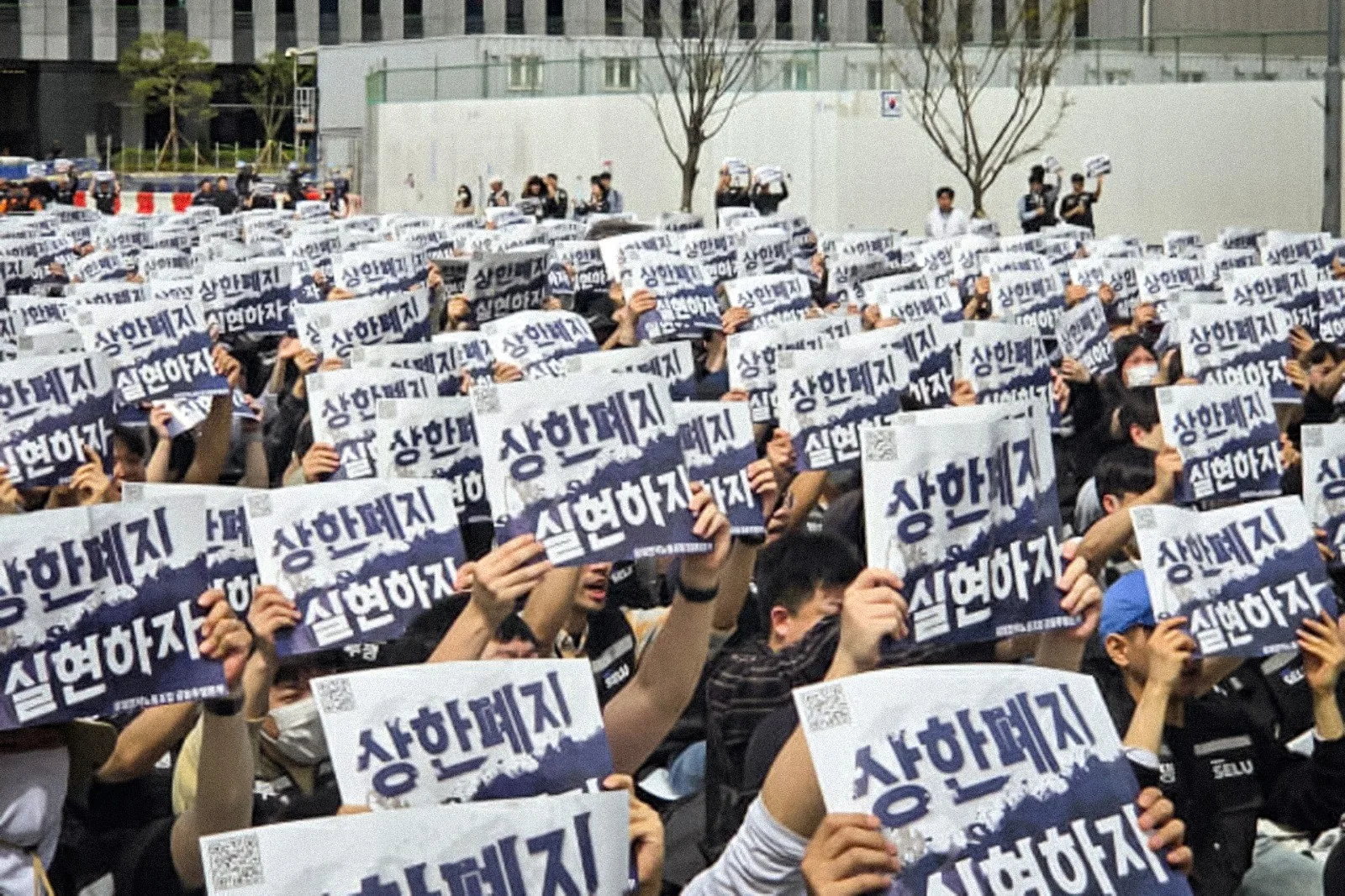
Starting with the workers at Hyundai, LG, Kakao and later Naver, who began organising almost immediately in emulation, the movement spread beyond the electronics sector. In July, the Korean Confederation of Trade Unions (KCTU) called a one-day general strike, demanding that the capitalists fully respect the bargaining rights of all subcontracted workers.
In September, workers at POSCO, South Korea’s largest steel company, launched the first strike since the company was founded in 1968, and have already staged two partial walkouts. All this has set an important example for the Taiwanese working class.
Workers have found the courage to prepare for struggle precisely because they have become conscious of the power in their hands. This is the shift in consciousness that Marx described as the transformation of a class ‘in itself’ into a class ‘for itself’. Or, in the words of the British Marxist theoretician Ted Grant, the workers have come to understand that “not a light bulb shines, and not a wheel turns, without the kind permission of the working class”.
The offensive struggles now being waged by Taiwanese and Korean workers are of enormous progressive and revolutionary significance. But these immediate struggles cannot be the be-all and end-all of these movements.
The global crisis of capitalism will only deepen, and the AI bubble will ultimately burst. When that happens, the ruling class will certainly try to claw back every concession the working class has won, and make all workers pay for the crisis of capitalism. At that point, the working class will need to do more than defend its own interests: it will need to be ready for the struggle to become the master of a new society.