Feeling the earth quake under their feet, the bourgeois liberals began to distance themselves from the government, demanding reforms. They were both frightened themselves and attempting to frighten the regime into granting concessions. ‘Reform before it is too late!’ That was their battle cry. They took heart from the growing conflict between ‘reformers’ and ‘reactionaries’ within the regime itself which proceeded in tandem with the conflict between the Cadets and the autocracy. There was even a ‘strike of Ministers’ in 1913. As always, splits at the top are the first warning of an impending revolutionary crisis. The Interior Minister, Maklakov, wrote in worried terms to the Tsar: “The mood among the factory workers is uneasy,” and advocated a crackdown. Naturally this proposal was approved by the Tsar but turned down by the Prime Minister Kokovtsov – further indications of vacillations and splits at the top as the government lost its nerve and arguments broke out over whether to use the mailed fist or the velvet glove to deal with the problem.
By now the government was monopolised by the most reactionary elements. As war approaches, everything becomes clearer, sharper. All elements of confusion and ambiguity are removed. The ‘middle-ground’ liberals, the compromisers, and all accidental figures and groupings are mercilessly squeezed out of the picture. And finally there remain only two trends which present society with a stark and imperious alternative – revolution or reaction. The liberals, in desperation, tried to lean on the working class and to this end patched up a deal. In March 1914, the Cadets set up a kind of ‘opposition committee’ and even included a Bolshevik on it (II Skvortsov-Stepanov). Despite the well-known spinelessness of the liberals, Dan and the Mensheviks placed all their hopes on this.
Informed of this development, Lenin considered it important as a symptom. Lenin advised Skvortsov-Stepanov to go along in order to obtain precise information on how far the liberals were prepared to go in practice, that is, to what extent the moneybags were prepared to make donations to help to develop the illegal press, and so on. The reply was, predictably, unclear! The Cadets (and still less their allies the Octobrists) had no serious intention of challenging the regime or aiding the revolution. Their pleas to the bureaucracy to ‘reform itself’ were aimed at preserving the system, not overthrowing it. The Mensheviks committed the ‘small’ mistake of confusing revolution with counter-revolution in a democratic guise. Faced with the working class, the liberals and reactionaries inevitably closed ranks in one reactionary bloc. The real difference between the liberals and the government was on how best to defeat the working class. Nevertheless, as Lenin said, it was necessary to use these splits in a skilful way, but not to sow illusions in them as the Mensheviks did.
Objectively the situation was ripe for revolution, but the decisive factor was the subjective factor – the capability of the working class and its leadership to take advantage of the situation to overthrow the autocracy and take power. The party was now stronger than ever, after parting company with the opportunists. But the war intervened to cut across the whole process. By the spring of 1914 Pravda had a daily circulation of almost 40,000, but many more were actually circulated and read in the factories. Pravda in April 1914 had 8,858 subscribers in 740 areas of Russia; by June the figure had risen to 11,534 in 944 areas. This sharp increase shows the rapid spread of Bolshevik ideas and the increased penetration of the masses. The Liquidators raised an anguished plea for ‘unity’ only when the Bolsheviks already had, in practice, obtained an overwhelming majority in the class. In the spring of 1914 – Pravda’s second anniversary (22 April) – there was a campaign for fund-raising (‘Press day’). All party groups, trade union cells, factory groups, cultural societies, etc. were involved. The campaign obtained greetings and donations from 1,107 different workers’ groups. In addition to Pravda, there was also a theoretical journal, Prosveshcheniye (Enlightenment) as well as a host of regional and local papers.
Despite this remarkable progress, on the eve of a new revolutionary upturn, Lenin was uneasy. While recognising that magnificent work had been done on the ground, he saw that the Central Committee tended to lag behind:
While in the field of agitation and propaganda of the party over the past two to three years of the new upswing an enormous amount of work has been done, in the field of organisational consolidation, up to the present time, proportionately very little has been done. (Voprosy Istoriya KPSS, 1957, no. 4, p. 117.)
Lenin was critical not only of the CC but also of the Pravda editorial board. He saw the need for new blood, for the renovation of the leading bodies with fresh layers of workers. This entailed, to some extent, a gamble, but anything was better than stagnation and excessive reliance on ‘old glories’, some of whom had fallen into routinism and conservatism. It was necessary to strike a balance. Lenin, with his habitual patience, tact, and loyalty, was always ready to preserve older comrades, but also always on the lookout for new talent – a most important part of the art of leadership. Lenin insistently demanded the inclusion of fresh workers in the leading bodies. Preparation was now underway for a new party congress. Once again the Liquidators opposed it, describing it as a ‘private meeting of Lenin’s clique’. But their protests no longer cut any ice.
The Liquidators were desperately thrashing about, announcing all kinds of plans – for the setting up of a federal committee to call a joint congress and the like, all of which were rejected. The Bolsheviks now had the upper hand. They had the troops on the ground. The Liquidators did not. The situation was so clear that the basis for conciliationism had completely evaporated. The Bolsheviks now turned down the proposals for unity but made it clear that any bona fide workers’ group in Russia would be invited to send delegates to the congress, irrespective of tendency. The question of ‘unity’ had been settled in action. The ‘August Bloc’, riven with internal contradictions from its inception, finally broke up in early 1914. The Latvian Social Democrats – the only mass organisation represented there – broke away, and the whole thing fell to bits. Trotsky had already resigned from the journals of the Liquidators and in February 1914 attempted to establish a new ‘non-factional’ journal, Bor’ba. But the time for such attempts was long past. With his usual wry humour, Lenin commented that the unifiers couldn’t even unite among themselves. In desperation the Mensheviks turned to the Second International. But after the conduct of the Second International in the previous dispute, Lenin was on his guard. He considered this attempt to look for an honest broker as a joke. But because of the authority of the International, to turn down the offer of mediation would not have been understood. The Bolsheviks decided, after all, to participate in the ‘unification meeting’ called by the International Bureau, with the intention of “exposing the fiction of the August Bloc”. (See VI Lenin, Collected Works, in Russian, vol. 24, p. 289.)
At the meeting which took place in Brussels in July 1914, the Bolsheviks were represented by second-line leaders. Also present were the Menshevik Liquidators, Trotsky’s Bor’ba, Plekhanov’s Yedinstvo (Unity) group, the Menshevik Duma deputies, Vperyod, the Bund, the Letts, the Lithuanian Social Democrats, and three Polish groups. The International had wheeled out some of its big guns in an attempt to bring about a shotgun marriage between two politically irreconcilable trends by bureaucratic means. This was quite logical for people who had long ago turned their back on principled politics in favour of Realpolitik. The chairman of the meeting was the Belgian Social Democratic leader Vandervelde, along with Huysmans and Kautsky. In the course of the meeting, Kautsky uttered prophetic words that, “In Germany there is no split, despite the differences between Rosa Luxemburg and Bernstein,” a phrase which would soon be shown up for the hollow sham it was. The meeting accepted Kautsky’s motion that there were no differences in the Russian Social Democracy which should impede unity. But the Bolsheviks stood firm, despite pressures from all sides. At the meeting, which lasted three days, the Bolshevik representatives rejected the International’s pretensions to act as an arbitration court. They saw no reason to make concessions this time. Vandervelde threatened the Bolsheviks with condemnation at the next International Congress. In fact, the next Congress would never be held. Events on a vast scale would blow the old International sky high, cruelly exposing all the lies, half-truths, and shams upon which it had rested.
The weakness of the Russian bourgeoisie, and its dependence on foreign capital, in turn determined the foreign policy of tsarism, which found itself entangled as a junior partner in an alliance with Anglo-French imperialism. By 1912, everything was, in practice, subordinated to the perspective of war. The foreign policy of tsarism was dictated by the war aims of the ruling autocracy and the landlords, which was identical to those of the Russian bankers and capitalists. It amounted to the conquest of foreign territories, markets, and sources of raw materials – the classical policy of imperialism and expansionism. The Russian bourgeoisie, including its ‘liberal’ wing, was content to play second fiddle to the autocracy in the hope of obtaining profitable markets as a result of war. But on the eve of the war, the autocracy was once more staring revolution in the face.
On the eve of the First World War, the revolutionary movement was even stronger and more widespread than in 1905. More important still, the consciousness of the working class was on a qualitatively higher level, a fact that was reflected in the Bolshevik majority. Trotsky later commented:
In order to understand the two chief tendencies in the Russian working class, it is important to have in mind that Menshevism finally took shape in the years of ebb and reaction. It relied chiefly upon a thin layer of workers who had broken with the revolution. Whereas Bolshevism, cruelly shattered in the period of the reaction, began to rise swiftly on the crest of a new revolutionary tide in the years before the war. “The most energetic and audacious element, ready for tireless struggle, for resistance and continual organisation, is that element, those organisations and those people who are concentrated around Lenin.” In these words the Police Department estimated the work of the Bolsheviks during the years preceding the war. (L. Trotsky, The History of the Russian Revolution, p. 58.)
The Bolsheviks’ superiority was shown by a whole series of facts. In the elections to the Fourth Duma, the Bolsheviks won six out of nine of the workers’ places. In the political campaign around the establishment of an independent Duma fraction, the Bolshevik deputies got more than 69 per cent of all workers’ signatures. After the establishment of an independent Duma Bolshevik fraction in October 1913, the Liquidators got the support of only 215 workers’ groups, while the Bolshevik deputies got 1,295 (85.7 per cent!). Other statistics indicate the crushing superiority of the Bolshevik influence. In 1913, the Liquidators’ newspaper got the support of 661 workers’ groups while Pravda had 2,181 (77 per cent). By 1914, (up to 13 May), the corresponding figures were 671 to 2,873 (i.e., 81 per cent). Thus, despite the difficulty of arriving at precise figures under the prevailing conditions of illegal and semi-legal work, it can be calculated with a large degree of certainty that the Bolsheviks had the support of at least three-quarters of the organised working class.
The workers’ movement was going from strength to strength. New areas were constantly being drawn into the struggle. A strike of 50,000 oil workers in Baku began in May 1914. Strikes in solidarity with Baku took place in St. Petersburg, Moscow, Kharkov, Kiev, Rostov, and Nikolaev. On 1 July, the St. Petersburg committee of the Party called out the workers with the slogan: “Comrades of Baku, we are with you! A victory of the Baku workers is our victory!” The temperature was rising fast. On that day, a mass meeting of 12,000 workers in the big Putilov works was broken up by the police, with 50 injured and two dead. The news from Petersburg shook the whole country. By 4 July, there were 90,000 on strike. The Bolshevik Central Committee called a three-day general strike as a test of strength. By 7 July, the strike was almost total with 130,000 workers out.
Even while the workers struck, French President Poincaré was in Petersburg to discuss certain delicate matters pertaining to the international situation with the Tsar. While the two men calmly discussed the coming war, another kind of war had broken out on the streets of St. Petersburg. The centre of the capital was occupied by police and troops who clashed with the workers. Although the strike had only been called for three days, the strike wave, in fact, was uninterrupted. The figures in table 4.2 show the numbers out on strike and reveal the real position in the days leading up to the War.
| Day | Number of workers on strike |
|---|---|
| 8 July | 150,000 |
| 9 July | 117,000 |
| 10 July | 111,000 |
| 11 and 12 July | More than 130,000 |
| (Source, Istoriya KPSS, vol. 2, p. 463.) | |
The government struck back. Pravda was closed on 8 July and Bolsheviks were arrested everywhere. Union headquarters and workers’ clubs were closed down. This was tantamount to officially recognising that in July 1914 Russia was once more in the throes of a revolutionary situation. This fact could not be altered by a few arrests. By the summer, the strike movement had already exceeded that of 1905. One and a half million workers were participating in strikes, most of them political. But there were also weaknesses: the movement was mainly concentrated in St. Petersburg, Moscow, and the other major industrial centres. In 1905, the movement, at its high point, had been more widespread. In 1905, Petersburg accounted for 20 per cent of the total strike statistics. In 1912-13, it was 40 per cent, and in 1914, more than 50 per cent.
These statistics show that there was quite a wide gap between the proletarian vanguard, concentrated in St. Petersburg and the other centres of industry, and the more backward masses, especially in the provinces, and the peasantry. A certain amount of time and experience was necessary in order to allow the provinces to catch up. It was still too early to enter into a decisive battle, although there was a great deal of impatience and ultra-left tendencies among the young Bolsheviks. Sections of the youth in Petersburg were impatient to go over onto the offensive. An ultra-left group led by the section of the bakers’ union set up a ‘left Bolshevik committee’ and argued in favour of extending the barricade fighting. These young hotheads were responsible for a serious setback. They called together 123 delegates from factory committees who were all arrested by the police. On 14 July, the strike came to an end. Things were clearly coming to a head, although Lenin was in favour of postponing the decisive clash for a little longer. He understood that the attitude of the peasantry was decisive for determining that of the army. Those who were pushing for the continuation of strike action and barricade fighting were pressing for an insurrection before the time was ripe. The July events could have been transformed, in normal circumstances, into a revolutionary situation. But dramatic events on the international scale cut across these developments.
As the whole of Europe stood trembling on the brink of the abyss, Russian tsarism was more afraid of social revolution than of war. On 28 June (NS), the Austrian Crown prince Franz Ferdinand was assassinated in Sarajevo. Immediately a general mobilisation was declared in Russia. When on 10 July (NS) the Austrian government presented Serbia with a humiliating ultimatum, St. Petersburg hastened to put pressure on its Serbian ‘brothers’ to accede to all demands other than those that violated its rights as a sovereign state. This is just what the Serbs did in their reply to the note of 10 July. It made no difference. The Vienna government considered the Serbian reply to be ‘insufficient’. At this juncture, any answer from Serbia would have been insufficient. On 15 July, the Austrians began shelling Belgrade. Late on the evening of 18 July, Count Pourtalès called on the Russian foreign minister Sazonov and informed him ‘with tears in his eyes’ that from midnight, Germany was at war with Russia. The great slaughter was about to commence.
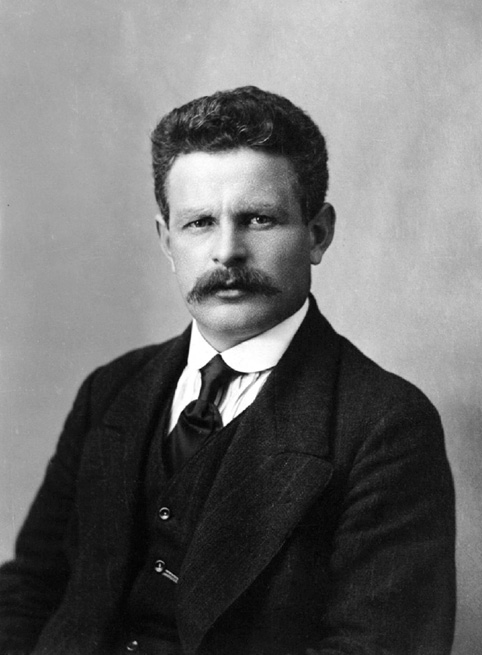
20. Roman Malinovsky.
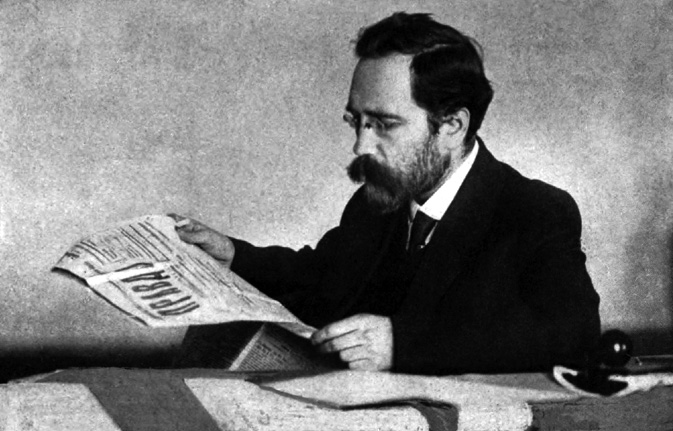
21. Kamenev reading Pravda.
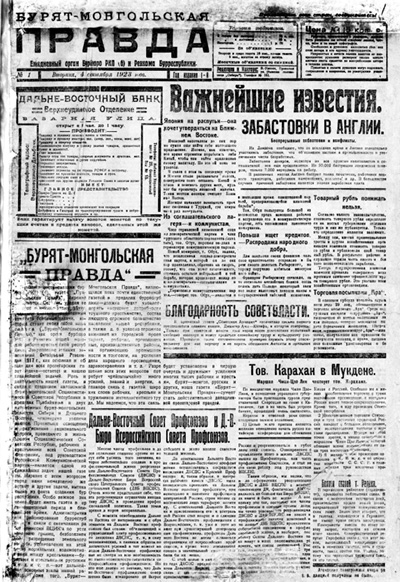
22. An issue of Pravda from 1923.
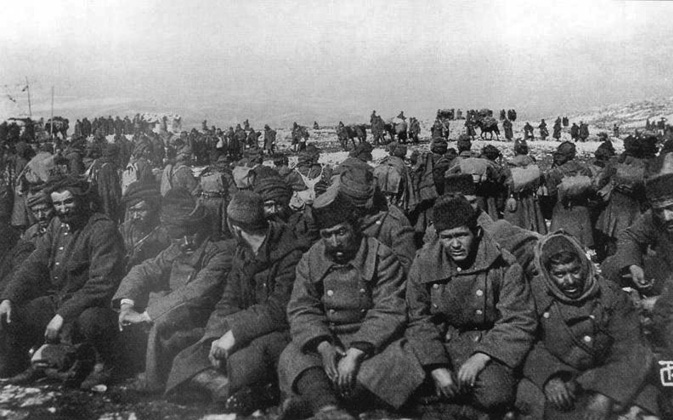
23. Ottoman Prisoners of War in 1913.
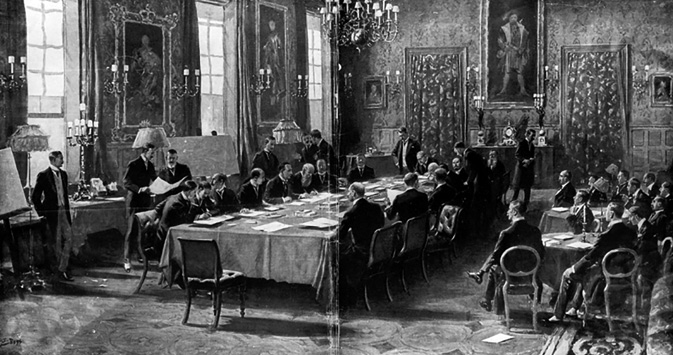
24. Signing of the Peace Treaty, London 1913.